Xinxiang Medical University Affiliated Second Hospital, Xinxiang, Henan, P. R. China.
The Fifth People's Hospital of Kaifeng, Kaifeng, Henan, P. R. China.
Brain Behav. 2021 Apr;11(4):e02059. doi: 10.1002/brb3.2059. Epub 2021 Feb 9.
Obsessive-compulsive disorder (OCD) tends to be treatment refractory. Recently, cognitive-coping therapy (CCT) for OCD is reported to be an efficacious psychotherapy. However, the underlying neurophysiological mechanism remains unknown. Here, the effects of CCT on OCD and the resting-state brain function were investigated.
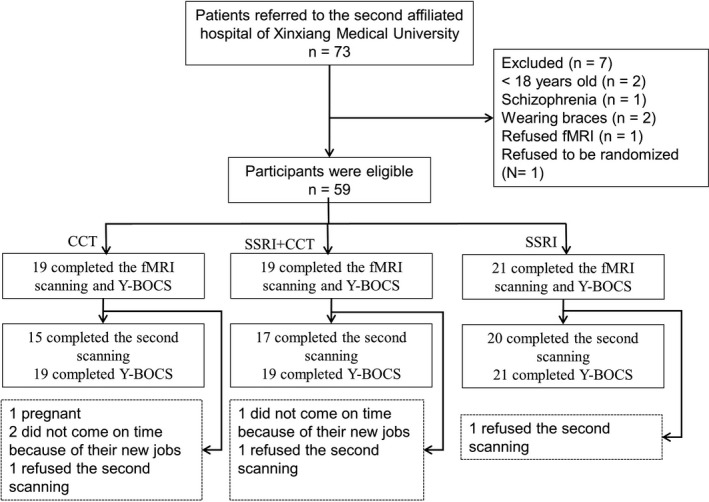
Fifty-nine OCD patients underwent CCT, pharmacotherapy plus CCT (pCCT), or pharmacotherapy. Before and after a 4-week treatment, Yale-Brown obsessive-compulsive scale (Y-BOCS) was evaluated and resting-state functional magnetic resonance imaging (rs-fMRI) was scanned.
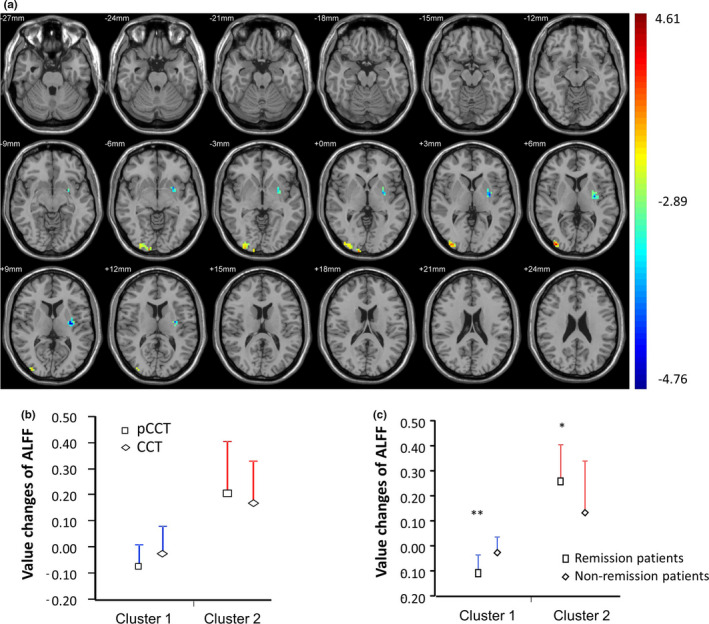
Compared with the baseline, significant reduction of Y-BOCS scores was found after four-week treatment (p < .001) in groups of CCT and pCCT, not in pharmacotherapy. Post-treatment Y-BOCS scores of CCT group and pCCT group were not different, but significantly lower than that of pharmacotherapy group (p < .001). Compared with pretreatment, two clusters of brain regions with significant change in amplitude of low-frequency fluctuation (ALFF) were obtained in those who treated with CCT and pCCT, but not in those who received pharmacotherapy. The ALFF in cluster 1 (insula, putamen, and postcentral gyrus in left cerebrum) was decreased, while the ALFF in cluster 2 (occipital medial gyrus, occipital inferior gyrus, and lingual gyrus in right hemisphere) was increased after treatment (corrected p < .05). The changes of ALFF were correlated with the reduction of Y-BOCS score and were greater in remission than in nonremission. The reduction of the fear of negative events was correlated to the changes of ALFF of clusters and the reduction of Y-BOCS score.
The effectiveness of CCT for OCD was related to the alteration of resting-state brain function-the brain plasticity.
ChiCTR-IPC-15005969.
强迫症(OCD)往往难以治疗。最近,有报道称认知应对疗法(CCT)对 OCD 是一种有效的心理治疗方法。然而,其潜在的神经生理机制尚不清楚。本研究旨在探讨 CCT 对 OCD 及静息态脑功能的影响。
59 例 OCD 患者分别接受 CCT、药物联合 CCT(pCCT)或药物治疗。在 4 周治疗前后,分别采用耶鲁-布朗强迫量表(Y-BOCS)评估和静息态功能磁共振成像(rs-fMRI)扫描。
与基线相比,CCT 组和 pCCT 组在 4 周治疗后 Y-BOCS 评分显著降低(p<0.001),而药物组无明显变化。CCT 组和 pCCT 组治疗后 Y-BOCS 评分无差异,但显著低于药物组(p<0.001)。与治疗前相比,CCT 组和 pCCT 组治疗后有两个脑区的低频振幅(ALFF)发生显著变化,而药物组无明显变化。其中,簇 1(左脑岛、壳核和中央后回)的 ALFF 降低,而簇 2(右脑枕内侧回、枕下回和舌回)的 ALFF 升高(校正后 p<0.05)。ALFF 的变化与 Y-BOCS 评分的降低相关,且在缓解组的变化大于非缓解组。对负性事件的恐惧减少与脑区 ALFF 的变化及 Y-BOCS 评分的降低相关。
CCT 治疗 OCD 的有效性与静息态脑功能的改变有关,即脑可塑性。
ChiCTR-IPC-15005969。