Guervilly Christophe, Bonifay Amandine, Burtey Stephane, Sabatier Florence, Cauchois Raphaël, Abdili Evelyne, Arnaud Laurent, Lano Guillaume, Pietri Léa, Robert Thomas, Velier Mélanie, Papazian Laurent, Albanese Jacques, Kaplanski Gilles, Dignat-George Françoise, Lacroix Romaric
Medical Intensive Care Unit, North Hospital, Assistance Publique-Hôpitaux de Marseille (AP-HM), Chemin des Bourrely, Marseille, France.
Center for Studies and Research on Health Services and Quality of Life, EA3279 Research Unit, Aix-Marseille University, Marseille, France.
Blood Adv. 2021 Feb 9;5(3):628-634. doi: 10.1182/bloodadvances.2020003308.
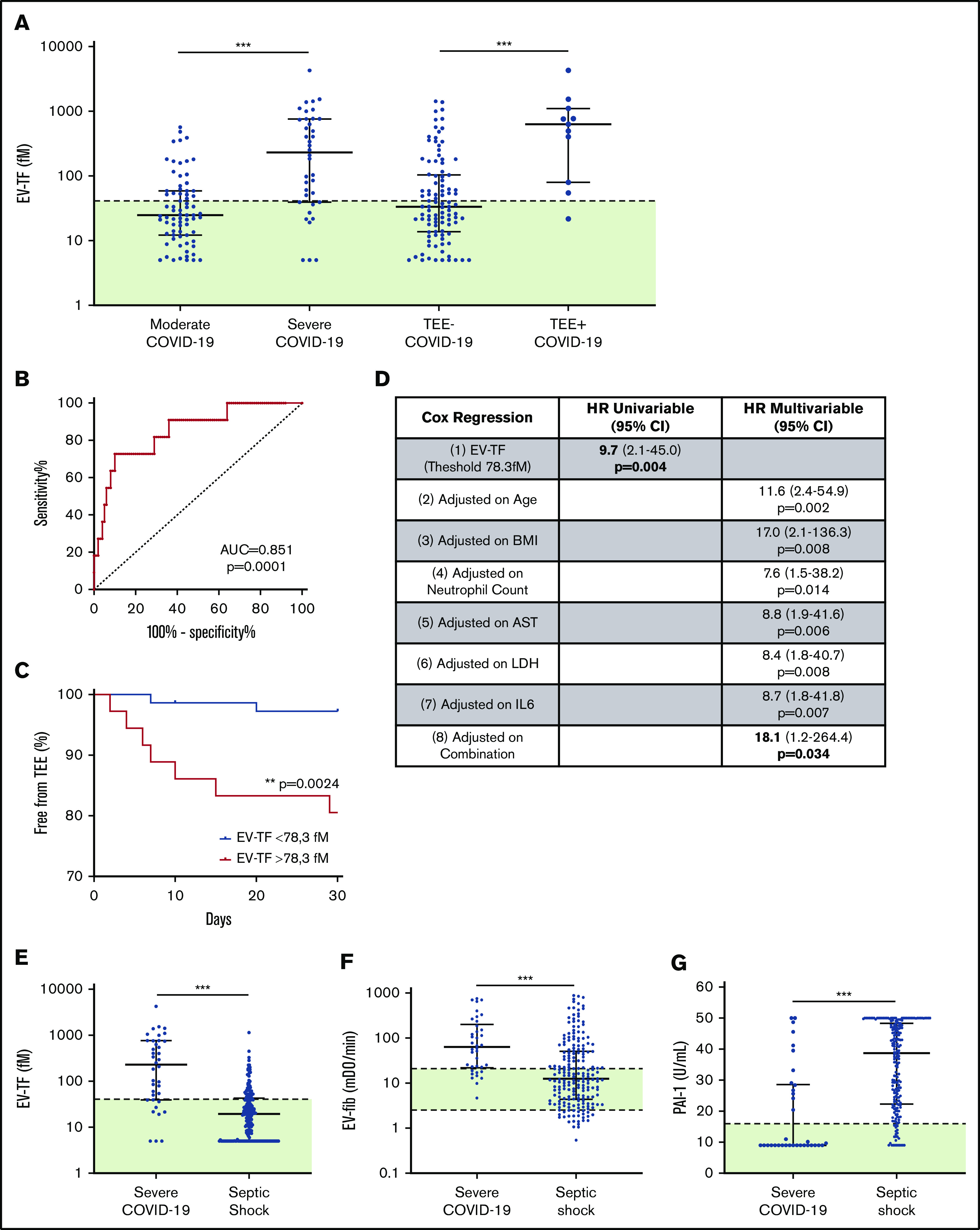
Coronavirus disease 2019 (COVID-19) has become one of the biggest public health challenges of this century. Severe forms of the disease are associated with a thrombo-inflammatory state that can turn into thrombosis. Because tissue factor (TF) conveyed by extracellular vesicles (EVs) has been implicated in thrombosis, we quantified the EV-TF activity in a cohort of hospitalized patients with COVID-19 (n = 111) and evaluated its link with inflammation, disease severity, and thrombotic events. Patients with severe disease were compared with those who had moderate disease and with patients who had septic shock not related to COVID-19 (n = 218). The EV-TF activity was notably increased in patients with severe COVID-19 compared with that observed in patients with moderate COVID-19 (median, 231 [25th to 75th percentile, 39-761] vs median, 25 [25th to 75th percentile, 12-59] fM; P < .0001); EV-TF was correlated with leukocytes, D-dimer, and inflammation parameters. High EV-TF values were associated with an increased thrombotic risk in multivariable models. Compared with patients who had septic shock, those with COVID-19 were characterized by a distinct coagulopathy profile with significantly higher EV-TF and EV-fibrinolytic activities that were not counterbalanced by an increase in plasminogen activator inhibitor-1 (PAI-1). Thus, this article is the first to describe the dissemination of extreme levels of EV-TF in patients with severe COVID-19, which supports the international recommendations of systematic preventive anticoagulation in hospitalized patients and potential intensification of anticoagulation in patients with severe disease.
2019冠状病毒病(COVID-19)已成为本世纪最大的公共卫生挑战之一。该疾病的严重形式与血栓炎症状态相关,后者可发展为血栓形成。由于细胞外囊泡(EVs)携带的组织因子(TF)与血栓形成有关,我们对一组住院的COVID-19患者(n = 111)的EV-TF活性进行了定量,并评估了其与炎症、疾病严重程度和血栓事件的关联。将重症患者与中度患者以及与COVID-19无关的感染性休克患者(n = 218)进行比较。与中度COVID-19患者相比,重症COVID-19患者的EV-TF活性显著增加(中位数,231[第25至75百分位数,39 - 761]对中位数,25[第25至75百分位数,12 - 59]fM;P <.0001);EV-TF与白细胞、D-二聚体和炎症参数相关。在多变量模型中,高EV-TF值与血栓形成风险增加相关。与感染性休克患者相比,COVID-19患者的特征是具有独特的凝血病谱,EV-TF和EV-纤维蛋白溶解活性显著更高,且未被纤溶酶原激活物抑制剂-1(PAI-1)的增加所抵消。因此,本文首次描述了重症COVID-19患者中EV-TF的极高水平传播,这支持了对住院患者进行系统性预防性抗凝以及对重症患者加强抗凝的国际建议。