Key Laboratory of Zoonosis Research, Ministry of Education, Institute of Zoonosis, Double First-class Discipline of Human-animal Medicine, Jilin University, Changchun, People's Republic of China.
Jilin Center for Animal Disease Control and Prevention, Changchun, Jilin, People's Republic of China.
Emerg Microbes Infect. 2021 Dec;10(1):356-364. doi: 10.1080/22221751.2021.1888658.
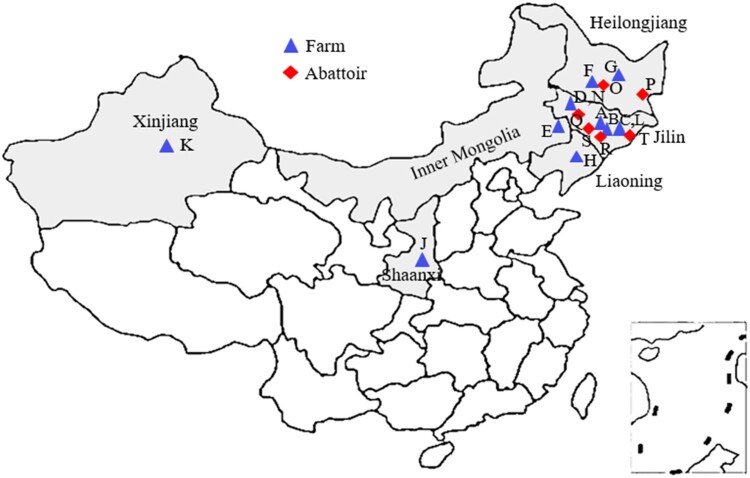
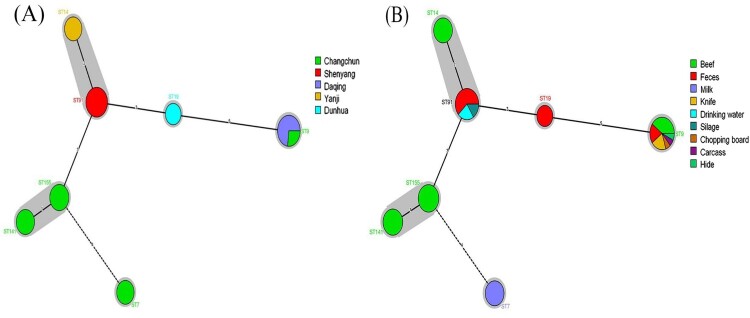
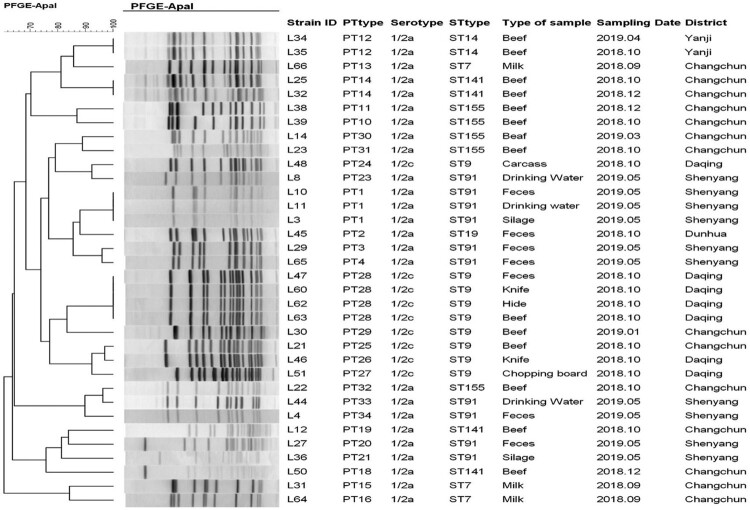
is an important foodborne pathogen, and is ubiquitously distributed in the natural environment. Cattle and sheep, as natural hosts, can transmit to related meat and dairy products. In this study, the prevalence, distribution, and transmission characteristics of were analysed by investigating 5214 samples of cattle and sheep in farm and slaughtering environments in China. A low contamination incidence of (0.5%, 20/4430) was observed in farm environment, but there was a high contamination incidence in slaughtering environment (9.4%, 74/784). The incidence of in cattle and sheep farm and slaughtering environments is more common and significantly higher (9.7%, 508/5214) than that of (1.8%, 94/5214). The distinct molecular and genetic characteristics of by PFGE and MLST indicated that and were gradually transmitted from the farm and slaughtering environments to end products, such as beef and mutton along the slaughtering chain. The ST7, ST9, ST91, and ST155 found in our study were associated with the human listeriosis cases in China. In addition, the findings of virulence markers (, , LIPI-3 LIPI-4, and ECIII) concerned with the pathogenesis of human listeriosis and antibiotics resistance of in this study implies a potential public health risk. This study fills the gap in the epidemiology of beef cattle and sheep that carry in farm and slaughtering environments in major cattle and sheep producing areas in China.
是一种重要的食源性致病菌,广泛存在于自然环境中。牛、羊作为天然宿主,可以将其传播给相关的肉类和奶制品。本研究通过调查中国农场和屠宰环境中 5214 份牛、羊样本,分析了 的流行情况、分布和传播特征。在农场环境中, 污染的低发生率为 0.5%(20/4430),但在屠宰环境中,污染的高发生率为 9.4%(74/784)。牛、羊农场和屠宰环境中 的发生率更为常见,明显高于 (9.7%,508/5214)。PFGE 和 MLST 分析的 分子和遗传特征表明, 和 逐渐从农场和屠宰环境传播到牛肉和羊肉等最终产品,沿着屠宰链传播。本研究中发现的 ST7、ST9、ST91 和 ST155 与中国的人类李斯特菌病病例有关。此外,本研究中与人类李斯特菌病发病机制相关的毒力标记物(、、LIPI-3 LIPI-4 和 ECIII)和 对抗生素的耐药性表明存在潜在的公共卫生风险。本研究填补了中国主要牛羊产区农场和屠宰环境中携带 的牛、羊流行病学空白。