Veloo Yuvaneswary, Thahir Syahidiah Syed Abu, Zakaria Zunita, Rahman Salina Abdul, Mansor Rozaihan, Rajendiran Sakshaleni
National Institutes of Health, Ministry of Health, Shah Alam 40170, Malaysia.
Institute of Bioscience, Universiti Putra Malaysia, Serdang 43400, Malaysia.
Antibiotics (Basel). 2025 Apr 26;14(5):436. doi: 10.3390/antibiotics14050436.
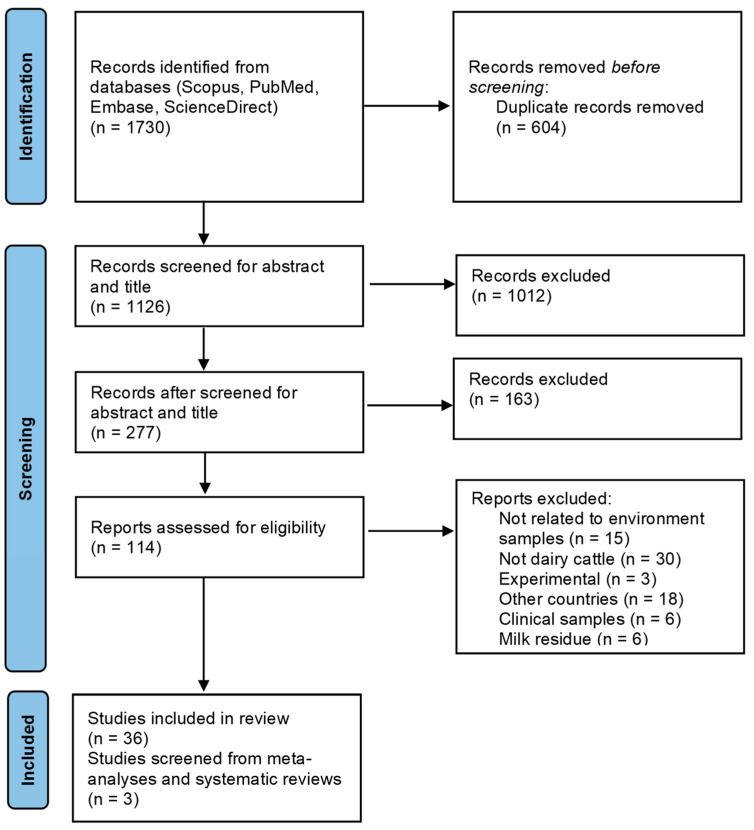
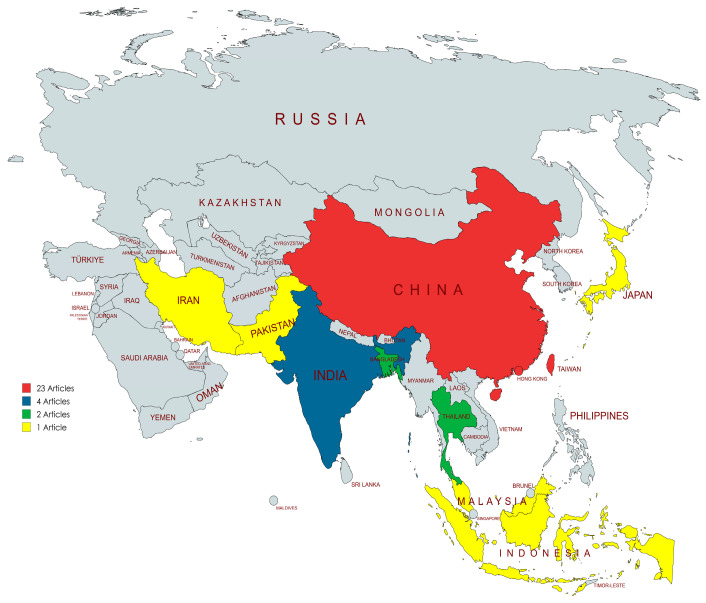
Antimicrobial resistance (AMR) poses a significant "One Health" challenge in the farming industry attributed to antimicrobial misuse and overuse, affecting the health of humans, animals, and the environment. Recognizing the crucial role of the environment in facilitating the transmission of AMR is imperative for addressing this global health issue. Despite its urgency, there remains a notable gap in understanding resistance levels in the environment. This scoping review aims to consolidate and summarize available evidence of AMR prevalence and resistance genes in dairy farm settings. This study was conducted following the PRISMA Extension checklist to retrieve relevant studies conducted in Asian countries between 2013 and 2023. An electronic literature search involving PubMed, ScienceDirect, Embase, and Scopus resulted in a total of 1126 unique articles that were identified. After a full-text eligibility assessment, 39 studies were included in this review. The findings indicate that AMR studies in dairy farm environments have primarily focused on selective bacteria, especially and other bacteria such as , spp., and spp. Antimicrobial resistance patterns were reported across 24 studies involving 78 antimicrobials, which predominantly consisted of gentamicin (70.8%), ampicillin (58.3%), and tetracycline (58.3%). This review emphasizes the current state of AMR in the environmental aspects of dairy farms across Asia, highlighting significant gaps in regional coverage and bacterial species studied. It highlights the need for broader surveillance, integration with antimicrobial stewardship, and cross-sector collaboration to address AMR through a One Health approach.
抗菌药物耐药性(AMR)因抗菌药物的滥用和过度使用,给养殖业带来了重大的“同一健康”挑战,影响着人类、动物和环境的健康。认识到环境在促进AMR传播中的关键作用,对于解决这一全球健康问题至关重要。尽管形势紧迫,但在了解环境中的耐药水平方面仍存在显著差距。本综述旨在整合和总结奶牛场环境中AMR流行情况和耐药基因的现有证据。本研究按照PRISMA扩展清单进行,以检索2013年至2023年期间在亚洲国家开展的相关研究。通过对PubMed、ScienceDirect、Embase和Scopus进行电子文献检索,共识别出1126篇独特文章。经过全文合格性评估,本综述纳入了39项研究。研究结果表明,奶牛场环境中的AMR研究主要集中在选择性细菌,尤其是[此处原文缺失具体细菌名称]以及其他细菌,如[此处原文缺失具体细菌名称]属、[此处原文缺失具体细菌名称]属和[此处原文缺失具体细菌名称]属。24项涉及78种抗菌药物的研究报告了抗菌药物耐药模式,其中主要包括庆大霉素(70.8%)、氨苄青霉素(58.3%)和四环素(58.3%)。本综述强调了亚洲奶牛场环境方面AMR的现状,突出了区域覆盖范围和所研究细菌种类方面的显著差距。它强调需要进行更广泛的监测、与抗菌药物管理相结合以及跨部门合作,以通过“同一健康”方法应对AMR。