Clinical Sciences Department, Navrongo Health Research Centre, Ghana Health Service, Navrongo, Ghana.
Julius Global Health, Julius Center for Health Sciences and Primary Care, University Medical Center Utrecht, Utrecht University, Utrecht, the Netherlands.
BMC Med. 2021 Feb 10;19(1):30. doi: 10.1186/s12916-021-01909-6.
The cardiovascular health index (CVHI) introduced by the American Heart Association is a valid, accessible, simple, and translatable metric for monitoring cardiovascular health in a population. Components of the CVHI include the following seven cardiovascular risk factors (often captured as life's simple 7): smoking, dietary intake, physical activity, body mass index, blood pressure, glucose, and total cholesterol. We sought to expand the evidence for its utility to under-studied populations in sub-Saharan Africa, by determining its association with common carotid intima-media thickness (CIMT).
We conducted a cross-sectional study involving 9011 participants drawn from Burkina Faso, Ghana, Kenya, and South Africa. We assessed established classical cardiovascular risk factors and measured carotid intima-media thickness of the left and right common carotid arteries using B-mode ultrasonography. Adjusted multilevel mixed-effect linear regression was used to determine the association of CVHI with common CIMT. In the combined population, an individual participant data meta-analyses random-effects was used to conduct pooled comparative sub-group analyses for differences between countries, sex, and socio-economic status.
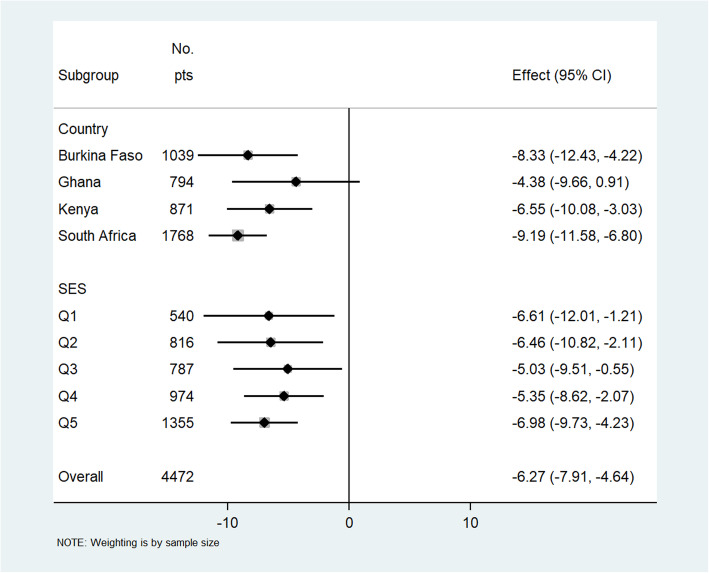
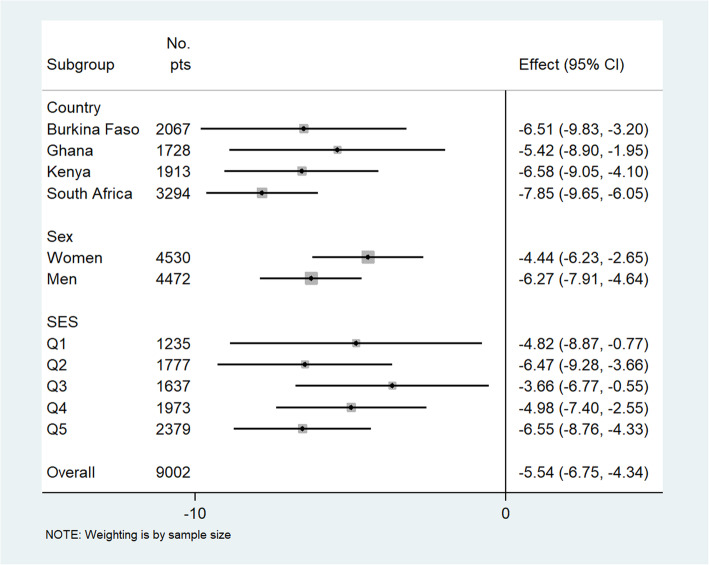
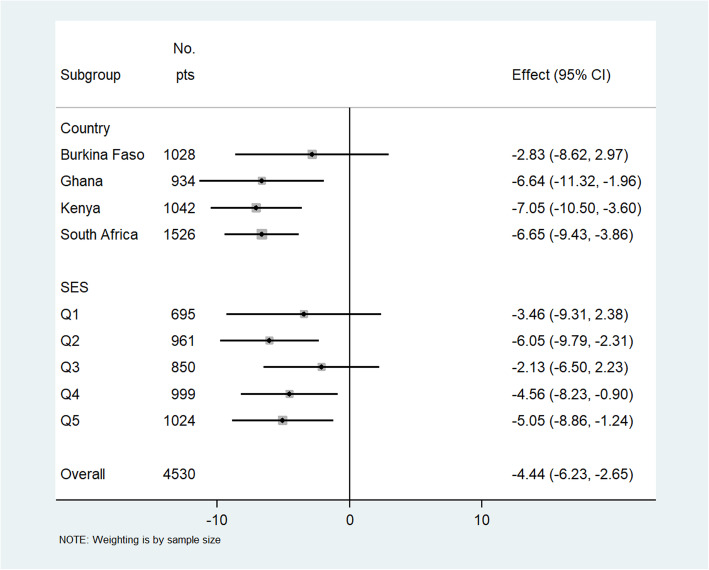
The mean age of the study population was 51 ± 7 years and 51% were women, with a mean common CIMT of 637 ± 117 μm and CVHI score of 10.3 ± 2.0. Inverse associations were found between CVHI and common CIMT (β-coefficients [95% confidence interval]: Burkina Faso, - 6.51 [- 9.83, - 3.20] μm; Ghana, - 5.42 [- 8.90, - 1.95]; Kenya, - 6.58 [- 9.05, - 4.10]; and South Africa, - 7.85 [- 9.65, - 6.05]). Inverse relations were observed for women (- 4.44 [- 6.23, - 2.65]) and men (- 6.27 [- 7.91, - 4.64]) in the pooled sample. Smoking (p < 0.001), physical activity (p < 0.001), and hyperglycemia (p < 0.001) were related to CIMT in women only, while blood pressure and obesity were related to CIMT in both women and men (p < 0.001).
This large pan-African population study demonstrates that CVHI is a strong marker of subclinical atherosclerosis, measured by common CIMT and importantly demonstrates that primary prevention of atherosclerotic cardiovascular disease in this understudied population should target physical activity, smoking, obesity, hypertension, and hyperglycemia.
美国心脏协会提出的心血管健康指数(CVHI)是一种有效的、可及的、简单的、可翻译的指标,可用于监测人群的心血管健康。CVHI 的组成部分包括以下七个心血管风险因素(通常被称为生活的简单 7 项):吸烟、饮食摄入、身体活动、体重指数、血压、血糖和总胆固醇。我们试图通过确定其与撒哈拉以南非洲研究不足人群的常见颈动脉内膜中层厚度(CIMT)的关联,来扩展其效用的证据。
我们进行了一项横断面研究,纳入了来自布基纳法索、加纳、肯尼亚和南非的 9011 名参与者。我们评估了已确立的经典心血管风险因素,并使用 B 型超声测量了左、右颈总动脉的颈动脉内膜中层厚度。采用调整后的多水平混合效应线性回归来确定 CVHI 与常见 CIMT 的关联。在合并人群中,采用个体参与者数据荟萃分析的随机效应进行了国家、性别和社会经济地位之间差异的汇总比较亚组分析。
研究人群的平均年龄为 51±7 岁,其中 51%为女性,平均 CIMT 为 637±117μm,CVHI 评分为 10.3±2.0。CVHI 与 CIMT 呈负相关(布基纳法索:-6.51[-9.83,-3.20]μm;加纳:-5.42[-8.90,-1.95]μm;肯尼亚:-6.58[-9.05,-4.10]μm;南非:-7.85[-9.65,-6.05]μm)。在合并样本中,女性(-4.44[-6.23,-2.65])和男性(-6.27[-7.91,-4.64])也观察到了负相关关系。在女性中,吸烟(p<0.001)、身体活动(p<0.001)和高血糖(p<0.001)与 CIMT 相关,而血压和肥胖与女性和男性的 CIMT 均相关(p<0.001)。
这项来自非洲多个国家的大型人群研究表明,CVHI 是亚临床动脉粥样硬化的一个强有力的标志物,通过常见的 CIMT 来衡量,重要的是,该研究表明,在这个研究不足的人群中,对动脉粥样硬化性心血管疾病的一级预防应该针对身体活动、吸烟、肥胖、高血压和高血糖。