Zhao Xixi, Kratzke Andrea K, Ballout Fatima, Kimura Robert E, Jandeska Sara E
Department of Internal Medicine and Pediatrics, Rush University Medical Center, Chicago, IL, USA.
Rush Medical College, Rush University Medical Center, Chicago, IL, USA.
Clin Kidney J. 2019 Oct 21;14(1):167-173. doi: 10.1093/ckj/sfz130. eCollection 2021 Jan.
Previous studies have established an association between low birthweight (LBW) and future kidney disease, but few have explored the progression of kidney dysfunction through the pediatric years leading up through adolescence and young adulthood.
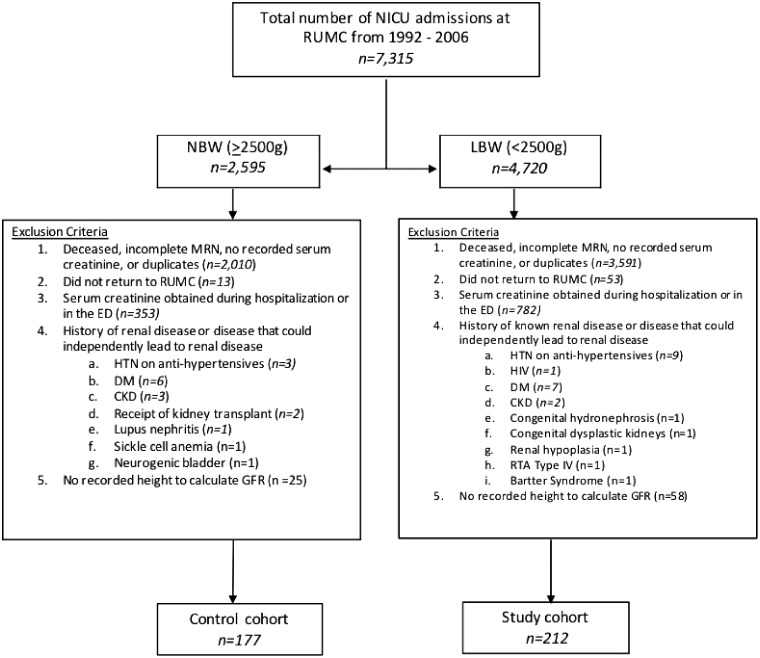
To better understand the temporal effects of birthweight on kidney disease progression, we conducted a retrospective cohort study comparing the glomerular filtration rate (GFR) between LBW (<2500 grams) and normal birthweight (NBW) infants who were admitted to the neonatal intensive care unit (NICU) at our institution from 1992 to 2006.
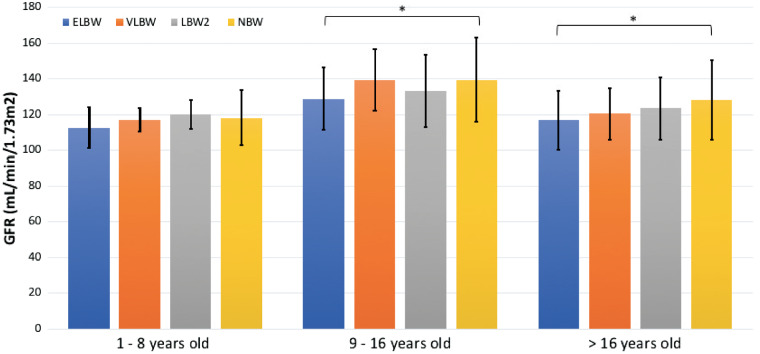
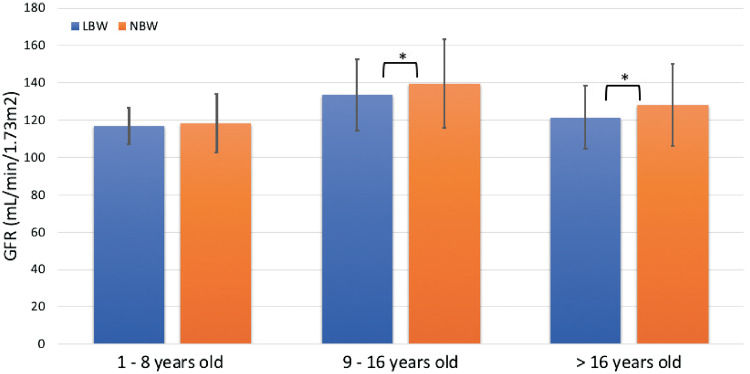
Age at follow-up ranged 1-26 years old. GFR was found to be significantly lower in participants born with LBW than those born with NBW, with a mean difference of 5.5 mL/min/1.73m (P < 0.01). These differences were found in the adolescent and young adult age group over 9 years of age, specifically in the extremely low birthweight group (ELBW) whose birthweight was less than 1000 grams.
We recommend screening for CKD in ELBW individuals starting at the age of 9 years old, regardless of their previous medical history.
既往研究已证实低出生体重(LBW)与未来肾脏疾病之间存在关联,但很少有研究探讨从儿童期直至青春期和青年期肾功能障碍的进展情况。
为了更好地了解出生体重对肾脏疾病进展的时间效应,我们进行了一项回顾性队列研究,比较了1992年至2006年期间在我们机构新生儿重症监护病房(NICU)住院的低出生体重(<2500克)婴儿和正常出生体重(NBW)婴儿的肾小球滤过率(GFR)。
随访年龄范围为1至26岁。发现低出生体重儿的GFR显著低于正常出生体重儿,平均差异为5.5 mL/min/1.73m²(P < 0.01)。这些差异在9岁以上的青少年和青年年龄组中出现,特别是在出生体重低于1000克的极低出生体重组(ELBW)中。
我们建议从9岁开始对极低出生体重个体进行慢性肾脏病筛查,无论其既往病史如何。