Martin-Cleary Catalina, Molinero-Casares Luis Miguel, Ortiz Alberto, Arce-Obieta Jose Miguel
Department of Nephrology and Hypertension, Investigación Sanitaria-Fundación Jimenez Diaz, Universidad Autónoma de Madrid, Madrid, Spain.
REDINREN, Madrid, Spain.
Clin Kidney J. 2019 Nov 7;14(1):309-316. doi: 10.1093/ckj/sfz139. eCollection 2021 Jan.
Predictive models and clinical risk scores for hospital-acquired acute kidney injury (AKI) are mainly focused on critical and surgical patients. We have used the electronic clinical records from a tertiary care general hospital to develop a risk score for new-onset AKI in general inpatients that can be estimated automatically from clinical records.
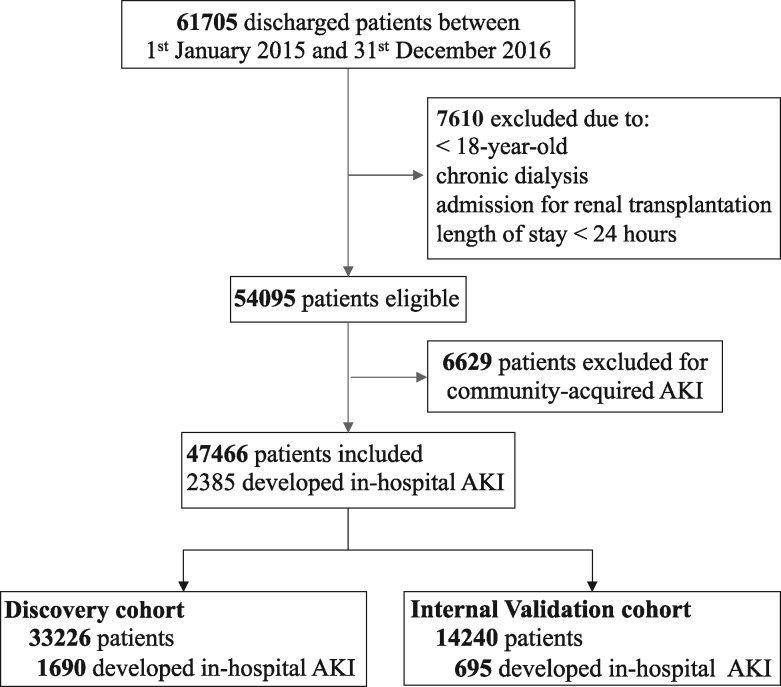
A total of 47 466 patients met inclusion criteria within a 2-year period. Of these, 2385 (5.0%) developed hospital-acquired AKI. Step-wise regression modelling and Bayesian model averaging were used to develop the Madrid Acute Kidney Injury Prediction Score (MAKIPS), which contains 23 variables, all obtainable automatically from electronic clinical records at admission. Bootstrap resampling was employed for internal validation. To optimize calibration, a penalized logistic regression model was estimated by the least absolute shrinkage and selection operator (lasso) method of coefficient shrinkage after estimation.
The area under the curve of the receiver operating characteristic curve of the MAKIPS score to predict hospital-acquired AKI at admission was 0.811. Among individual variables, the highest odds ratios, all >2.5, for hospital-acquired AKI were conferred by abdominal, cardiovascular or urological surgery followed by congestive heart failure. An online tool (http://www.bioestadistica.net/MAKIPS.aspx) will facilitate validation in other hospital environments.
MAKIPS is a new risk score to predict the risk of hospital-acquired AKI, based on variables present at admission in the electronic clinical records. This may help to identify patients who require specific monitoring because of a high risk of AKI.
医院获得性急性肾损伤(AKI)的预测模型和临床风险评分主要针对重症和外科患者。我们利用一家三级综合医院的电子临床记录,开发了一种针对普通住院患者新发AKI的风险评分,该评分可从临床记录中自动估算。
在两年期间,共有47466名患者符合纳入标准。其中,2385名(5.0%)发生了医院获得性AKI。采用逐步回归建模和贝叶斯模型平均法开发马德里急性肾损伤预测评分(MAKIPS),该评分包含23个变量,所有变量均可在入院时从电子临床记录中自动获取。采用自助重抽样进行内部验证。为了优化校准,在估计后通过系数收缩的最小绝对收缩和选择算子(lasso)方法估计惩罚逻辑回归模型。
MAKIPS评分在入院时预测医院获得性AKI的受试者工作特征曲线下面积为0.811。在个体变量中,腹部、心血管或泌尿外科手术以及充血性心力衰竭导致医院获得性AKI的比值比最高,均>2.5。一个在线工具(http://www.bioestadistica.net/MAKIPS.aspx)将有助于在其他医院环境中进行验证。
MAKIPS是一种基于电子临床记录中入院时存在的变量来预测医院获得性AKI风险的新风险评分。这可能有助于识别因AKI风险高而需要特殊监测的患者。