Centre de Recherche sur le Vieillissement, Centre Intégré Universitaire de Santé et Services Sociaux de l'Estrie-Centre Hospitalier Universitaire de Sherbrooke, Sherbrooke, Quebec, Canada.
Faculté de Médecine et des Sciences de la Santé, Université de Sherbrooke, Sherbrooke, Quebec, Canada.
J Nutr. 2021 May 11;151(5):1111-1118. doi: 10.1093/jn/nxaa458.
Omega-3 (n-3) fatty acid (FA) supplements increase blood concentrations of EPA and DHA. Most of the supplements on the market are esterified in triglycerides (TGs) or ethyl esters (EEs), which limits their absorption and may cause gastrointestinal side effects.
The objective of this study was to compare the 24-h AUC of the plasma concentrations of EPA, DHA, and EPA+DHA when provided esterified in monoglycerides (MAGs), EEs, or TGs, (primary outcomes) and evaluate their side effects over 24 h (secondary outcome).
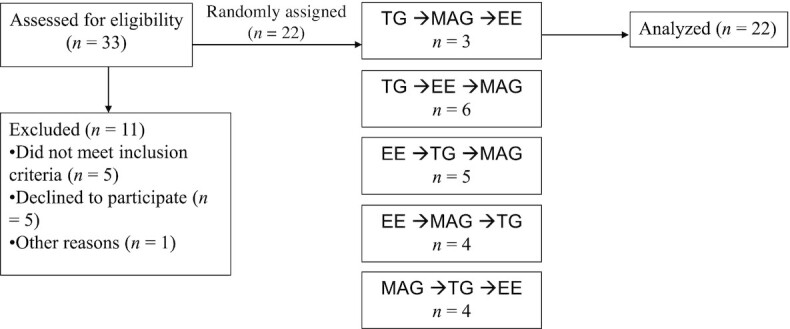
This was a randomized, triple-blind, crossover, controlled clinical trial. Eleven women and 11 men between 18 and 50 y of age ingested, in random order, a single oral dose of ∼1.2 g of EPA and DHA esterified in MAGs, EEs, and TGs with low-fat meals provided during the 24-h follow-up. Eleven blood samples over 24 h were collected from each participant, and the plasma n-3 FAs were quantified. Friedman's paired ANOVA statistical rank test was used for the pharmacokinetic parameters and a chi-square statistical test was used for the side effects.
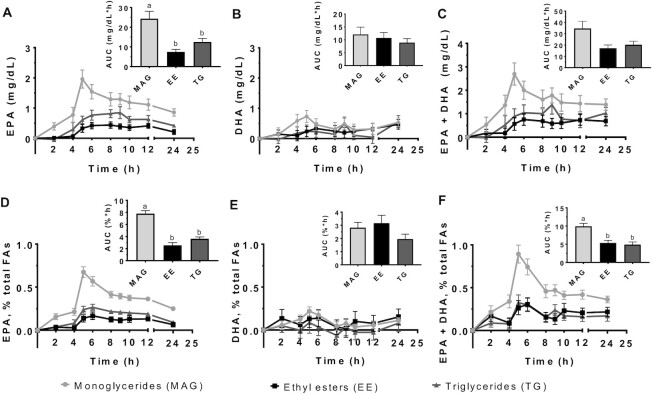
The 24-h AUC of plasma EPA was ∼2 times and ∼1 time higher after the MAG compared with the EE and TG forms of n-3 FAs, respectively (P ≤ 0.0027). Effects of the EE and TG treatments did not differ. The 3 supplements had similar eructation, dysgeusia, abdominal discomfort, nausea, and bloating side effects.
The plasma n-3 FA concentration in adults is greater after acute supplementation with n-3 FAs esterified in MAGs rather than in EEs or TGs, suggesting that with a lower dose of MAG n-3 FAs, the plasma n-3 FA concentrations attained are similar to those after higher doses of n-3 FAs esterified in EEs or TGs. This trial is registered at www.clinicaltrials.gov as NCT03897660.
ω-3(n-3)脂肪酸(FA)补充剂可增加 EPA 和 DHA 的血液浓度。市场上的大多数补充剂都是甘油三酯(TGs)或乙酯(EEs)酯化的,这限制了它们的吸收,并可能导致胃肠道副作用。
本研究旨在比较以单甘酯(MAGs)、EEs 或 TGs 酯化时,EPA、DHA 和 EPA+DHA 的血浆浓度 24 小时 AUC(主要结果),并评估其 24 小时内的副作用(次要结果)。
这是一项随机、三盲、交叉、对照临床试验。11 名年龄在 18 至 50 岁之间的女性和 11 名男性随机摄入单剂量约 1.2g 的 EPA 和 DHA 酯化在 MAGs、EEs 和 TGs 中,同时在 24 小时随访期间提供低脂肪餐。从每个参与者采集 11 个 24 小时的血液样本,并定量检测血浆 n-3 FA。采用 Friedman 配对 ANOVA 统计等级检验对药代动力学参数进行分析,采用卡方检验对副作用进行分析。
与 EE 和 TG 形式的 n-3 FA 相比,MAG 形式的 n-3 FA 后 24 小时 AUC 血浆 EPA 分别高约 2 倍和 1 倍(P≤0.0027)。EE 和 TG 处理的效果没有差异。这 3 种补充剂有类似的呃逆、味觉障碍、腹部不适、恶心和腹胀副作用。
与 EE 或 TG 酯化的 n-3 FA 相比,MAG 酯化的 n-3 FA 急性补充后成人血浆 n-3 FA 浓度更高,提示 MAG n-3 FA 剂量较低时,血浆 n-3 FA 浓度与 EE 或 TG 酯化的 n-3 FA 较高剂量时相当。该试验在 www.clinicaltrials.gov 上注册为 NCT03897660。