Erasmus Medical Center Rotterdam, Institute of Medical Education Research Rotterdam, Rotterdam, The Netherlands.
Department of Medicine, University of California at San Diego, San Diego, CA, USA.
J Gen Intern Med. 2021 Oct;36(10):2943-2951. doi: 10.1007/s11606-020-06428-3. Epub 2021 Feb 9.
Diagnostic errors are a major source of preventable harm but the science of reducing them remains underdeveloped.
To identify and prioritize research questions to advance the field of diagnostic safety in the next 5 years.
Ninety-seven researchers and 42 stakeholders were involved in the identification of the research priorities.
We used systematic prioritization methods based on the Child Health and Nutrition Research Initiative (CHNRI) methodology. We first invited a large international group of expert researchers in various disciplines to submit research questions while considering five prioritization criteria: (1) usefulness, (2) answerability, (3) effectiveness, (4) potential for translation, and (5) maximal potential for effect on diagnostic safety. After consolidation, these questions were prioritized at an in-person expert meeting in April 2019. Top-ranked questions were subsequently reprioritized through scoring on the five prioritization criteria using an online questionnaire. We also invited non-research stakeholders to assign weights to the five criteria and then used these weights to adjust the final prioritization score for each question.
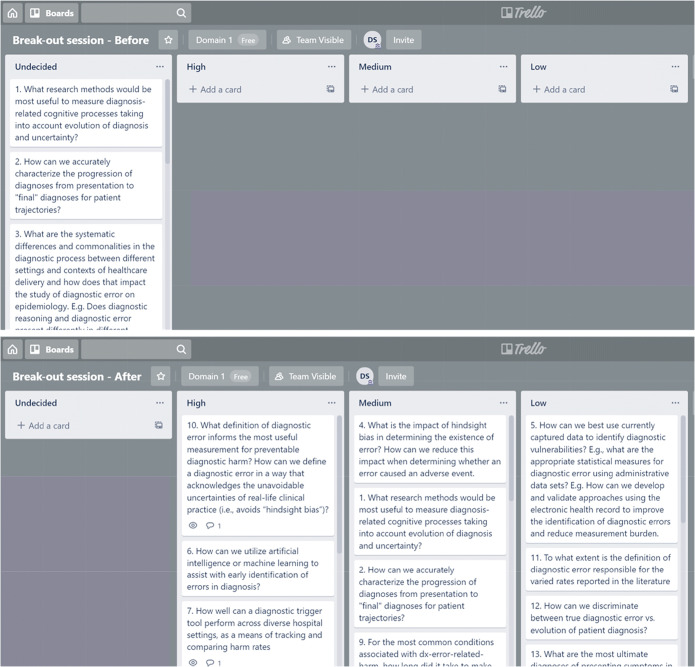
Of the 207 invited researchers, 97 researchers responded and 78 submitted 333 research questions which were then consolidated. Expert meeting participants (n = 21) discussed questions in different breakout sessions and prioritized 50, which were subsequently reduced to the top 20 using the online questionnaire. The top 20 questions addressed mostly system factors (e.g., implementation and evaluation of information technologies), teamwork factors (e.g., role of nurses and other health professionals in the diagnostic process), and strategies to engage patients in the diagnostic process.
Top research priorities for advancing diagnostic safety in the short-term include strengthening systems and teams and engaging patients to support diagnosis. High-priority areas identified using these systematic methods can inform an actionable research agenda for reducing preventable diagnostic harm.
诊断错误是可预防伤害的主要来源,但减少诊断错误的科学仍未得到充分发展。
确定并优先考虑未来 5 年内推进诊断安全领域的研究问题。
97 名研究人员和 42 名利益相关者参与了研究重点的确定。
我们使用了基于儿童健康与营养研究倡议(CHNRI)方法的系统优先排序方法。我们首先邀请了来自各个学科的大量国际专家研究人员提交研究问题,同时考虑了五个优先排序标准:(1)有用性,(2)可回答性,(3)有效性,(4)转化潜力,以及(5)对诊断安全的最大潜在影响。在整合后,这些问题在 2019 年 4 月的一次现场专家会议上进行了优先排序。排名靠前的问题随后通过在线问卷调查,根据五个优先排序标准进行评分,再次进行了优先排序。我们还邀请了非研究利益相关者对五个标准进行加权,然后使用这些权重来调整每个问题的最终优先排序得分。
在受邀的 207 名研究人员中,97 名研究人员做出了回应,其中 78 名提交了 333 个研究问题,这些问题随后进行了整合。专家会议参与者(n=21)在不同的分组会议中讨论了问题,并对 50 个问题进行了优先排序,随后通过在线问卷将这些问题减少到前 20 名。前 20 个问题主要涉及系统因素(例如,信息技术的实施和评估)、团队合作因素(例如,护士和其他卫生专业人员在诊断过程中的作用),以及让患者参与诊断过程的策略。
短期内推进诊断安全的首要研究重点包括加强系统和团队,并让患者参与以支持诊断。使用这些系统方法确定的高优先级领域可以为减少可预防的诊断伤害提供一个可行的研究议程。