HIV Programmes and Advocacy, International AIDS Society, Geneva, Switzerland.
Department of HIV and Global Hepatitis Programme, World Health Organization, Geneva, Switzerland.
J Acquir Immune Defic Syndr. 2018 Aug 15;78 Suppl 1(1):S3-S9. doi: 10.1097/QAI.0000000000001742.
WHO and the Collaborative Initiative for Paediatric HIV Education and Research (CIPHER) of the International AIDS Society (IAS) led a collaborative process to set global prioritized research agendas, aiming to focusing future research, funding, and stakeholder's efforts. This study describes the methodology used to establish the research agendas.
The Child Health and Nutrition Research Initiative methodology was adapted in parallel exercises on pediatric and adolescent HIV. After definition of scope by an expert working group, priority questions were collected from stakeholders through an online survey. Submitted questions were coded, analyzed, and collated. The same respondents were asked to score the collated lists through a second online survey. The top 10 ranked questions per thematic area (testing, treatment, and service delivery) were reviewed and priority themes developed with consideration of existing policy, systematic reviews, and planned, ongoing, and recently published research.
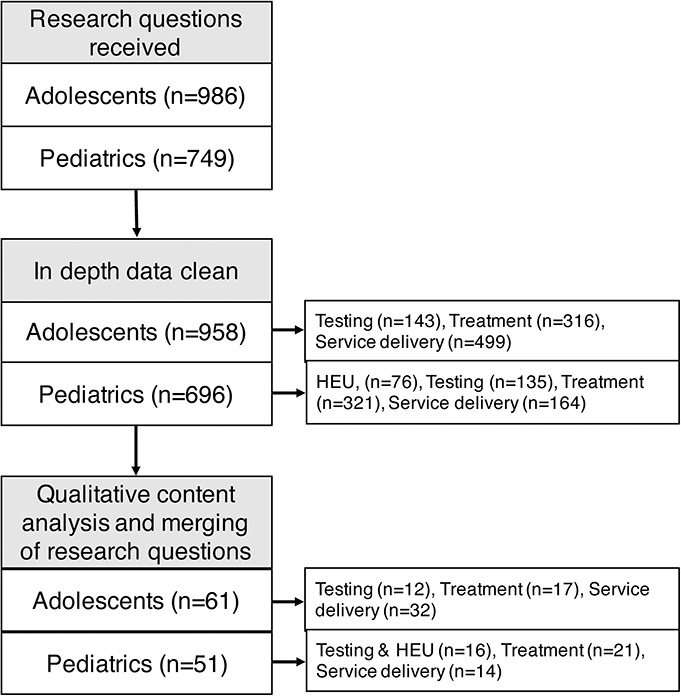
A total of 375 respondents submitted 1735 priority research questions. The majority of respondents were from Africa; 55% self-identified as researchers. The final collated lists included 51 and 61 research questions for pediatric and adolescent HIV, respectively. The response rate for the second survey was 48%. The final research agendas include 5 priority research themes per area, discussed in 2 separate publications.
To date, this is the largest example of the Child Health and Nutrition Research Initiative method in pediatric and adolescent HIV in terms of stakeholders reached, and the first to incorporate top thematic areas based on current evidence. Its impact on improving outcomes for these populations will require strong political and financial commitment.
世界卫生组织(WHO)和国际艾滋病协会(IAS)下属的儿科艾滋病教育和研究合作倡议(CIPHER)共同开展了一项合作进程,旨在制定全球重点优先研究议程,以集中未来的研究、资金和利益相关者的努力。本研究描述了制定研究议程所使用的方法。
儿童健康与营养研究倡议的方法在儿科和青少年艾滋病方面的平行活动中得到了应用。在专家工作组定义范围后,通过在线调查向利益攸关方收集优先问题。提交的问题被编码、分析和整理。同一批受访者被要求通过第二次在线调查对整理后的清单进行评分。对每个主题领域(检测、治疗和服务提供)排名前十的问题进行了审查,并在考虑现有政策、系统评价以及计划中的、正在进行的和最近发表的研究的基础上,制定了优先主题。
共有 375 名受访者提交了 1735 项优先研究问题。大多数受访者来自非洲;55%的人自认为是研究人员。最终的整理清单分别包含 51 项和 61 项儿科和青少年艾滋病研究问题。第二次调查的回复率为 48%。最终的研究议程包括每个领域的 5 个优先研究主题,将在两本单独的出版物中进行讨论。
迄今为止,就涉及的利益攸关方而言,这是儿童健康与营养研究倡议方法在儿科和青少年艾滋病方面最大的例子,也是第一个根据现有证据纳入优先主题领域的例子。要改善这些人群的结果,需要有强烈的政治和财政承诺。