Lapidaire Winok, Urrila Anna S, Artiges Eric, Miranda Ruben, Vulser Hélène, Bézivin-Frere Pauline, Lemaître Hervé, Penttilä Jani, Banaschewski Tobias, Bokde Arun L W, Bromberg Uli, Büchel Christian, Conrod Patricia J, Desrivières Sylvane, Frouin Vincent, Gallinat Jürgen, Garavan Hugh, Gowland Penny, Heinz Andreas, Ittermann Bernd, Papadopoulos-Orfanos Dimitri, Paus Tomáš, Smolka Michael N, Schumann Gunter, Martinot Marie-Laure Paillère, Martinot Jean-Luc
National Institute of Health and Medical Research, INSERM U A10 "Trajectoires développementales & psychiatrie", University Paris-Saclay, Ecole Normale Supérieure Paris-Saclay, CNRS, Centre Borelli, Gif-sur-Yvette, France.
Department of Health, Unit of Mental Health, National Institute for Health and Welfare, Helsinki, Finland.
PLoS One. 2021 Feb 10;16(2):e0243720. doi: 10.1371/journal.pone.0243720. eCollection 2021.
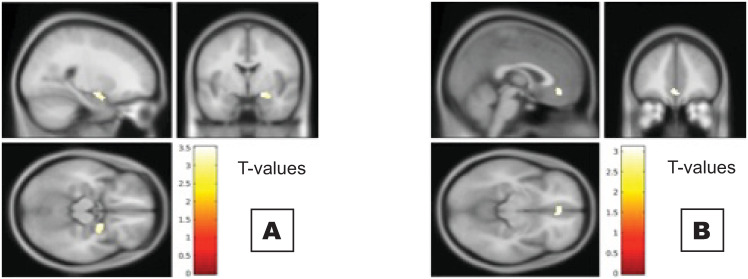
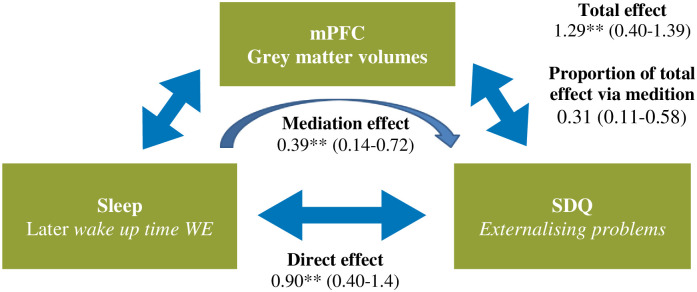
Changing sleep rhythms in adolescents often lead to sleep deficits and a delay in sleep timing between weekdays and weekends. The adolescent brain, and in particular the rapidly developing structures involved in emotional control, are vulnerable to external and internal factors. In our previous study in adolescents at age 14, we observed a strong relationship between weekend sleep schedules and regional medial prefrontal cortex grey matter volumes. Here, we aimed to assess whether this relationship remained in this group of adolescents of the general population at the age of 16 (n = 101; mean age 16.8 years; 55% girls). We further examined grey matter volumes in the hippocampi and the amygdalae, calculated with voxel-based morphometry. In addition, we investigated the relationships between sleep habits, assessed with self-reports, and regional grey matter volumes, and psychological functioning, assessed with the Strengths and Difficulties Questionnaire and tests on working memory and impulsivity. Later weekend wake-up times were associated with smaller grey matter volumes in the medial prefrontal cortex and the amygdalae, and greater weekend delays in wake-up time were associated with smaller grey matter volumes in the right hippocampus and amygdala. The medial prefrontal cortex region mediated the correlation between weekend wake up time and externalising symptoms. Paying attention to regular sleep habits during adolescence could act as a protective factor against the emergence of psychopathology via enabling favourable brain development.
青少年睡眠节律的改变常常导致睡眠不足以及工作日和周末之间睡眠时间的延迟。青少年的大脑,尤其是参与情绪控制的快速发育结构,容易受到外部和内部因素的影响。在我们之前对14岁青少年的研究中,我们观察到周末睡眠时间表与内侧前额叶皮质区域灰质体积之间存在密切关系。在此,我们旨在评估这种关系在这组16岁的普通青少年群体(n = 101;平均年龄16.8岁;55%为女孩)中是否依然存在。我们进一步使用基于体素的形态计量学方法计算了海马体和杏仁核的灰质体积。此外,我们调查了通过自我报告评估的睡眠习惯与区域灰质体积之间的关系,以及通过优势与困难问卷以及工作记忆和冲动性测试评估的心理功能之间的关系。周末较晚的起床时间与内侧前额叶皮质和杏仁核较小的灰质体积相关,而周末起床时间的更大延迟与右侧海马体和杏仁核较小的灰质体积相关。内侧前额叶皮质区域介导了周末起床时间与外化症状之间的相关性。在青少年时期注重规律的睡眠习惯,通过促进有利的大脑发育,可以作为预防精神病理学出现的保护因素。