School of Psychology, University of East Anglia.
Perspect Psychol Sci. 2021 May;16(3):553-576. doi: 10.1177/1745691620953773. Epub 2021 Feb 10.
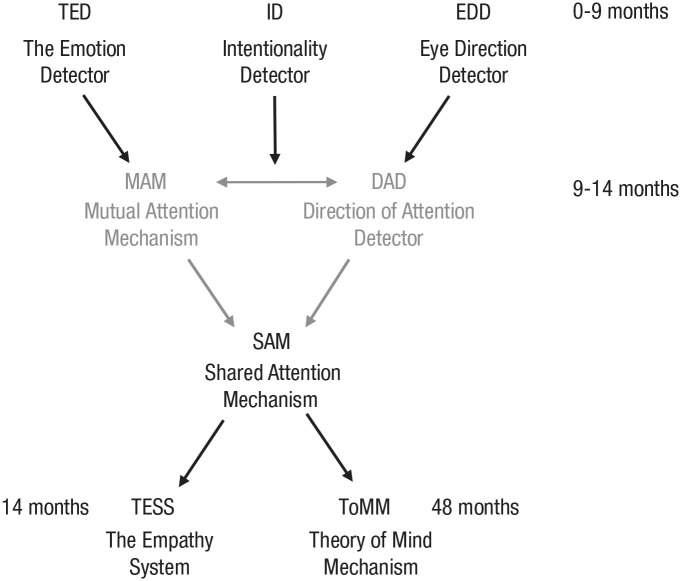
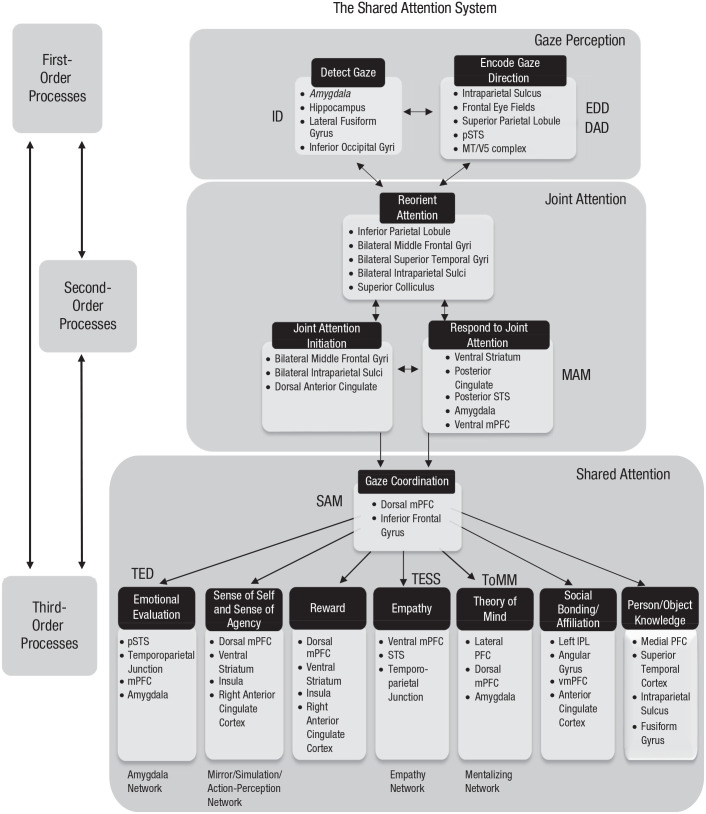
When two people look at the same object in the environment and are aware of each other's attentional state, they find themselves in a shared-attention episode. This can occur through intentional or incidental signaling and, in either case, causes an exchange of information between the two parties about the environment and each other's mental states. In this article, we give an overview of what is known about the building blocks of shared attention (gaze perception and joint attention) and focus on bringing to bear new findings on the initiation of shared attention that complement knowledge about gaze following and incorporate new insights from research into the sense of agency. We also present a neurocognitive model, incorporating first-, second-, and third-order social cognitive processes (the shared-attention system, or SAS), building on previous models and approaches. The SAS model aims to encompass perceptual, cognitive, and affective processes that contribute to and follow on from the establishment of shared attention. These processes include fundamental components of social cognition such as reward, affective evaluation, agency, empathy, and theory of mind.
当两个人在环境中观察同一个物体,并意识到彼此的注意力状态时,他们就处于共同关注的事件中。这种情况可以通过有意或无意的信号传递来实现,在任何一种情况下,都会导致双方之间关于环境和彼此心理状态的信息交换。在本文中,我们概述了关于共同注意的构建块(注视感知和共同注意)的已知内容,并重点介绍了新的关于共同注意发起的发现,这些发现补充了关于注视跟随的知识,并纳入了对主体感的研究的新见解。我们还提出了一个神经认知模型,该模型结合了第一、第二和第三阶社会认知过程(共同注意系统或 SAS),在此基础上借鉴了之前的模型和方法。SAS 模型旨在包含对共同注意的建立有贡献并随之而来的感知、认知和情感过程。这些过程包括社会认知的基本组成部分,如奖励、情感评价、主体感、同理心和心理理论。