Neuroimaging Group, Department of Psychiatry, University Hospital Cologne Cologne, Germany ; Institute of Neuroscience and Medicine - Cognitive Neurology (INM3), Research Center Juelich Juelich, Germany.
Front Psychol. 2012 Dec 3;3:537. doi: 10.3389/fpsyg.2012.00537. eCollection 2012.
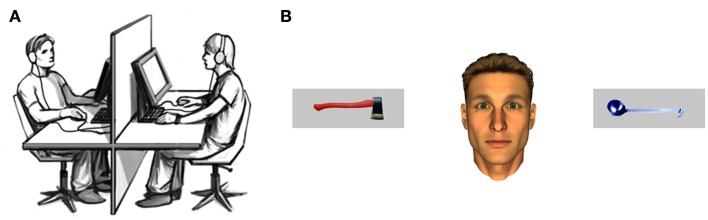
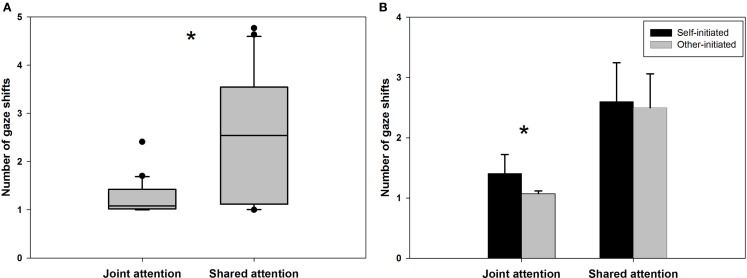
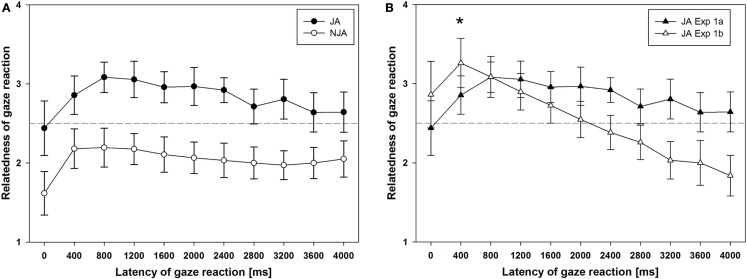
Social gaze provides a window into the interests and intentions of others and allows us to actively point out our own. It enables us to engage in triadic interactions involving human actors and physical objects and to build an indispensable basis for coordinated action and collaborative efforts. The object-related aspect of gaze in combination with the fact that any motor act of looking encompasses both input and output of the minds involved makes this non-verbal cue system particularly interesting for research in embodied social cognition. Social gaze comprises several core components, such as gaze-following or gaze aversion. Gaze-following can result in situations of either "joint attention" or "shared attention." The former describes situations in which the gaze-follower is aware of sharing a joint visual focus with the gazer. The latter refers to a situation in which gazer and gaze-follower focus on the same object and both are aware of their reciprocal awareness of this joint focus. Here, a novel interactive eye-tracking paradigm suited for studying triadic interactions was used to explore two aspects of social gaze. Experiments 1a and 1b assessed how the latency of another person's gaze reactions (i.e., gaze-following or gaze version) affected participants' sense of agency, which was measured by their experience of relatedness of these reactions. Results demonstrate that both timing and congruency of a gaze reaction as well as the other's action options influence the sense of agency. Experiment 2 explored differences in gaze dynamics when participants were asked to establish either joint or shared attention. Findings indicate that establishing shared attention takes longer and requires a larger number of gaze shifts as compared to joint attention, which more closely seems to resemble simple visual detection. Taken together, novel insights into the sense of agency and the awareness of others in gaze-based interaction are provided.
社交注视为我们提供了了解他人兴趣和意图的窗口,并使我们能够主动指出自己的兴趣和意图。它使我们能够参与涉及人类行为者和物理对象的三方互动,并为协调行动和协作努力建立不可或缺的基础。注视的物体相关方面,以及任何目光移动的动作都包含了所涉及的思维的输入和输出,这使得这种非言语线索系统对于具身社会认知的研究特别有趣。社交注视包括几个核心组成部分,例如注视追随或注视回避。注视追随可能导致“共同注意”或“共享注意”的情况。前者描述的是注视跟随者意识到与注视者共享共同的视觉焦点的情况。后者指的是注视者和注视跟随者关注同一个物体,并且双方都意识到他们对这个共同焦点的相互意识的情况。在这里,使用了一种新颖的交互式眼动追踪范式来研究社交注视的两个方面。实验 1a 和 1b 评估了另一个人的注视反应(即注视追随或注视回避)的潜伏期如何影响参与者的主体感,这是通过他们对这些反应的相关性的体验来衡量的。结果表明,注视反应的时间和一致性以及对方的行动选择都会影响主体感。实验 2 探讨了当参与者被要求建立共同注意或共享注意时,注视动态的差异。研究结果表明,与共同注意相比,建立共享注意需要更长的时间,并且需要更多的注视转移,而共享注意更类似于简单的视觉检测。总的来说,这些研究结果为基于注视的互动中的主体感和对他人的意识提供了新的见解。