Edwards S Gareth, Bayliss Andrew P
School of Psychology, University of East Anglia, Lawrence Stenhouse Building, Norwich, NR4 7TJ, UK.
Atten Percept Psychophys. 2019 Nov;81(8):2755-2765. doi: 10.3758/s13414-019-01671-1.
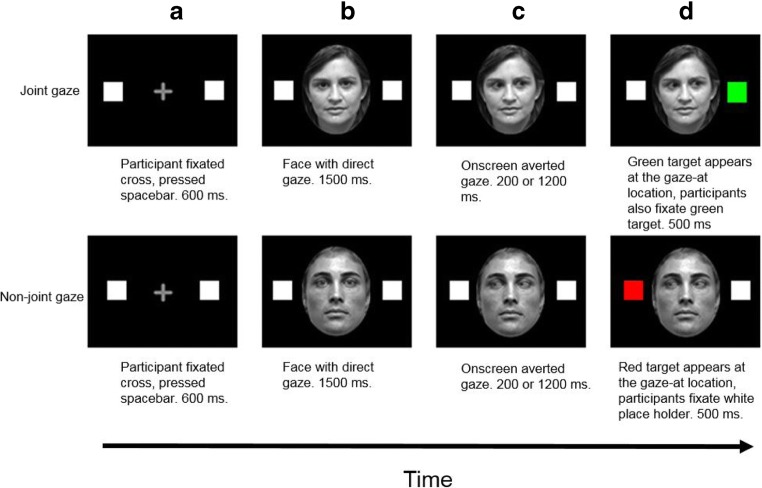
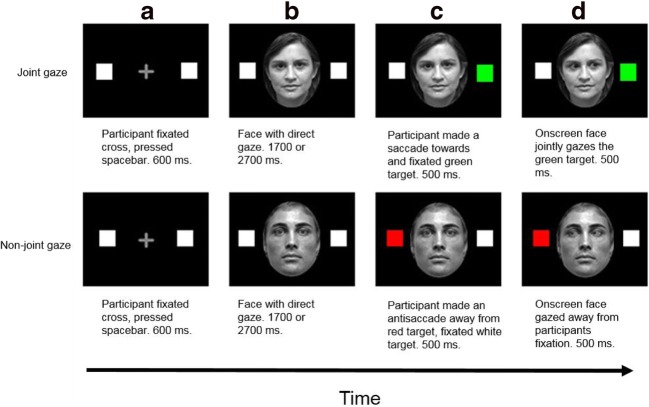
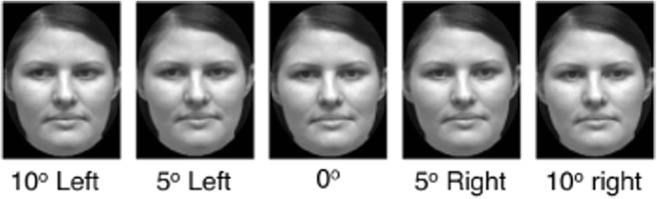
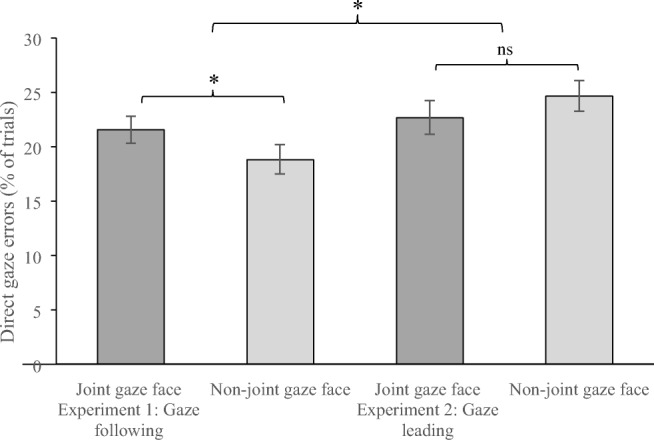
We tested whether gaze direction identification of individual faces can be modulated by prior social gaze encounters. In two experiments, participants first completed a joint-gaze learning task using a saccade/antisaccade paradigm. Participants would encounter some 'joint-gaze faces' that would consistently look at the participants saccade goal before participants looked there (Experiment 1) or would follow the participants gaze to the target (Experiment 2). 'Non-joint-gaze faces' would consistently look in the opposite direction. Participants then completed a second task in which they judged the gaze direction of the faces they had previously encountered. Participants were less likely to erroneously report faces with slightly deviated gaze as looking directly at them if the face had previously never engaged in joint gaze with them. However, this bias was only present when those faces had looked first (Experiment 1) and not when the faces looked after participants (Experiment 2). Comparing these data with gaze identification responses of a control group that did not complete any joint-gaze learning phase revealed that the difference in gaze identification in Experiment 1 is likely driven by a lowering of direct gaze bias in response to non-joint-gaze faces. Thus, previous joint-gaze experiences can affect gaze direction judgements at an identity-specific level. However, this modulation may rely on the socio-cognitive information available from viewing other's initiation behaviours, especially when they fail to engage in social contact.
我们测试了个体面孔的注视方向识别是否会受到先前社交注视接触的调节。在两项实验中,参与者首先使用扫视/反扫视范式完成了一项共同注视学习任务。参与者会遇到一些“共同注视面孔”,这些面孔会在参与者看向扫视目标之前始终看向该目标(实验1),或者会跟随参与者的注视看向目标(实验2)。“非共同注视面孔”则会始终看向相反方向。然后,参与者完成第二项任务,在该任务中他们判断自己之前遇到的面孔的注视方向。如果面孔之前从未与他们进行过共同注视,那么参与者错误地将注视略有偏差的面孔报告为直接看向他们的可能性就较小。然而,这种偏差仅在那些面孔先看向他们时出现(实验1),而在面孔在参与者之后看向他们时则不会出现(实验2)。将这些数据与未完成任何共同注视学习阶段的对照组的注视识别反应进行比较后发现,实验1中注视识别的差异可能是由于对非共同注视面孔的直接注视偏差降低所致。因此,先前的共同注视经历可以在个体特异性水平上影响注视方向判断。然而,这种调节可能依赖于从观察他人的起始行为中获得的社会认知信息,尤其是当他们未能进行社交接触时。