Medical Genetics Division, Fondazione IRCCS Casa Sollievo della Sofferenza, 71013 San Giovanni Rotondo, Italy.
Huntington and Rare Diseases Unit, Fondazione IRCCS Casa Sollievo della Sofferenza, 71013 San Giovanni Rotondo, Italy.
Int J Mol Sci. 2021 Feb 8;22(4):1689. doi: 10.3390/ijms22041689.
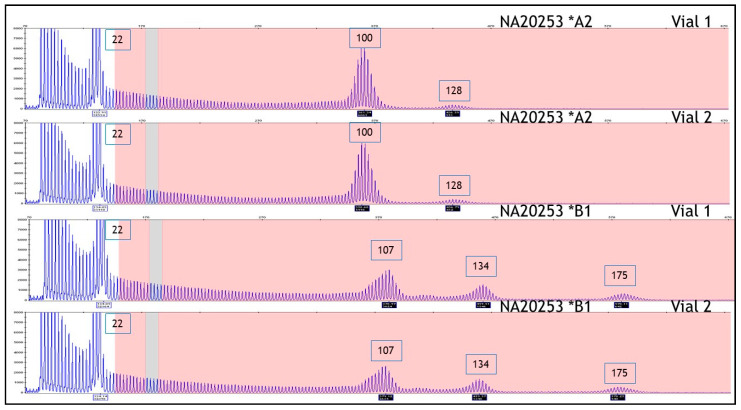
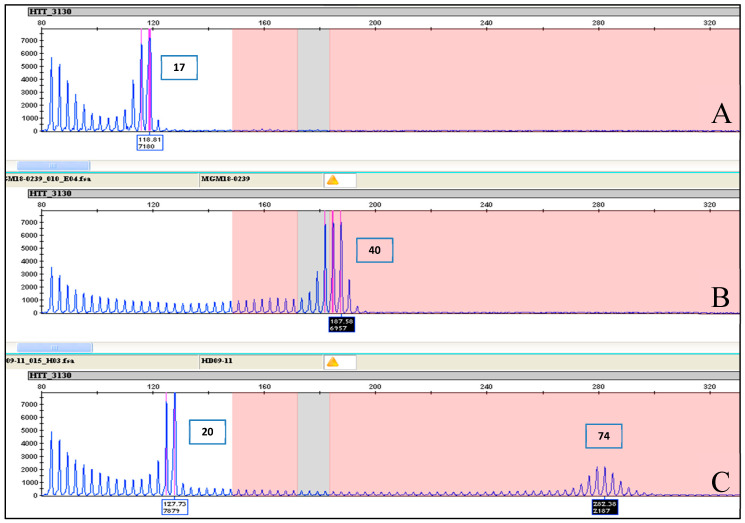
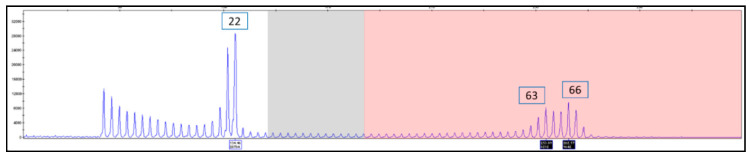
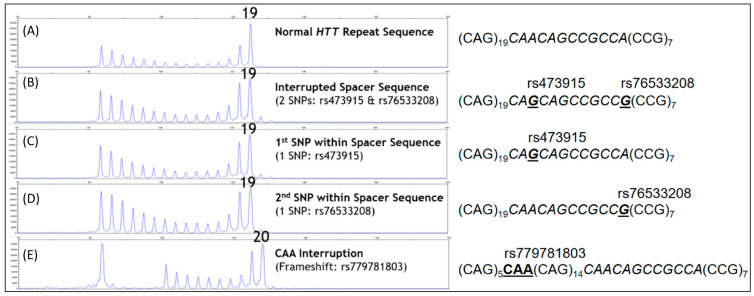
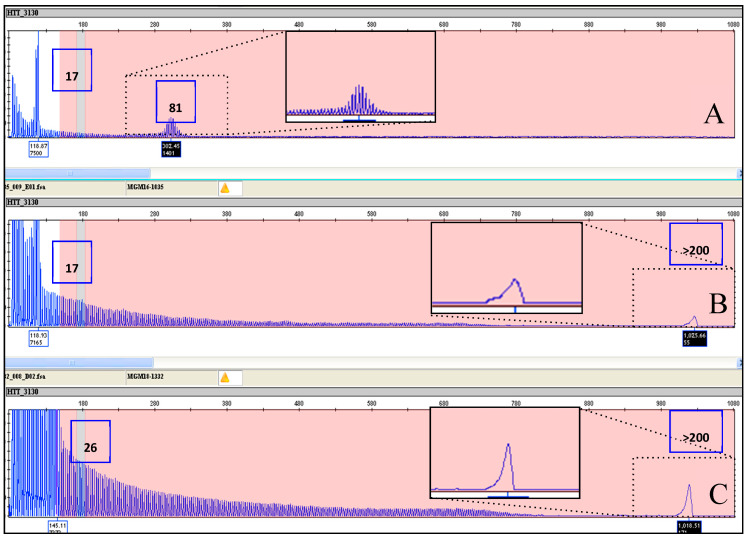
The expanded CAG repeat number in gene causes Huntington disease (HD), which is a severe, dominant neurodegenerative illness. The accurate determination of the expanded allele size is crucial to confirm the genetic status in symptomatic and presymptomatic at-risk subjects and avoid genetic polymorphism-related false-negative diagnoses. Precise CAG repeat number determination is critical to discriminate the cutoff between unexpanded and intermediate mutable alleles (IAs, 27-35 CAG) as well as between IAs and pathological, low-penetrance alleles (i.e., 36-39 CAG repeats), and it is also critical to detect large repeat expansions causing pediatric HD variants. We analyzed the -CAG repeat number of 14 DNA reference materials and of a DNA collection of 43 additional samples carrying unexpanded, IAs, low and complete penetrance alleles, including large (>60 repeats) and very large (>100 repeats) expansions using a novel triplet-primed PCR-based assay, the AmplideX PCR/CE Kit. The results demonstrate that the method accurately genotypes both normal and expanded -CAG repeat numbers and reveals previously undisclosed and very large CAG expansions >200 repeats. We also show that this technique can improve genetic test reliability and accuracy by detecting CAG expansions in samples with sequence variations within or adjacent to the repeat tract that cause allele drop-outs or inaccuracies using other PCR methods.
基因中的扩展 CAG 重复次数导致亨廷顿病(HD),这是一种严重的显性神经退行性疾病。准确确定扩展等位基因的大小对于确认有症状和无症状高危人群的遗传状态,以及避免与遗传多态性相关的假阴性诊断至关重要。精确确定 CAG 重复次数对于区分未扩展和中间易变等位基因(IA,27-35 CAG)以及 IA 与病理性、低外显率等位基因(即 36-39 CAG 重复)之间的界限至关重要,对于检测导致儿科 HD 变体的大重复扩展也至关重要。我们使用新型三核苷酸引物 PCR 法(AmplideX PCR/CE 试剂盒)分析了 14 种 DNA 参考材料和另外 43 种携带未扩展、IA、低和完全外显率等位基因的 DNA 样本的 -CAG 重复次数,包括大于 60 个重复的大重复和大于 100 个重复的非常大重复。结果表明,该方法可以准确地对正常和扩展的 -CAG 重复次数进行基因分型,并揭示了以前未发现的非常大的 CAG 扩展>200 个重复。我们还表明,该技术可以通过检测重复序列内或附近的序列变异导致等位基因丢失或使用其他 PCR 方法不准确的样本中的 CAG 扩展,提高遗传测试的可靠性和准确性。