
居住绿地与城市青少年物质使用:探究与同伴网络健康、性别和执行功能的交互影响。
Residential Greenspace and Urban Adolescent Substance Use: Exploring Interactive Effects with Peer Network Health, Sex, and Executive Function.
机构信息
Department of Geography and Urban Studies, Temple University, Philadelphia, PA 19122, USA.
Department of Geography, Planning, and Sustainability, Rowan University, Glassboro, NJ 08028, USA.
出版信息
Int J Environ Res Public Health. 2021 Feb 8;18(4):1611. doi: 10.3390/ijerph18041611.
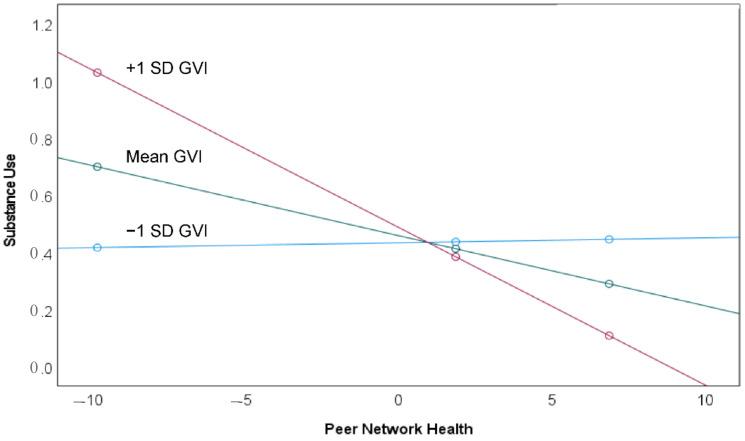
While urban greenspace is increasingly recognized as important to mental health, its role in substance use is understudied. This exploratory study investigates the interaction of greenspace with peer network health, sex, and executive function (EF) in models of substance use among a sample of disadvantaged, urban youth. Adolescents and their parents were recruited from a hospital in the mid-Atlantic region of the U.S. Residential greenspace at the streetscape level was derived from analysis of Google Street View imagery. Logistic regression models were used to test the moderating effect of greenspace on the association between peer network health and substance use, as well as additional moderating effects of sex and EF. The significant negative association of peer network health with substance use occurred only among youth residing in high greenspace environments, a moderating effect which was stronger among youth with high EF deficit. The moderating effect of greenspace did not differ between girls and boys. Greenspace may play an important role in moderating peer influences on substance use among disadvantaged, urban adolescents, and such moderation may differ according to an individual's level of EF. This research provides evidence of differences in environmental susceptibility regarding contextual mechanisms of substance use among youth, and it informs the development of targeted substance use interventions that leverage social and environmental influences on adolescent substance use.
虽然城市绿地对心理健康的重要性越来越受到重视,但它在物质使用方面的作用还没有得到充分研究。本探索性研究调查了在一个处于不利地位的城市青年样本中,绿地与同伴网络健康、性别和执行功能 (EF) 之间的相互作用,以了解物质使用的模型。青少年及其父母是从美国中大西洋地区的一家医院招募的。街道景观层面的居住绿地是通过对谷歌街景图像的分析得出的。逻辑回归模型用于检验绿地对同伴网络健康与物质使用之间关联的调节作用,以及性别和 EF 的额外调节作用。只有在居住在高绿地环境中的青少年中,同伴网络健康与物质使用之间才存在显著的负相关,而 EF 缺陷较高的青少年的调节作用更强。绿地的调节作用在女孩和男孩之间没有差异。绿地可能在调节劣势城市青少年中同伴对物质使用的影响方面发挥着重要作用,而这种调节作用可能因个体的 EF 水平而异。这项研究为环境易感性在青少年物质使用的背景机制方面的差异提供了证据,并为利用社会和环境对青少年物质使用的影响来制定有针对性的物质使用干预措施提供了信息。


 Zotero 插件