Ran Hailiang, Fang Die, Donald Ahouanse Roland, Wang Rui, Che Yusan, He Xingting, Wang Tianlan, Xu Xiufeng, Lu Jin, Xiao Yuanyuan
Department of Epidemiology and Health Statistics, School of Public Health, Kunming Medical University, Kunming, Yunnan, China.
Psychiatric Department, First Affiliated Hospital of Kunming Medical University, Kunming, Yunnan, China.
BMC Public Health. 2021 Feb 10;21(1):332. doi: 10.1186/s12889-021-10386-8.
Parenting styles are significantly associated with self-harm (SH) in adolescents. Nevertheless, little is known about the mechanism underlying this association. This study primarily aimed to evaluate the potential mediating role of impulsivity in the association between parenting styles and SH in Chinese adolescents.
Self-administered questionnaires were used to conduct a survey among a sample population consisting of 3146 adolescents in southwest China. Logistic regression analyses were performed to evaluate the association between parenting styles, impulsivity, and SH. A path model investigation further examined the mediating role of impulsivity in terms of the association between parenting styles and SH.
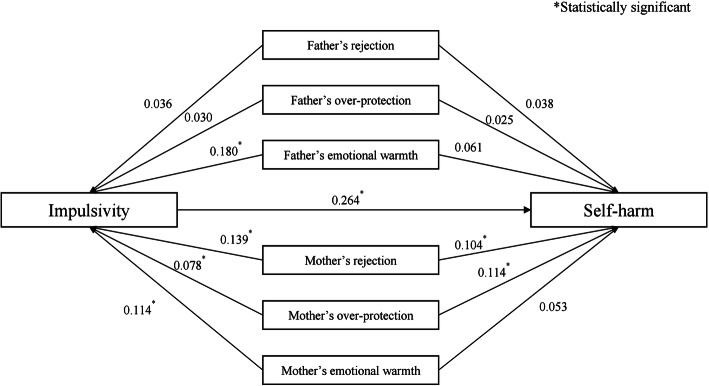
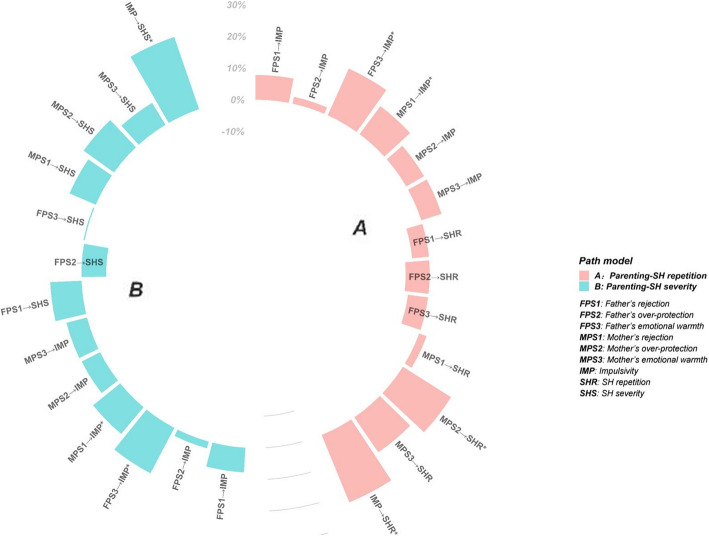
The age range of participants was 10 to 17 years old. The prevalence of SH was 47.0% (95% CI: 36.3-58.0%). Impulsivity, less paternal emotional warmth, maternal over-protection, and rejection were significantly associated with SH. The path model identified impulsivity as a salient mediator, accounting for 23.4% of the total association between parenting styles and SH. The hypothesized path model indicated differences in the parenting styles of fathers and mothers: Impulsivity played a significant mediating role, though only in respect to the maternal over-protection and rejection paths.
For Chinese children and adolescents who experience a harsher maternal parenting style, impulsivity-centered intervention measures might be effective in reducing SH related to parenting styles.
养育方式与青少年自我伤害行为显著相关。然而,对于这种关联背后的机制知之甚少。本研究主要旨在评估冲动性在中国青少年养育方式与自我伤害行为关联中的潜在中介作用。
采用自填式问卷对中国西南部3146名青少年组成的样本人群进行调查。进行逻辑回归分析以评估养育方式、冲动性和自我伤害行为之间的关联。路径模型研究进一步考察了冲动性在养育方式与自我伤害行为关联方面的中介作用。
参与者年龄范围为10至17岁。自我伤害行为的患病率为47.0%(95%置信区间:36.3 - 58.0%)。冲动性、较少的父亲情感温暖、母亲过度保护和拒绝与自我伤害行为显著相关。路径模型确定冲动性是一个显著的中介因素,占养育方式与自我伤害行为总关联的23.4%。假设的路径模型显示了父亲和母亲养育方式的差异:冲动性起到了显著的中介作用,不过仅在母亲过度保护和拒绝路径方面。
对于经历更严厉母亲养育方式的中国儿童和青少年,以冲动性为中心的干预措施可能对减少与养育方式相关的自我伤害行为有效。