Department of Physical Education, Institute of Life Sciences, Federal University of Juiz de Fora, Campus: Governador Valadares, Rua Manoel Byrro, 241 - Vila Bretas, Governador Valadares, MG, 35010-260, Brazil.
School of Physical Education, Physiotherapy and Occupational Therapy, Federal University of Minas Gerais, Belo Horizonte, MG, Brazil.
J Int Soc Sports Nutr. 2021 Feb 10;18(1):14. doi: 10.1186/s12970-020-00406-0.
Chocolate milk has gained recent scientific support as a recovery drink. However, it is known that high exercise-demand triggers gastrointestinal discomfort which continues post-exercise, thereby hindering this nutritional strategy. In addition, those who are lactose intolerant cannot benefit from a milk-based beverage. Thus, the aim of this preliminary study was to develop a low-fat, lactose-free, and leucine-enriched chocolate cow milk prototype (CML) representing nutrition-related recommendations for football players, as well as assess athletes' individual subjective outcomes for gastrointestinal complaints and sensorial acceptability in a field-based setting following strenuous team-sport physical demands.
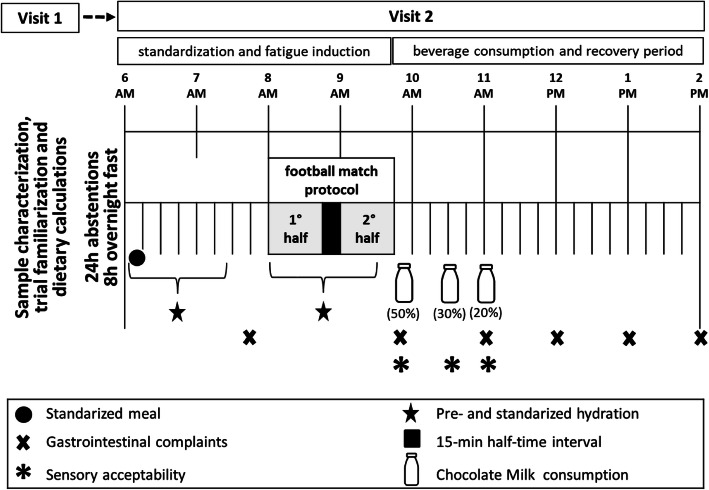
This study followed a single group and repeated-measured design with 10 football players (23 ± 2 yrs., 74 ± 14 kg, 174 ± 5 cm) who consumed CML following a 90-min football match simulation protocol (FMP). The total CML intake to achieve 0.150 g leucine·kg [BW]·h occurred in aliquots of 50, 30 and 20% at 0-, 45- and 75-min post-FMP, respectively. Athletes were evaluated by the prevalence, the type and severity (bloating, nausea, flatulence, and gastric reflux) of gastrointestinal complaints and sensorial acceptability (overall perception, appearance, consistency, and flavour) after drinking each aliquot in a 4-h recovery period.
The CML showed higher scores for "Product Acceptability Index" (88%) and sensorial acceptability (~ 8 in 9-point hedonic scale). Kendall's W with bootstrapped resample (95%CI) revealed agreement among respondents as "moderate" (overall perception, flavour) to "strong" (appearance, consistency) and with no significant agreement differences between rater response in the timeline analysis (0.57 up to 0.87; p > 0.05). Agresti-Caffo add-4 analysis (95% confidence interval, [95%CI]) revealed no differences in each time-point analysis versus baseline for athletes classified as having severe gastrointestinal symptoms, but confirmed concern with bloating (three athletes showed a transient response at 2-h and only one continued until 3-h; p = 0.051).
These preliminary findings suggest that CML presents good taste and high acceptability by the sampled athletes. Thus, CML may be an alternative sport drink for immediate post-workout supplementation to overcome the energy deficit, offer co-ingested leucine, maintain palatability and adherence including lactose intolerance following a team sport-specific fatigue.
RBR-2vmpz9 , 10/12/2019, retrospectively registered.
巧克力牛奶作为一种恢复性饮料,最近得到了科学的支持。然而,众所周知,高强度运动需求会引发胃肠道不适,这种不适会持续到运动后,从而阻碍了这种营养策略的实施。此外,乳糖不耐受者也无法从牛奶基饮料中受益。因此,本初步研究的目的是开发一种低脂、无乳糖、富含亮氨酸的巧克力牛奶原型(CML),以满足足球运动员的营养相关建议,并在高强度团队运动体能需求后,在现场环境中评估运动员对胃肠道不适的个体主观结果和感官接受度。
本研究采用单组重复测量设计,纳入 10 名足球运动员(23±2 岁,74±14kg,174±5cm),在 90 分钟的足球模拟比赛(FMP)后,摄入 CML。摄入 CML 的总量为 0.150g 亮氨酸·kg[BW]·h,在 FMP 后 0、45 和 75 分钟时分别摄入 50%、30%和 20%的 CML。在 4 小时的恢复期间,运动员根据胃肠道不适的发生率、类型和严重程度(腹胀、恶心、肠胃气胀和胃食管反流)以及感官接受度(整体感知、外观、一致性和口味)对每一份 CML 进行评估。
CML 的“产品接受度指数”得分较高(88%),感官接受度也较高(在 9 分愉悦量表中约为 8 分)。Kendall 的 W 检验和 bootstrap 重采样(95%CI)显示,受访者的一致性为“中度”(整体感知、口味)至“强烈”(外观、一致性),且在时间线分析中,评分者的一致性差异无统计学意义(0.57 至 0.87;p>0.05)。Agresti-Caffo add-4 分析(95%置信区间,[95%CI])显示,对于被分类为有严重胃肠道症状的运动员,在每个时间点的分析中,与基线相比,均无差异,但确认了腹胀问题(3 名运动员在 2 小时时有短暂反应,只有 1 名运动员持续到 3 小时;p=0.051)。
这些初步发现表明,CML 受到了抽样运动员的良好口感和高接受度。因此,CML 可能是一种替代运动饮料,可在运动后立即补充,以克服能量不足,提供共摄入的亮氨酸,保持适口性和依从性,包括乳糖不耐受的运动员在进行特定的团队运动后。
RBR-2vmpz9,2019 年 12 月 10 日,回顾性注册。