Centre for Evidence-Based Health Care, Division Epidemiology and Biostatistics, Faculty of Medicine and Health Sciences, Stellenbosch University, Cape Town, South Africa.
Social, Methodological, Innovative, Kreative, Centre for Sociological Research, Faculty of Social Sciences, Katholieke Universiteit Leuven, Leuven, Belgium.
Syst Rev. 2021 Feb 11;10(1):54. doi: 10.1186/s13643-021-01582-z.
People living with human immunodeficiency virus (PLHIV) struggle with the challenges of living with a chronic disease and integrating antiretroviral treatment (ART) and care into their daily lives. The aims of this study were as follows: (1) to undertake the first mega-aggregation of qualitative evidence syntheses using the methods of framework synthesis and (2) make sense of existing qualitative evidence syntheses that explore the barriers and facilitators of adherence to antiretroviral treatment, linkage to care and retention in care for PLHIV to identify research gaps.
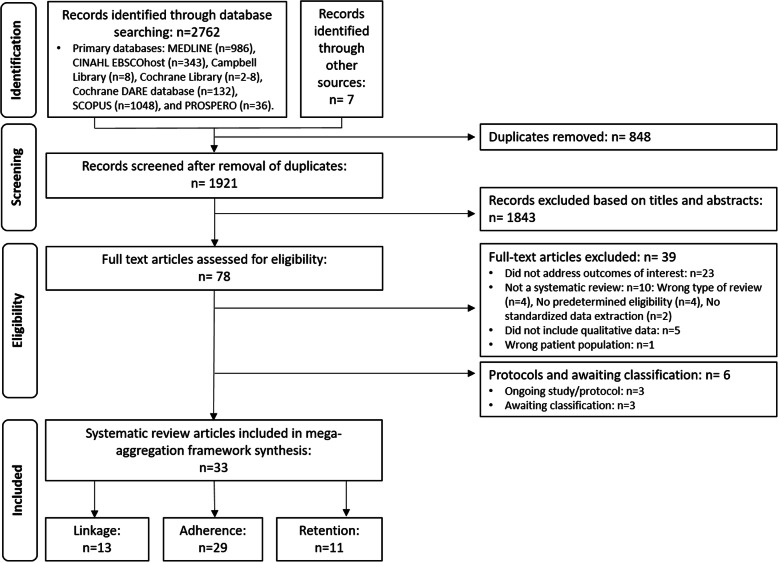
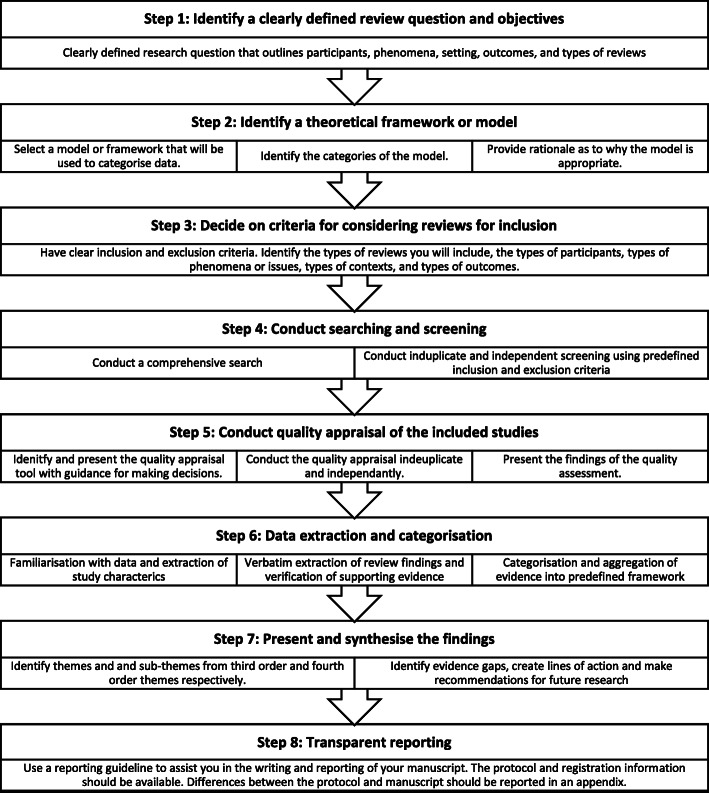
We conducted a comprehensive search and did all screening, data extraction and critical appraisal independently and in duplicate. We used the Kaufman HIV Behaviour Change model (Kaufman et al., 2014) as a framework to synthesise the findings using the mega-aggregative framework synthesis approach, which consists of 8 steps: (1) identify a clearly defined review question and objectives, (2) identify a theoretical framework or model, (3) decide on criteria for considering reviews for inclusion, (4) conduct searching and screening, (5) conduct quality appraisal of the included studies, (6) data extraction and categorisation, (7) present and synthesise the findings, and (8) transparent reporting. We evaluated systematic reviews up to July 2018 and assessed methodological quality, across reviews, using the Joanna Briggs Institute Critical Appraisal Checklist for Systematic Reviews.
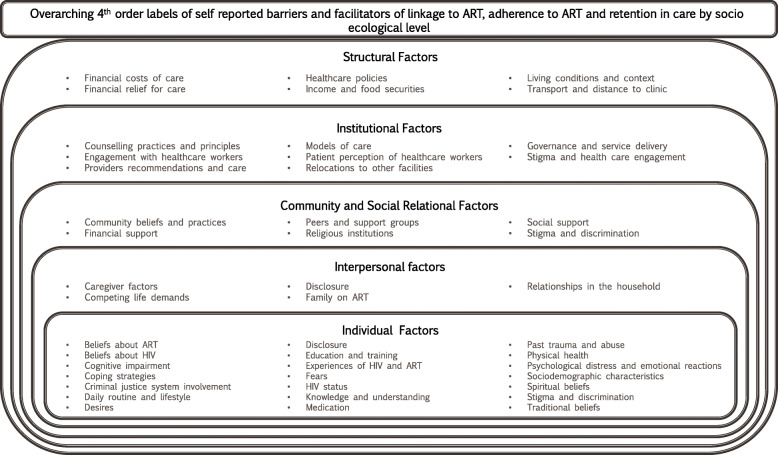
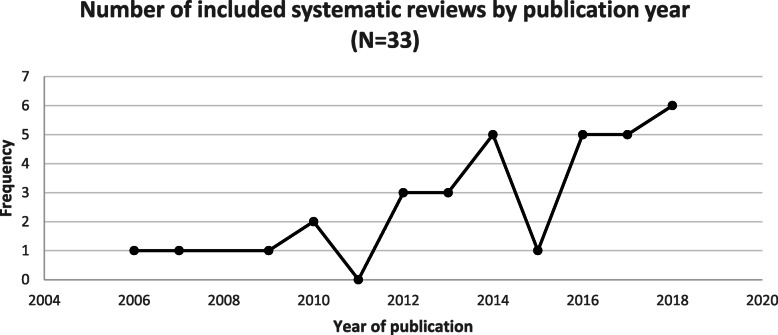
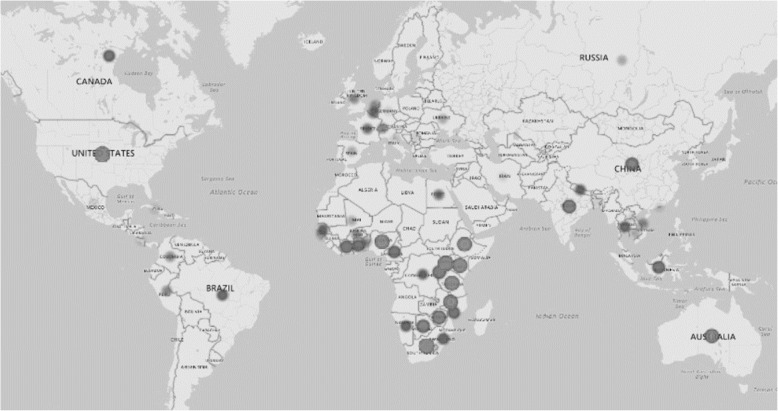
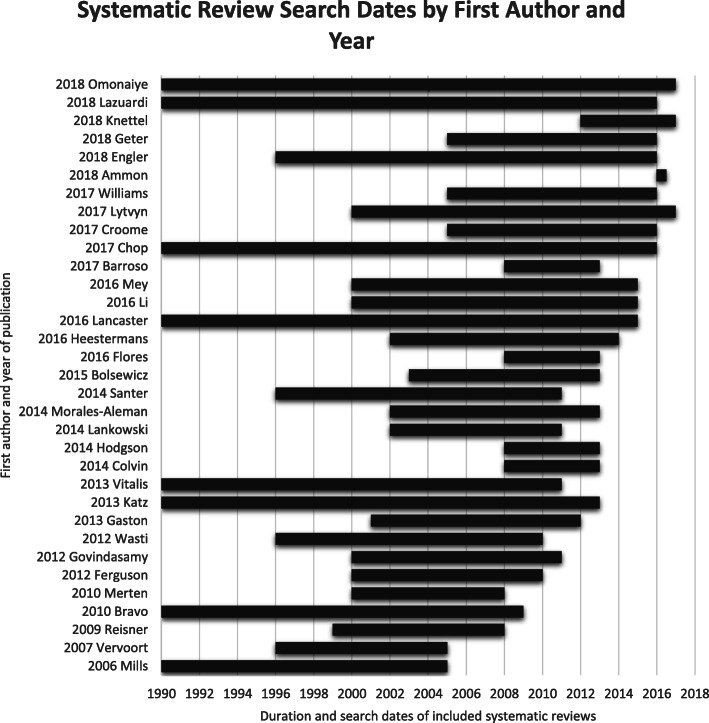
We included 33 systematic reviews from low, middle- and high-income countries, which reported on 1,111,964 PLHIV. The methodological quality of included reviews varied considerably. We identified 544 unique third-order concepts from the included systematic reviews, which were reclassified into 45 fourth-order themes within the individual, interpersonal, community, institutional and structural levels of the Kaufman HIV Behaviour Change model. We found that the main influencers of linkage, adherence and retention behaviours were psychosocial and personal characteristics-perceptions of ART, desires, fears, experiences of HIV and ART, coping strategies and mental health issues-interwoven with other factors on the interpersonal, community, institutional and structural level. Using this approach, we found interdependence between factors influencing ART linkage, retention and adherence and identified the need for qualitative evidence that explores, in greater depth, the complex relationships between structural factors and adherence, sociodemographic factors such as community violence and retention, and the experiences of growing up with HIV in low- and middle-income countries-specifically in children, youth, women and key populations.
This is the first mega-aggregation framework synthesis, or synthesis of qualitative evidence syntheses using the methods of framework synthesis at the overview level. We found the novel method to be a transparent and efficient method for assessing the quality and making sense of existing qualitative systematic reviews.
The protocol of this overview was registered on PROSPERO ( CRD42017078155 ) on 17 December 2017.
人类免疫缺陷病毒(HIV)感染者(PLHIV)在与慢性病作斗争的同时,还需要将抗逆转录病毒治疗(ART)和护理融入日常生活。本研究的目的如下:(1)使用框架综合方法首次对定性证据综合进行大规模聚合;(2)了解探索 PLHIV 对 ART 治疗的依从性、与护理的联系以及护理保留的障碍和促进因素的现有定性证据综合,以确定研究空白。
我们进行了全面的搜索,并独立且重复地进行了所有筛选、数据提取和批判性评价。我们使用 Kaufman HIV 行为改变模型(Kaufman 等人,2014 年)作为框架,使用 mega-聚合框架综合方法综合研究结果,该方法包括 8 个步骤:(1)确定明确的审查问题和目标;(2)确定理论框架或模型;(3)决定考虑纳入的审查标准;(4)进行搜索和筛选;(5)对纳入研究进行质量评估;(6)数据提取和分类;(7)呈现和综合研究结果;(8)透明报告。我们评估了截至 2018 年 7 月的系统评价,并使用 Joanna Briggs 研究所系统评价的批判性评估清单对跨评价的方法学质量进行了评估。
我们纳入了来自低、中、高收入国家的 33 项系统评价,这些评价报告了 1111964 名 PLHIV。纳入的系统评价的方法学质量差异很大。我们从纳入的系统评价中确定了 544 个独特的三级概念,这些概念在 Kaufman HIV 行为改变模型的个体、人际、社区、机构和结构层面被重新分类为 45 个四级主题。我们发现,影响联系、依从性和保留行为的主要因素是心理社会和个人特征——对 ART 的看法、欲望、恐惧、HIV 和 ART 的体验、应对策略和心理健康问题——与人际、社区、机构和结构层面的其他因素交织在一起。使用这种方法,我们发现影响 ART 联系、保留和依从性的因素之间存在相互依存关系,并确定需要定性证据更深入地探讨结构因素与依从性、社会人口因素(如社区暴力和保留)以及在中低收入国家(特别是儿童、青年、妇女和重点人群)中成长过程中的 HIV 经历之间的复杂关系。
这是第一个 mega-aggregation 框架综合,或使用框架综合方法在综述层面综合定性证据。我们发现,这种新方法是一种透明且有效的方法,用于评估现有定性系统评价的质量并理解它们。
本综述方案于 2017 年 12 月 17 日在 PROSPERO(CRD42017078155)上进行了注册。