Department of Microbiology, Li Ka Shing Faculty of Medicine, The University of Hong Kong, Hong Kong, China
Carol Yu Centre for Infection, Li Ka Shing Faculty of Medicine, The University of Hong Kong, Hong Kong, China.
mSphere. 2021 Feb 10;6(1):e00819-20. doi: 10.1128/mSphere.00819-20.
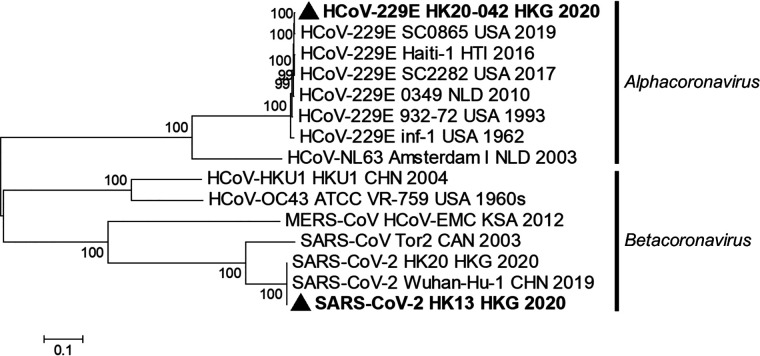
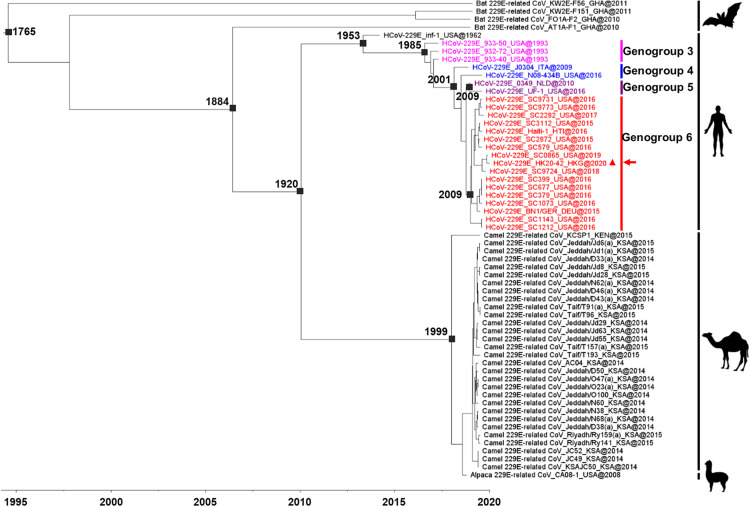
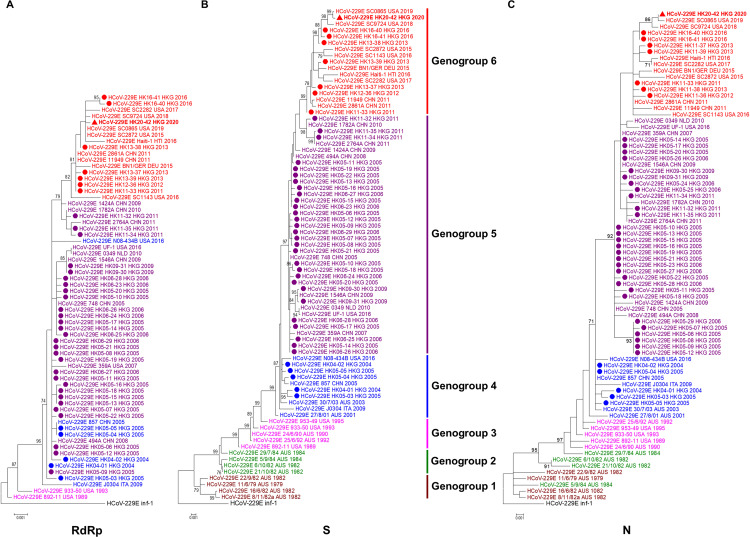
Compared to other human coronaviruses, the genetic diversity and evolution of human coronavirus 229E (HCoV-229E) are relatively understudied. We report a fatal case of COVID-19 pneumonia coinfected with HCoV-229E in Hong Kong. Genome sequencing of SARS-CoV-2 and HCoV-229E from a nasopharyngeal sample of the patient showed that the SARS-CoV-2 strain HK13 was most closely related to SARS-CoV-2 type strain Wuhan-Hu-1 (99.99% nucleotide identity), compatible with his recent history of travel to Wuhan. The HCoV-229E strain HK20-42 was most closely related to HCoV-229E strain SC0865 from the United States (99.86% nucleotide identity). To investigate if it may represent a newly emerged HCoV-229E genotype in Hong Kong, we retrieved 41 archived respiratory samples that tested positive for HCoV-229E from 2004 to 2019. Pneumonia and exacerbations of chronic airway diseases were common among infected patients. Complete RdRp, S, and N gene sequencing of the 41 HCoV-229E strains revealed that our contemporary HCoV-229E strains have undergone significant genetic drift with clustering of strains in chronological order. Two novel genogroups were identified, in addition to previously described genogroups 1 to 4, with recent circulating strains including strain HK20-42 belonging to novel genogroup 6. Positive selection was detected in the spike protein and receptor-binding domain, which may be important for viral evolution at the receptor-binding interphase. Molecular dating analysis showed that HCoV-229E shared the most recent common ancestor with bat and camel/alpaca 229E-related viruses at ∼1884, while camel/alpaca viruses had a relatively recent common ancestor at ∼1999. Further studies are required to ascertain the evolutionary origin and path of HCoV-229E. Since its first appearance in the 1960s, the genetic diversity and evolution of human coronavirus 229E (HCoV-229E) have been relatively understudied. In this study, we report a fatal case of COVID-19 coinfected with HCoV-229E in Hong Kong. Genome sequencing revealed that our SARS-CoV-2 strain is highly identical to the SARS-CoV-2 strain from Wuhan, compatible with the patient's recent travel history, whereas our HCoV-229E strain in this study is highly identical to a recent strain in the United States. We also retrieved 41 archived HCoV-229E strains from 2004 to 2019 in Hong Kong for sequence analysis. Pneumonia and exacerbations of chronic airway diseases were common diagnoses among the 41 patients. The results showed that HCoV-229E was evolving in chronological order. Two novel genogroups were identified in addition to the four preexisting HCoV-229E genogroups, with recent circulating strains belonging to novel genogroup 6. Molecular clock analysis dated bat-to-human and bat-to-camelid transmission to as early as 1884.
与其他人类冠状病毒相比,人类冠状病毒 229E(HCoV-229E)的遗传多样性和进化研究相对较少。我们报告了一例在香港发生的 COVID-19 肺炎合并 HCoV-229E 感染的致死病例。对来自患者鼻咽样本的 SARS-CoV-2 和 HCoV-229E 的基因组测序表明,SARS-CoV-2 株 HK13 与 SARS-CoV-2 武汉株 Wuhan-Hu-1 最为密切相关(核苷酸同一性为 99.99%),与患者最近前往武汉的旅行史相符。HCoV-229E 株 HK20-42 与来自美国的 HCoV-229E 株 SC0865 最为密切相关(核苷酸同一性为 99.86%)。为了研究其是否代表香港出现的一种新的 HCoV-229E 基因型,我们从 2004 年至 2019 年检索了 41 份 HCoV-229E 阳性的呼吸道存档样本。感染患者中常见肺炎和慢性气道疾病恶化。对 41 株 HCoV-229E 的完整 RdRp、S 和 N 基因测序表明,我们的当代 HCoV-229E 株发生了显著的遗传漂移,株系按时间顺序聚类。除了先前描述的第 1 至 4 个基因群外,还确定了两个新的基因群,最近流行的株系包括属于新基因群 6 的株系 HK20-42。在刺突蛋白和受体结合结构域中检测到正选择,这可能对受体结合界面的病毒进化很重要。分子钟分析显示,HCoV-229E 与蝙蝠和骆驼/羊驼 229E 相关病毒的最近共同祖先出现在约 1884 年,而骆驼/羊驼病毒的最近共同祖先出现在约 1999 年。需要进一步研究以确定 HCoV-229E 的进化起源和途径。自 20 世纪 60 年代首次出现以来,人类冠状病毒 229E(HCoV-229E)的遗传多样性和进化研究相对较少。在本研究中,我们报告了一例在香港发生的 COVID-19 合并 HCoV-229E 感染的致死病例。基因组测序显示,我们的 SARS-CoV-2 株与来自武汉的 SARS-CoV-2 株高度一致,与患者最近的旅行史相符,而我们在本研究中分离的 HCoV-229E 株与美国最近的一株高度一致。我们还从 2004 年至 2019 年在香港检索了 41 份 HCoV-229E 存档样本进行序列分析。肺炎和慢性气道疾病恶化是 41 名患者的常见诊断。结果表明,HCoV-229E 是按时间顺序进化的。除了现有的四个 HCoV-229E 基因群外,还确定了两个新的基因群,最近流行的株系属于新的基因群 6。分子钟分析将蝙蝠到人类和蝙蝠到骆驼/羊驼的传播追溯到早在 1884 年。