Alyahya Mohammad S, Hijazi Heba H, Alolayyan Main Naser, Ajayneh Farah Jehad, Khader Yousef S, Al-Sheyab Nihaya A
Department of Health Management and Policy, Faculty of Medicine, Jordan University of Science and Technology, Irbid, 22110, Jordan.
Department of Public Health and Community Medicine, Faculty of Medicine, Jordan University of Science & Technology, Irbid, 22110, Jordan.
Risk Manag Healthc Policy. 2021 Feb 3;14:415-430. doi: 10.2147/RMHP.S293110. eCollection 2021.
Examining cognitive medical errors (MEs) and their contributing factors is vital in health systems research, as it provides baseline data that can be used to develop appropriate interventions to prevent and/or minimize errors. The primary aim of this study was to investigate the association between cognitive MEs and hospitals' organizational factors and the individual psychological and functional factors.
This cross-sectional study was conducted in three main hospitals in Northern Jordan. A proportional sampling technique was employed to decide the number of participants from each hospital. Data from physicians and nurses (n=400) were collected using a self-administered questionnaire, which was developed based on pertinent literature review. Exploratory and confirmatory factor analyses were conducted to validate the study instrument. The relationships between the variables were analyzed through structural equation modeling (SEM) using AMOS. Multi-group analysis was also performed to examine the differences in the participants' perceptions towards the respective variables between the three selected hospitals.
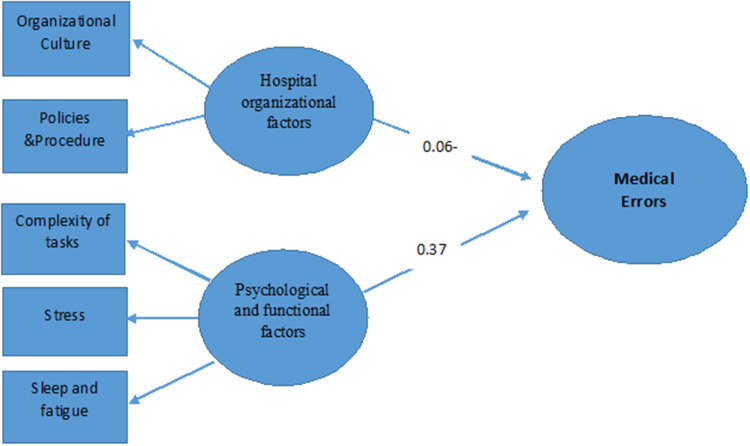
Our results showed a non-significant negative association between MEs and hospital organizational factors. Also, the SEM analysis showed a positive significant correlation between MEs and psychological and functional factors, whereby excessive workload, complexity of tasks, stress, sleep deprivation, and fatigue were found to be predictors of MEs occurrence. In comparison to the results from the university hospital, the multi-group analysis results from the governmental public hospital and the private hospital showed a significant impact of psychological and functional factors on MEs.
To reduce the occurrence of MEs in hospitals, there is a need to enhance organizational safety culture. Efforts should be directed at both organizational and individual levels. Also, it is essential that health decision makers develop strategies to reduce work-related stress and improve healthcare staff well-being, as work stress may cause cognitive impairments among healthcare workers and hence threaten patients' safety.
在卫生系统研究中,检查认知医疗差错(MEs)及其促成因素至关重要,因为它提供了可用于制定适当干预措施以预防和/或最小化差错的基线数据。本研究的主要目的是调查认知医疗差错与医院组织因素以及个体心理和功能因素之间的关联。
本横断面研究在约旦北部的三家主要医院进行。采用比例抽样技术确定每家医院的参与者数量。使用基于相关文献综述编制的自填式问卷收集医生和护士(n = 400)的数据。进行探索性和验证性因素分析以验证研究工具。使用AMOS通过结构方程模型(SEM)分析变量之间的关系。还进行了多组分析,以检查三家选定医院的参与者对各自变量的看法差异。
我们的结果显示医疗差错与医院组织因素之间存在不显著的负相关。此外,SEM分析显示医疗差错与心理和功能因素之间存在显著正相关,其中发现工作量过大、任务复杂性、压力、睡眠不足和疲劳是医疗差错发生的预测因素。与大学医院的结果相比,政府公立医院和私立医院的多组分析结果显示心理和功能因素对医疗差错有显著影响。
为减少医院中医疗差错的发生,有必要加强组织安全文化。应在组织和个人层面都做出努力。此外,卫生决策者制定减少工作相关压力和改善医护人员福祉的策略至关重要,因为工作压力可能导致医护人员认知受损,从而威胁患者安全。