Shen An-Ran, Zhong Xin, Tang Tao-Tao, Wang Cui, Jing Jing, Liu Bi-Cheng, Lv Lin-Li
Institute of Nephrology, Zhongda Hospital, Southeast University School of Medicine, Nanjing, China.
Front Physiol. 2021 Jan 25;11:627800. doi: 10.3389/fphys.2020.627800. eCollection 2020.
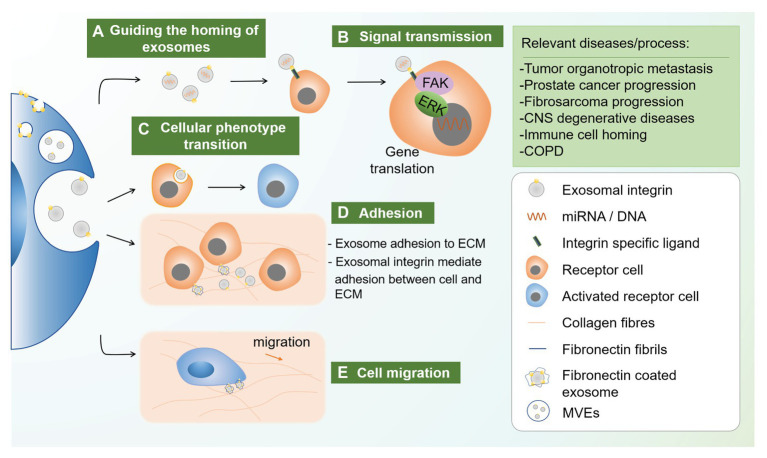
Integrins are transmembrane receptors that function as noncovalent heterodimers that mediate cellular adhesion and migration, cell to cell communication, and intracellular signaling activation. In kidney, latency associated peptide-transforming growth factor β (TGF-β) and soluble urokinase plasminogen activator receptor (suPAR) were found as the novel ligands of integrins that contribute to renal interstitial fibrosis and focal segmental glomerular sclerosis glomerulosclerosis (FSGS). Interestingly, recent studies revealed that integrins are the compositional cargo of exosomes. Increasing evidence suggested that exosomal integrin played critical roles in diverse pathophysiologic conditions such as tumor metastasis, neurological disorders, immunology regulation, and other processes. This review will focus on the biology and function of exosomal integrin, emphasizing its potential role in kidney disease as well as its implications in developing novel therapeutic and diagnosis approaches for kidney disease.
整合素是跨膜受体,作为非共价异二聚体发挥作用,介导细胞黏附与迁移、细胞间通讯以及细胞内信号激活。在肾脏中,潜伏相关肽转化生长因子β(TGF-β)和可溶性尿激酶型纤溶酶原激活物受体(suPAR)被发现是整合素的新型配体,它们促成肾间质纤维化和局灶节段性肾小球硬化(FSGS)。有趣的是,最近的研究表明整合素是外泌体的组成成分。越来越多的证据表明,外泌体整合素在多种病理生理状况如肿瘤转移、神经疾病、免疫调节及其他过程中发挥关键作用。本综述将聚焦于外泌体整合素的生物学特性与功能,着重阐述其在肾脏疾病中的潜在作用以及对开发肾脏疾病新型治疗和诊断方法的意义。