Department of Radiation Oncology, Health Services Research Group, University Hospital Halle (Saale), Ernst-Grube-Str. 40, 06120, Halle (Saale), Germany.
Institute of Medical Epidemiology, Biometry, and Informatics, Martin Luther University Halle-Wittenberg, Magdeburger Strasse 8, 06112, Halle (Saale), Germany.
J Cancer Res Clin Oncol. 2021 May;147(5):1325-1334. doi: 10.1007/s00432-021-03537-2. Epub 2021 Feb 11.
Despite recent improvements in cancer treatment in Germany, a marked difference in cancer survival based on socioeconomic factors persists. We aim to quantify the effect of socioeconomic inequality on head and neck cancer (HNC) survival.
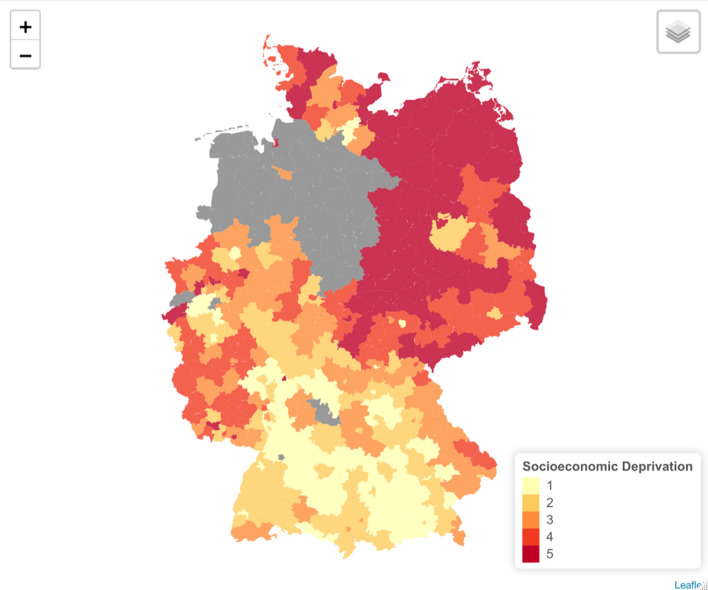
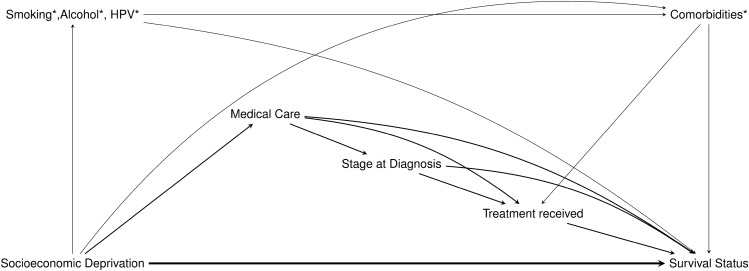
Information on 20,821 HNC patients diagnosed in 2009-2013 was routinely collected by German population-based cancer registries. Socioeconomic inequality was defined by the German Index of Socioeconomic Deprivation. The Cox proportional regression and relative survival analysis measured the survival disparity according to level of socioeconomic deprivation with respective confidence intervals (CI). A causal mediation analysis was conducted to quantify the effect of socioeconomic deprivation mediated through medical care, stage at diagnosis, and treatment on HNC survival.
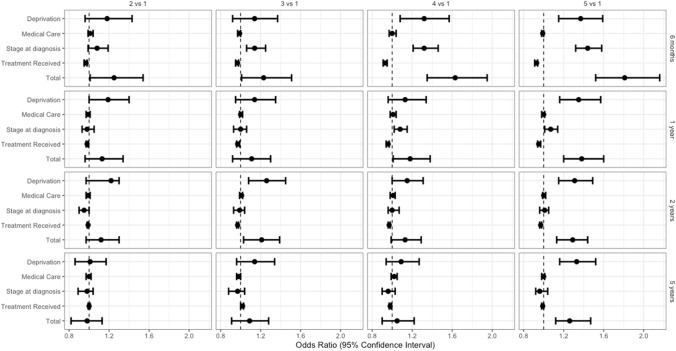
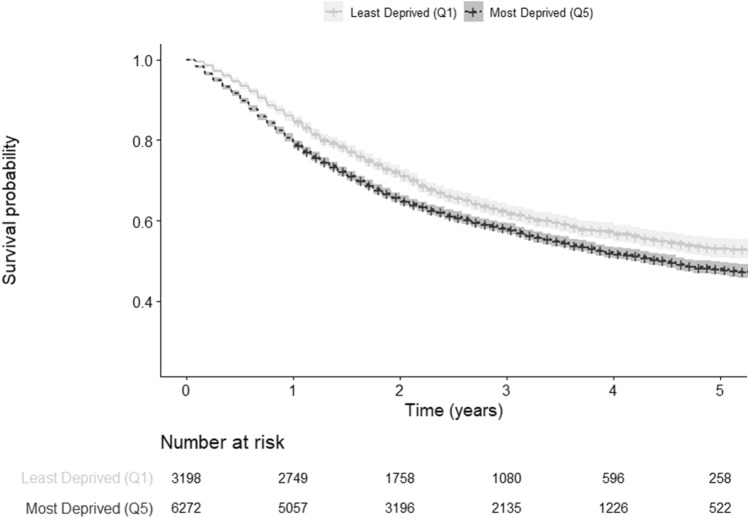
The most socioeconomically deprived patients were found to have the highest hazard of dying when compared to the most affluent (Hazard Ratio: 1.25, 95% CI 1.17-1.34). The most deprived patients also had the worst 5-year age-adjusted relative survival (50.8%, 95% CI 48.5-53.0). Our mediation analysis showed that most of the effect of deprivation on survival was mediated through differential stage at diagnosis during the first 6 months after HNC diagnosis. As follow-up time increased, medical care, stage at diagnosis, and treatment played no role in mediating the effect of deprivation on survival.
This study confirms the survival disparity between affluent and deprived HNC patients in Germany. Considering data limitations, our results suggest that, within six months after HNC diagnosis, the elimination of differences in stage at diagnosis could reduce survival inequalities.
尽管德国在癌症治疗方面最近有所改善,但基于社会经济因素的癌症生存率仍存在显著差异。我们旨在量化社会经济不平等对头颈部癌症(HNC)生存率的影响。
通过德国基于人群的癌症登记处常规收集了 2009 年至 2013 年间诊断的 20821 例 HNC 患者的信息。社会经济不平等程度由德国社会经济剥夺指数定义。Cox 比例风险回归和相对生存分析根据社会经济剥夺程度测量了相应的置信区间(CI)的生存差异。进行因果中介分析,以量化社会经济剥夺通过医疗保健、诊断时的分期和治疗对 HNC 生存的影响。
与最富裕的患者相比,最贫困的患者被发现死亡的风险最高(风险比:1.25,95%CI 1.17-1.34)。最贫困的患者也有最差的 5 年年龄调整相对生存率(50.8%,95%CI 48.5-53.0)。我们的中介分析表明,剥夺对生存的影响主要是通过 HNC 诊断后 6 个月内诊断分期的差异来介导的。随着随访时间的增加,医疗保健、诊断时的分期和治疗在中介剥夺对生存的影响方面没有作用。
本研究证实了德国富裕和贫困 HNC 患者之间的生存差异。考虑到数据的局限性,我们的结果表明,在 HNC 诊断后六个月内,消除分期差异可以减少生存不平等。