Dandoy Christopher E, Rotz Seth, Alonso Priscila Badia, Klunk Anna, Desmond Catherine, Huber John, Ingraham Hannah, Higham Christine, Dvorak Christopher C, Duncan Christine, Schoettler Michelle, Lehmann Leslie, Cancio Maria, Killinger James, Davila Blachy, Phelan Rachel, Mahadeo Kris M, Khazal Sajad, Lalefar Nahal, Vissa Madhav, Myers Kasiani, Wallace Greg, Nelson Adam, Khandelwal Pooja, Bhatla Deepika, Gloude Nicholas, Anderson Eric, Huo Jeffrey, Roehrs Philip, Auletta Jeffery J, Chima Ranjit, Lane Adam, Davies Stella M, Jodele Sonata
Division of Bone Marrow Transplantation and Immune Deficiency, Cincinnati Children's Hospital Medical Center, Cincinnati, OH.
Department of Pediatrics, University of Cincinnati, Cincinnati, OH.
Blood Adv. 2021 Jan 12;5(1):1-11. doi: 10.1182/bloodadvances.2020003455.
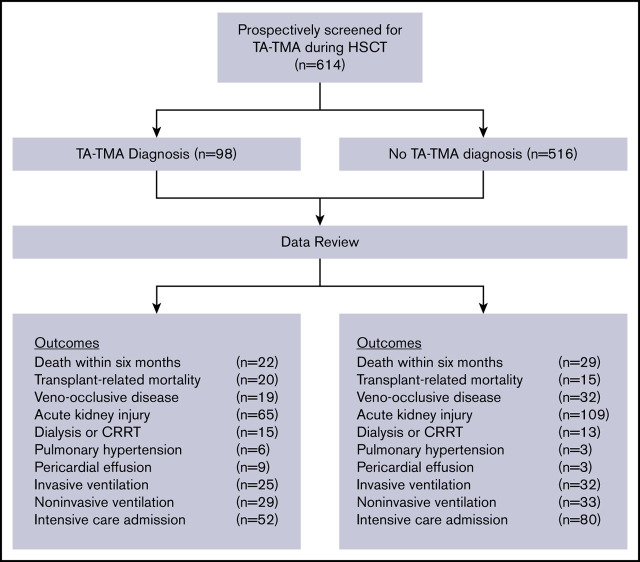
Transplant-associated thrombotic microangiopathy (TA-TMA) is a severe complication of hematopoietic stem cell transplantation (HSCT). A single-center prospective screening study has shown that the incidence of TA-TMA is much higher than prior retrospective studies that did not systematically screen. These data have not been replicated in a multicenter study. Our objective was to determine the incidence and risk factors for TA-TMA and compare outcomes of pediatric HSCT patients with and without TA-TMA. Patients were prospectively screened for TA-TMA at participating centers using a simple to implement and inexpensive strategy from the start of the preparative regimen through day +100. TA-TMA was diagnosed if ≥4 of 7 laboratory/clinical markers diagnostic for TA-TMA were present concurrently or if tissue histology showed TA-TMA. A total of 614 patients (359 males; 58%) received prospective TA-TMA screening at 13 pediatric centers. TA-TMA was diagnosed in 98 patients (16%) at a median of 22 days (interquartile range, 14-44) posttransplant. Patients with TA-TMA had significantly increased bloodstream infections (38% [37/98] vs 21% [107/51], P ≤ .001), mean total hospitalization days (68; 95% confidence interval [CI], 63-74 vs 43; 95% CI, 41-45; P ≤ .001), and number of days spent in the intensive care unit (10.1; 95% CI, 6.4-14; vs 1.6; 95% CI, 1.1-2.2; P ≤ .001) in the first 100 days after HSCT compared with patients without TA-TMA. Overall survival was significantly higher in patients without TA-TMA (93%; 490/516) compared with patients with TA-TMA (78%; 76/98) (P ≤ .001). These data support the need for systematic screening for TA-TMA and demonstrate the feasibility and efficacy of an easy to implement strategy to do so.
移植相关血栓性微血管病(TA-TMA)是造血干细胞移植(HSCT)的一种严重并发症。一项单中心前瞻性筛查研究表明,TA-TMA的发病率远高于既往未进行系统筛查的回顾性研究。这些数据尚未在多中心研究中得到重复验证。我们的目的是确定TA-TMA的发病率和危险因素,并比较患有和未患有TA-TMA的儿科HSCT患者的结局。从预处理方案开始至+100天,在参与研究的中心采用一种简单易行且成本低廉的策略对患者进行TA-TMA的前瞻性筛查。如果同时出现7项TA-TMA诊断性实验室/临床指标中的≥4项,或者组织病理学显示为TA-TMA,则诊断为TA-TMA。共有614例患者(359例男性;58%)在13家儿科中心接受了TA-TMA的前瞻性筛查。98例患者(16%)在移植后中位22天(四分位间距,14 - 44天)被诊断为TA-TMA。与未患TA-TMA的患者相比,患TA-TMA的患者在HSCT后的前100天内血流感染显著增加(38% [37/98] 对21% [107/51],P≤0.001),平均总住院天数(68天;95%置信区间[CI],63 - 74天对43天;95% CI,41 - 45天;P≤0.001),以及在重症监护病房的天数(10.1天;95% CI,6.4 - 14天;对1.6天;95% CI,1.1 - 2.2天;P≤0.001)。未患TA-TMA的患者总体生存率(93%;490/516)显著高于患TA-TMA的患者(78%;76/98)(P≤0.001)。这些数据支持对TA-TMA进行系统筛查的必要性,并证明了一种易于实施的筛查策略的可行性和有效性。