Huang Kuo-Hao, Wang Chen-Ying, Chen Cheng-Yu, Hsu Tuan-Ti, Lin Chun-Pin
Graduate Institute of Clinical Dentistry, School of Dentistry, National Taiwan University, Taipei 106319, Taiwan.
Department of Dentistry, National Taiwan University Hospital, Taipei 100229, Taiwan.
Biomedicines. 2021 Jan 29;9(2):128. doi: 10.3390/biomedicines9020128.
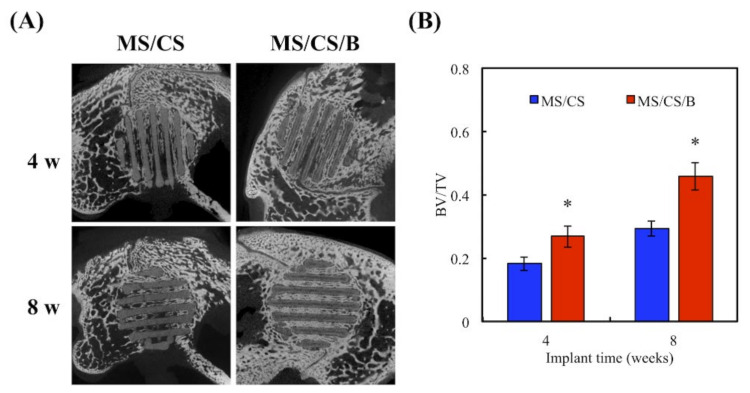
Tissue engineering and scaffolds play an important role in tissue regeneration by supporting cell adhesion, proliferation, and differentiation. The design of a scaffold is critical in determining its feasibility, and it is critical to note that each tissue is unique in terms of its morphology and composition. However, calcium-silicate-based scaffolds are undegradable, which severely limits their application in bone regeneration. In this study, we developed a biodegradable mesoporous calcium silicate (MS)/calcium sulfate (CS)/poly-ε-caprolactone (PCL) composite and fabricated a composite scaffold with 3D printing technologies. In addition, we were able to load bone morphogenetic protein-2 (BMP-2) into MS powder via a one-step immersion procedure. The results demonstrated that the MS/CS scaffold gradually degraded within 3 months. More importantly, the scaffold exhibited a gradual release of BMP-2 throughout the test period. The adhesion and proliferation of human dental pulp stem cells on the MS/CS/BMP-2 (MS/CS/B) scaffold were significantly greater than that on the MS/CS scaffold. It was also found that cells cultured on the MS/CS/B scaffold had significantly higher levels of alkaline phosphatase activity and angiogenic-related protein expression. The MS/CS/B scaffold promoted the growth of new blood vessels and bone regeneration within 4 weeks of implantation in rabbits with induced critical-sized femoral defects. Therefore, it is hypothesized that the 3D-printed MS/CS/B scaffold can act both as a conventional BMP-2 delivery system and as an ideal osteoinductive biomaterial for bone regeneration.
组织工程和支架在组织再生中发挥着重要作用,通过支持细胞黏附、增殖和分化来实现。支架的设计对于确定其可行性至关重要,并且需要注意的是,每种组织在形态和组成方面都是独特的。然而,基于硅酸钙的支架不可降解,这严重限制了它们在骨再生中的应用。在本研究中,我们开发了一种可生物降解的介孔硅酸钙(MS)/硫酸钙(CS)/聚ε-己内酯(PCL)复合材料,并使用3D打印技术制造了复合支架。此外,我们能够通过一步浸泡程序将骨形态发生蛋白-2(BMP-2)负载到MS粉末中。结果表明,MS/CS支架在3个月内逐渐降解。更重要的是,在整个测试期间,该支架呈现出BMP-2的逐渐释放。人牙髓干细胞在MS/CS/BMP-2(MS/CS/B)支架上的黏附和增殖明显大于在MS/CS支架上的情况。还发现,在MS/CS/B支架上培养的细胞具有显著更高水平的碱性磷酸酶活性和血管生成相关蛋白表达。在诱导的临界尺寸股骨缺损的兔子中植入后4周内,MS/CS/B支架促进了新血管的生长和骨再生。因此,据推测,3D打印的MS/CS/B支架既可以作为传统的BMP-2递送系统,也可以作为用于骨再生的理想骨诱导生物材料。