Laboratory of Microbiology, Wageningen University and Research, 6708 WE Wageningen, The Netherlands.
Fundación MEDINA, Centro de Excelencia en Investigación de Medicamentos Innovadores en Andalucía, Avda. del Conocimiento 34, 18016 Granada, Spain.
Mar Drugs. 2021 Jan 30;19(2):75. doi: 10.3390/md19020075.
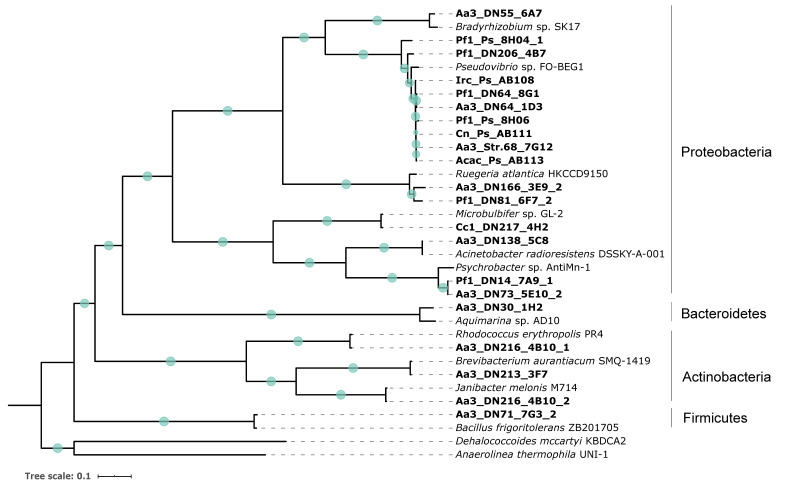
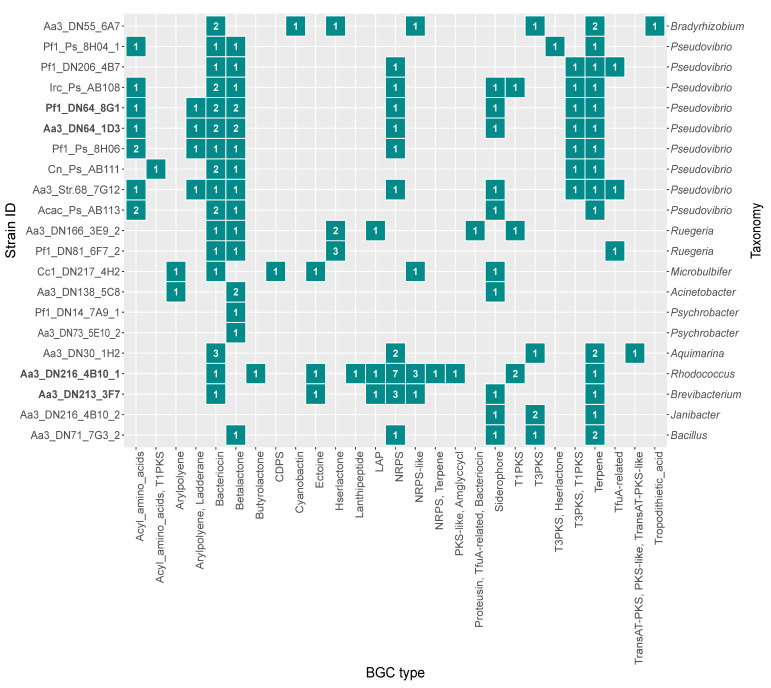
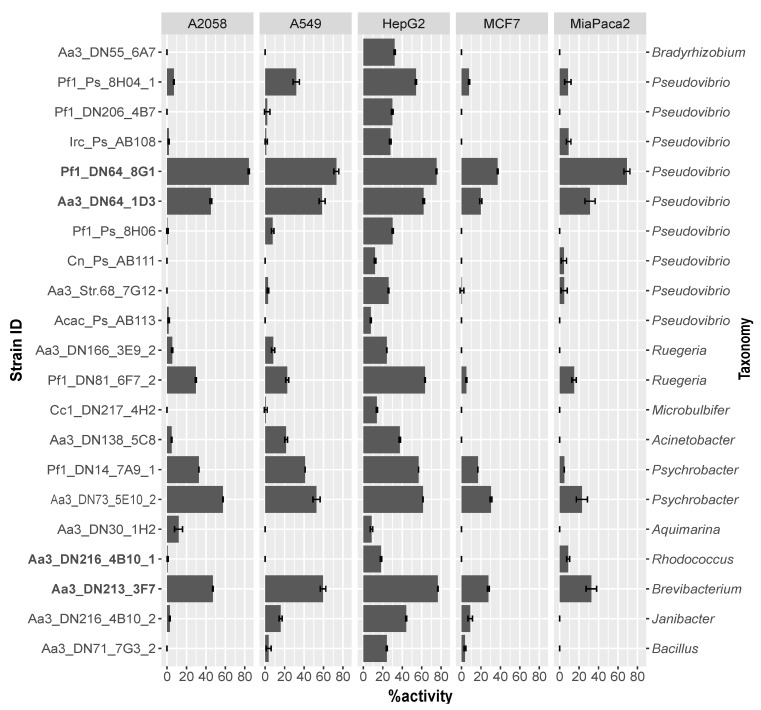
Marine sponges harbor diverse microbial communities that represent a significant source of natural products. In the present study, extracts of 21 sponge-associated bacteria were screened for their antimicrobial and anticancer activity, and their genomes were mined for secondary metabolite biosynthetic gene clusters (BGCs). Phylogenetic analysis assigned the strains to four major phyla in the sponge microbiome, namely Proteobacteria, Actinobacteria, Bacteroidetes, and Firmicutes. Bioassays identified one extract with anti-methicillin-resistant (MRSA) activity, and more than 70% of the total extracts had a moderate to high cytotoxicity. The most active extracts were derived from the Proteobacteria and Actinobacteria, prominent for producing bioactive substances. The strong bioactivity potential of the aforementioned strains was also evident in the abundance of BGCs, which encoded mainly beta-lactones, bacteriocins, non-ribosomal peptide synthetases (NRPS), terpenes, and siderophores. Gene-trait matching was performed for the most active strains, aiming at linking their biosynthetic potential with the experimental results. Genetic associations were established for the anti-MRSA and cytotoxic phenotypes based on the similarity of the detected BGCs with BGCs encoding natural products with known bioactivity. Overall, our study highlights the significance of combining in vitro and in silico approaches in the search of novel natural products of pharmaceutical interest.
海洋海绵蕴藏着多种多样的微生物群落,这些微生物群落是天然产物的重要来源。在本研究中,我们对 21 种海绵相关细菌的提取物进行了筛选,以评估它们的抗菌和抗癌活性,并对其基因组进行了挖掘,以寻找次级代谢产物生物合成基因簇(BGCs)。系统发育分析将这些菌株分配到海绵微生物组的四个主要门,即变形菌门、放线菌门、拟杆菌门和厚壁菌门。生物测定鉴定出一种具有抗耐甲氧西林金黄色葡萄球菌(MRSA)活性的提取物,超过 70%的总提取物具有中度至高度细胞毒性。最活跃的提取物来自变形菌门和放线菌门,这些菌门主要产生生物活性物质。上述菌株具有很强的生物活性潜力,这也体现在 BGCs 的丰富度上,这些 BGCs 编码主要的β-内酰胺、细菌素、非核糖体肽合成酶(NRPS)、萜类和铁载体。我们对最活跃的菌株进行了基因-表型匹配,旨在将它们的生物合成潜力与实验结果联系起来。基于检测到的 BGCs 与具有已知生物活性的天然产物编码 BGCs 的相似性,我们为抗 MRSA 和细胞毒性表型建立了遗传关联。总的来说,我们的研究强调了结合体外和计算方法在寻找具有药物应用潜力的新型天然产物方面的重要性。