Department of Orthopaedics, The Affiliated Hospital of Guizhou Medical University, Guiyang, China.
BMC Musculoskelet Disord. 2021 Feb 11;22(1):174. doi: 10.1186/s12891-021-04043-9.
This study aimed to investigate the effect of abnormal Core binding factor-β expression on proliferation, differentiation and apoptosis of chondrocytes, and elucidate the relationship between Core binding factor-β and osteoarthritis-related markers and degenerative joint disease.
Cartilage tissues, from healthy subjects and patients with osteoarthritis, were collected for histology and expression of Core binding factor-β, MMP-13, IL-1β, COMP, and YKL-40. Human articular chondrocytes were cultured in vitro, and a viral vector was constructed to regulate cellular Core binding factor-β expression. Cellular proliferation and apoptosis were observed, and osteoarthritis-related inflammatory factor expression and cartilage metabolite synthesis assayed.
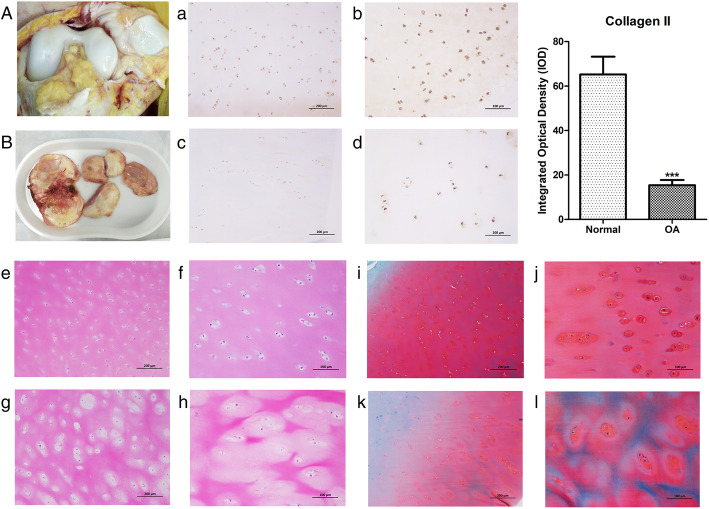
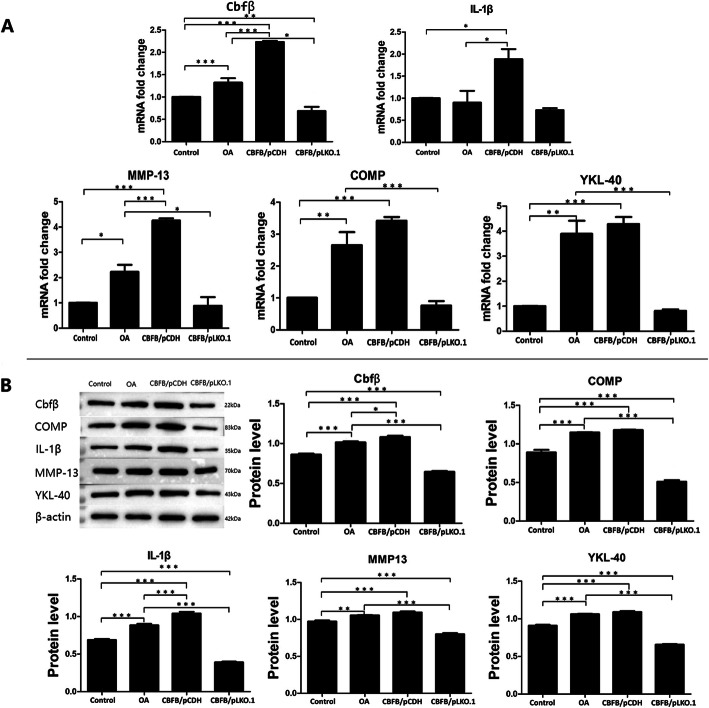
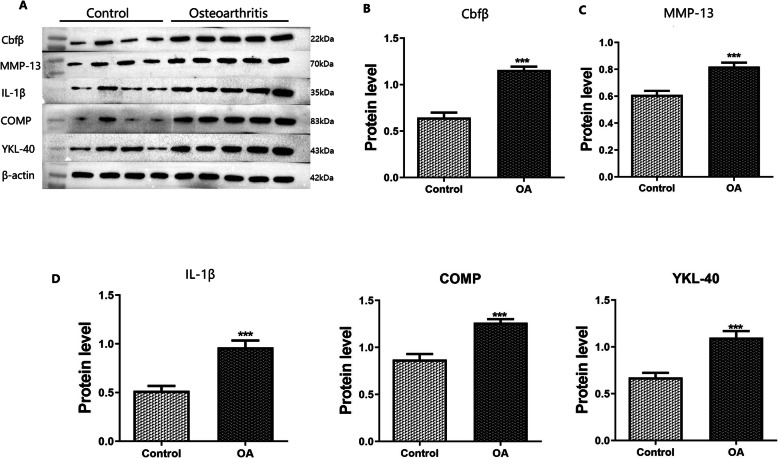
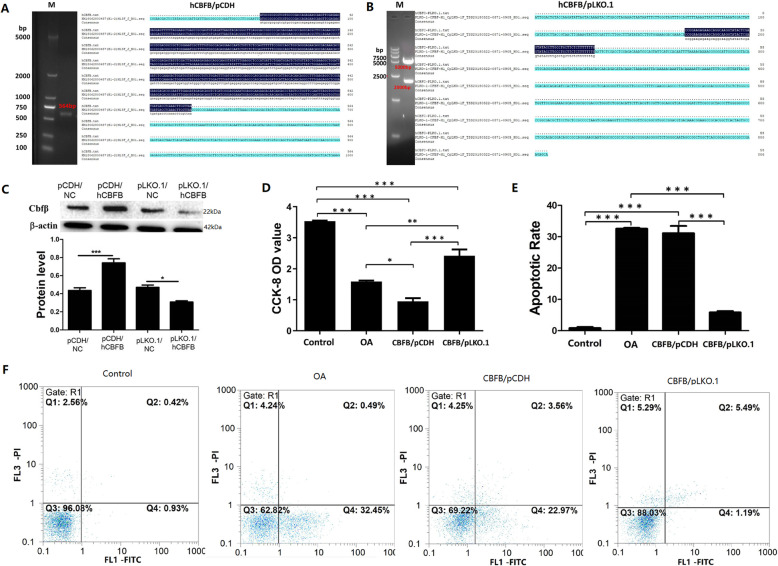
Human osteoarthritis lesions had disordered cartilage structure and cellular arrangement, and increased emptying of cartilage lacunae. Normal cell counts were significantly reduced, cartilage extracellular matrix was obviously damaged, and type II collagen expression was significantly decreased. Core binding factor-β was highly expressed in the osteoarthritis cartilage (p < 0.001), and MMP-13, IL-1β, COMP and YKL-40 expression were greater than found in normal cartilage (p < 0.001). Cellular proliferation in the Core binding factor-β high-expression group was reduced and the total apoptosis rate was increased (p < 0.05), while the opposite was found in the Core binding factor-β inhibition group (p < 0.01). Compared with normal chondrocytes, high Core binding factor-β expression (Osteoarthritis and CBFB/pCDH groups) was associated with significantly increased MMP13, IL-1β, COMP and YKL-40 protein expression (p < 0.01), while Core binding factor-β inhibition (CBFB/pLKO.1 group) was associated with significantly decreased COMP, MMP13, IL-1β and YKL-40 expression in osteoarthritis cells (p < 0.001).
Abnormal Core binding factor-β expression might play an upstream regulatory role in mediating abnormal chondrocyte apoptosis and the inflammatory response. On inhibiting Core binding factor-β expression, a delay in cartilage degeneration was expected.
The study was registered for clinical trials in ChiCTR: ChiCTR1800017066 (Reg. Date-2018/7/10).
本研究旨在探讨核心结合因子-β表达异常对软骨细胞增殖、分化和凋亡的影响,并阐明核心结合因子-β与骨关节炎相关标志物和退行性关节病的关系。
收集健康受试者和骨关节炎患者的软骨组织进行组织学和核心结合因子-β、MMP-13、IL-1β、COMP 和 YKL-40 的表达分析。体外培养人关节软骨细胞,构建病毒载体调节细胞核心结合因子-β表达。观察细胞增殖和凋亡,检测骨关节炎相关炎症因子表达和软骨代谢产物合成。
人骨关节炎病变的软骨结构和细胞排列紊乱,软骨陷窝排空增加。正常细胞计数明显减少,软骨细胞外基质明显受损,II 型胶原表达明显降低。骨关节炎软骨中核心结合因子-β表达升高(p<0.001),MMP-13、IL-1β、COMP 和 YKL-40 的表达均高于正常软骨(p<0.001)。高核心结合因子-β表达组(骨关节炎和 CBFB/pCDH 组)细胞增殖减少,总凋亡率增加(p<0.05),而核心结合因子-β抑制组(CBFB/pLKO.1 组)则相反(p<0.01)。与正常软骨细胞相比,高核心结合因子-β表达(骨关节炎和 CBFB/pCDH 组)与 MMP13、IL-1β、COMP 和 YKL-40 蛋白表达显著增加相关(p<0.01),而核心结合因子-β抑制(CBFB/pLKO.1 组)与骨关节炎细胞中 COMP、MMP13、IL-1β和 YKL-40 表达显著降低相关(p<0.001)。
异常核心结合因子-β表达可能在上游调节软骨细胞凋亡和炎症反应中发挥调控作用。抑制核心结合因子-β表达有望延缓软骨退变。
本研究在中国临床试验注册中心注册,注册号 ChiCTR1800017066(注册日期-2018/7/10)。