Zhang Yan, Chen Huiwen, Wu Jinjin, McVicar Abigail, Chen Yilin, Su Jiacan, Li Yi-Ping, Chen Wei
Department of Pathology, University of Alabama at Birmingham, Birmingham, AL 35294, USA.
Key Laboratory of Biomedical Information Engineering of Ministry of Education, Biomedical Informatics and Genomics Center, School of Life Science and Technology, Xi'an Jiaotong University, Shaanxi, Xi'an 710049, P.R. China.
Int J Biol Sci. 2024 Mar 11;20(6):1965-1977. doi: 10.7150/ijbs.90250. eCollection 2024.
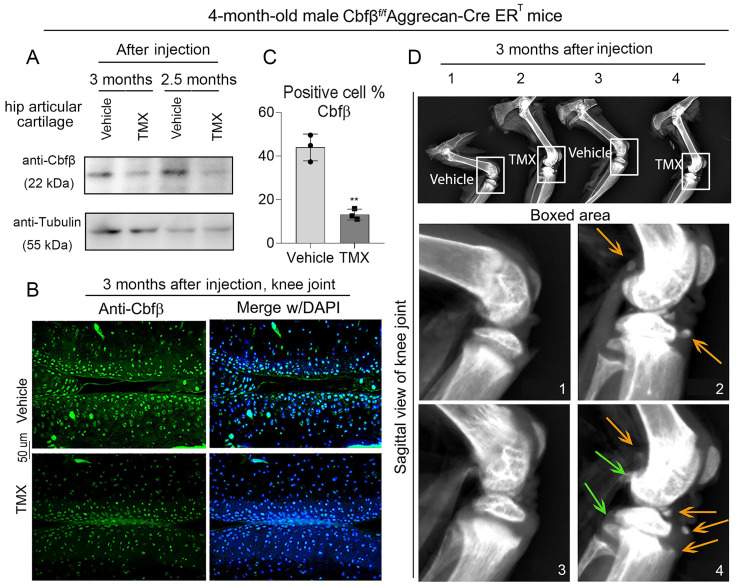
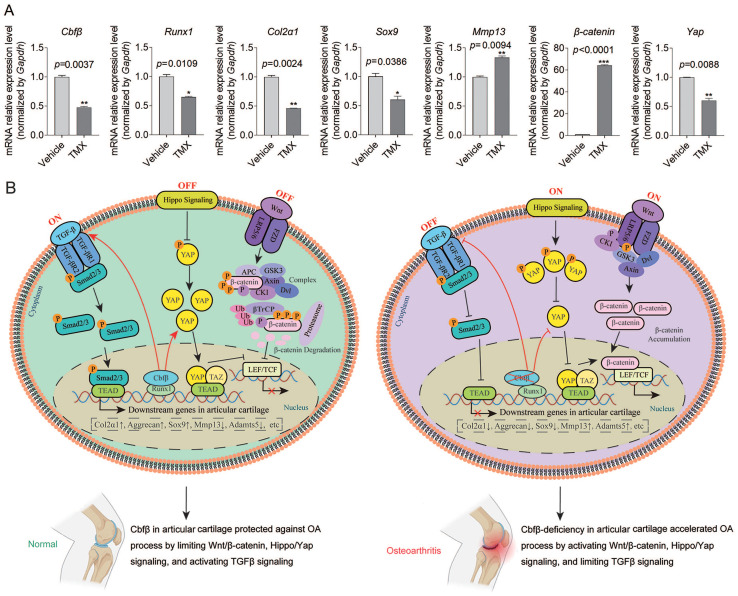
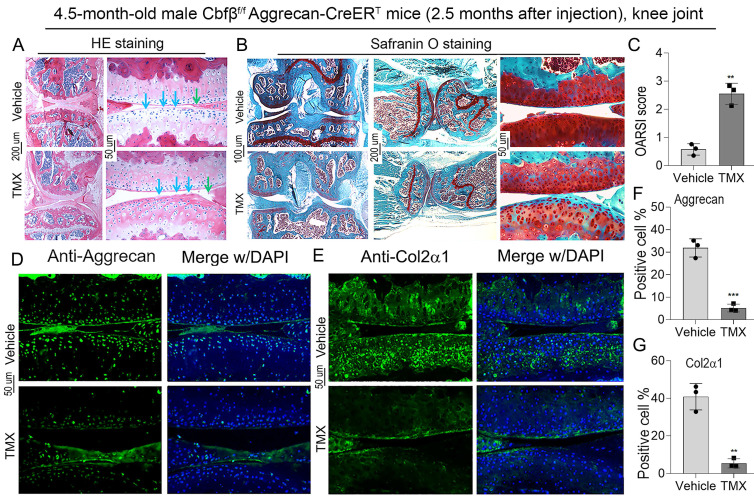
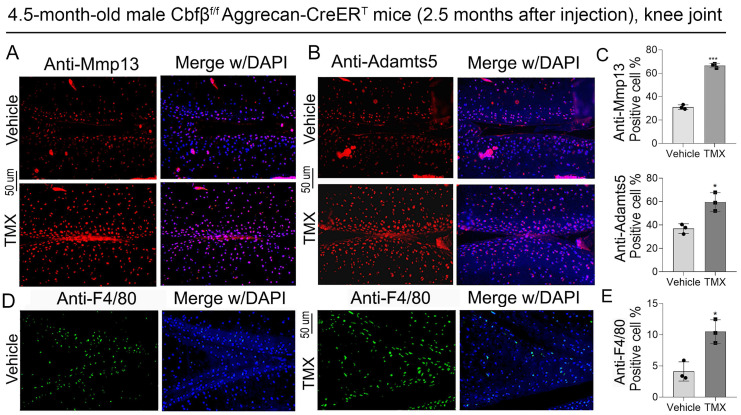
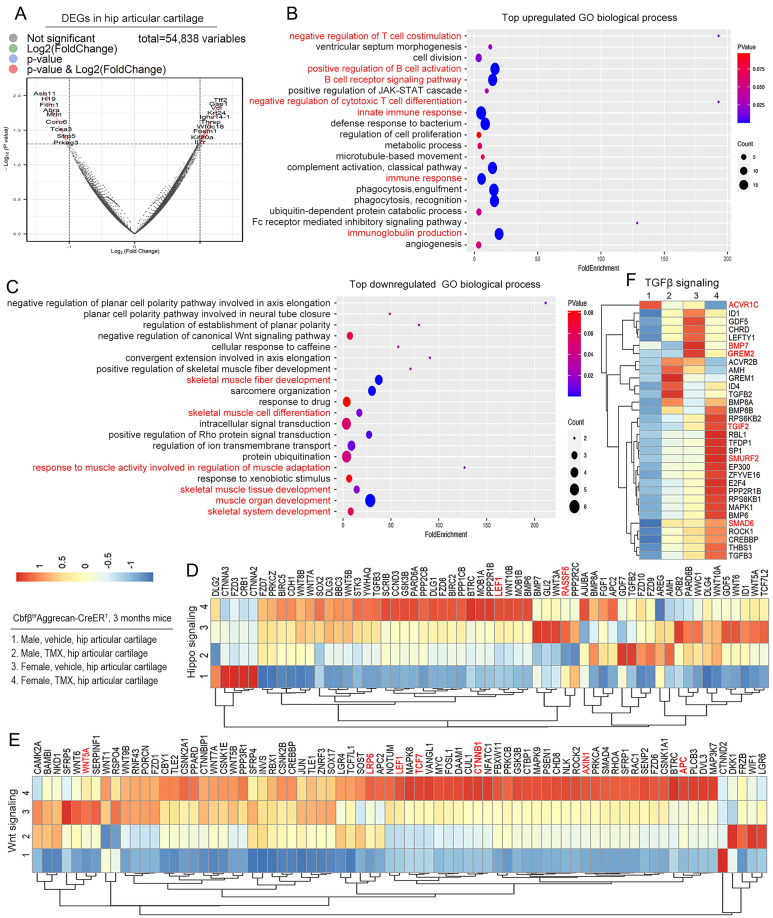
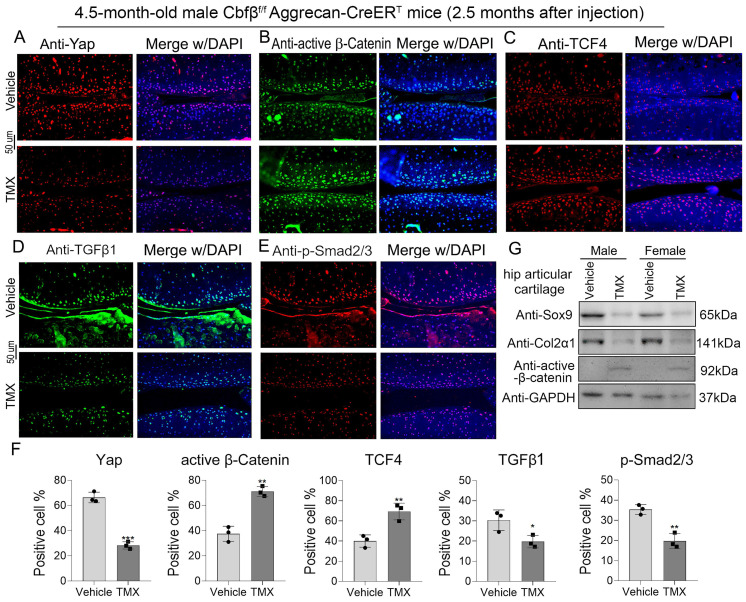
Osteoarthritis (OA) is the most prevalent degenerative joint disorder, causing physical impairments among the elderly. Core binding factor subunit β (Cbfβ) has a critical role in bone homeostasis and cartilage development. However, the function and mechanism of Cbfβ in articular cartilage and OA remains unclear. We found that CbfβAggrecan-CreER mice with Cbfβ-deficiency in articular cartilage developed a spontaneous osteoarthritis-like phenotype with articular cartilage degradation. Immunofluorescence staining showed that CbfβAggrecan-CreER mice exhibited a significant increase in the expression of articular cartilage degradation markers and inflammatory markers in the knee joints. RNA-sequencing analysis demonstrated that Cbfβ orchestrated Hippo/Yap, TGFβ/Smad, and Wnt/β-catenin signaling pathways in articular cartilage, and Cbfβ deficiency resulted in the abnormal expression of downstream genes involved in maintaining articular cartilage homeostasis. Immunofluorescence staining results showed Cbfβ deficiency significantly increased active β-catenin and TCF4 expression while reducing Yap, TGFβ1, and p-Smad 2/3 expression. Western blot and qPCR validated gene expression changes in hip articular cartilage of Cbfβ-deficient mice. Our results demonstrate that deficiency of Cbfβ in articular cartilage leads to an OA-like phenotype via affecting Hippo/Yap, TGFβ, and Wnt/β-catenin signaling pathways, disrupting articular cartilage homeostasis and leading to the pathological process of OA in mice. Our results indicate that targeting Cbfβ may be a potential therapeutic target for the design of novel and effective treatments for OA.
骨关节炎(OA)是最常见的退行性关节疾病,会导致老年人身体功能受损。核心结合因子亚基β(Cbfβ)在骨稳态和软骨发育中起关键作用。然而,Cbfβ在关节软骨和OA中的功能及机制仍不清楚。我们发现,关节软骨中缺乏Cbfβ的CbfβAggrecan-CreER小鼠出现了自发性骨关节炎样表型,伴有关节软骨退化。免疫荧光染色显示,CbfβAggrecan-CreER小鼠膝关节中关节软骨降解标志物和炎症标志物的表达显著增加。RNA测序分析表明,Cbfβ在关节软骨中调控Hippo/Yap、TGFβ/Smad和Wnt/β-连环蛋白信号通路,Cbfβ缺乏导致参与维持关节软骨稳态的下游基因异常表达。免疫荧光染色结果显示,Cbfβ缺乏显著增加了活性β-连环蛋白和TCF4的表达,同时降低了Yap、TGFβ1和p-Smad 2/3的表达。蛋白质免疫印迹和定量聚合酶链反应验证了Cbfβ缺陷小鼠髋关节软骨中的基因表达变化。我们的结果表明,关节软骨中Cbfβ的缺乏通过影响Hippo/Yap、TGFβ和Wnt/β-连环蛋白信号通路,破坏关节软骨稳态,导致小鼠OA的病理过程。我们的结果表明,靶向Cbfβ可能是设计新型有效OA治疗方法的潜在治疗靶点。