Salvado Rita, Santos-Minguez Sandra, Agudo-Conde Cristina, Lugones-Sanchez Cristina, Cabo-Laso Angela, Mª Hernandez-Sanchez Jesus, Benito Rocio, Rodriguez-Sanchez Emiliano, Gomez-Marcos Manuel A, Hernandez-Rivas Jesus M, Guimarães Cunha Pedro, Garcia-Ortiz Luis, Investigators Mivas
Primary Health Care Research Unit of Salamanca (APISAL), Health Service of Castilla y León (SACyL), Institute for Biomedical Research of Salamanca (IBSAL), Salamanca, Castilla y León, Spain
Institute of Molecular and Cellular Biology of Cancer (IBMCC), Cancer Research Institute (USAL-CSIC), Institute for Biomedical Research of Salamanca (IBSAL), Salamanca, Castilla y León, Spain.
BMJ Open. 2021 Feb 11;11(2):e038933. doi: 10.1136/bmjopen-2020-038933.
Intestinal microbiota is arising as a new element in the physiopathology of cardiovascular diseases. A healthy microbiota includes a balanced representation of bacteria with health promotion functions (symbiotes). The aim of this study is to analyse the relationship between intestinal microbiota composition and arterial stiffness.
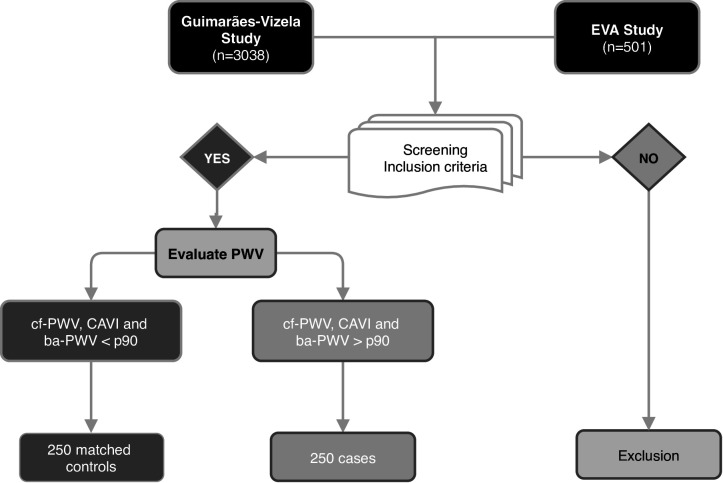
An observational case-control study will be developed. Cases will be defined by the presence of at least one of the following: carotid-femoral pulse wave velocity (cf-PWV), Cardio-Ankle Vascular Index (CAVI), brachial ankle pulse wave velocity (ba or ba-PWV) above the 90 percentile, for age and sex, of the reference population. Controls will be selected from the same population as cases. The study will be developed in Primary Healthcare Centres. We will select 500 subjects (250 cases and 250 controls), between 45 and 74 years of age. Cases will be selected from a database that combines data from EVA study (Spain) and Guimarães/Vizela study (Portugal).
cf-PWV will be measured using the SphygmoCor system, CAVI, ba-PWV and Ankle-Brachial Index will be determined using VaSera device. Gut microbiome composition in faecal samples will be determined by 16S ribosomal RNA sequencing. Lifestyle will be assessed by food frequency questionnaire, adherence to the Mediterranean diet and IPAQ (International Physical Activity Questionnaire). Body composition will be evaluated by bioimpedance.
The study has been approved by 'Committee of ethics of research with medicines of the health area of Salamanca' on 14 December 2018 (cod. 2018-11-136) and the 'Ethics committee for health of Guimaraes' (Portugal) on 15 October 2019 (ref: 67/2019). All study participants will sign an informed consent form agreeing to participate in the study, in compliance with the Declaration of Helsinki and the WHO standards for observational studies. The results of this study will allow a better description of gut microbiota in patients with arterial stiffness.
ClinicalTrials.gov, identifier NCT03900338.
肠道微生物群正成为心血管疾病病理生理学中的一个新因素。健康的微生物群包括具有促进健康功能的细菌(共生菌)的平衡代表。本研究的目的是分析肠道微生物群组成与动脉僵硬度之间的关系。
将开展一项观察性病例对照研究。病例将由以下至少一项指标来定义:颈动脉 - 股动脉脉搏波速度(cf-PWV)、心踝血管指数(CAVI)、肱踝脉搏波速度(ba或ba-PWV)高于参考人群年龄和性别的第90百分位数。对照将从与病例相同的人群中选取。该研究将在初级医疗保健中心开展。我们将选取500名年龄在45至74岁之间的受试者(250例病例和250例对照)。病例将从一个结合了西班牙EVA研究和葡萄牙吉马良斯/维泽拉研究数据的数据库中选取。
cf-PWV将使用SphygmoCor系统进行测量,CAVI、ba-PWV和踝臂指数将使用VaSera设备进行测定。粪便样本中的肠道微生物群组成将通过16S核糖体RNA测序来确定。生活方式将通过食物频率问卷、对地中海饮食的依从性以及国际体力活动问卷(IPAQ)进行评估。身体成分将通过生物阻抗进行评估。
该研究于2018年12月14日获得“萨拉曼卡健康领域药物研究伦理委员会”(编号2018 - 11 - 136)以及2019年10月15日“吉马良斯健康伦理委员会”(葡萄牙,编号:67/2019)的批准。所有研究参与者将签署知情同意书,同意参与该研究,符合《赫尔辛基宣言》和世界卫生组织观察性研究标准。本研究结果将有助于更好地描述动脉僵硬度患者的肠道微生物群。
ClinicalTrials.gov,标识符NCT03900338。