Department of Chemistry "G. Ciamician", University of Bologna, via Selmi 2, 40126, Bologna, Italy.
Department of History and Cultures, University of Bologna, 40124, Bologna, Italy.
Sci Rep. 2021 Feb 11;11(1):3650. doi: 10.1038/s41598-021-82831-y.
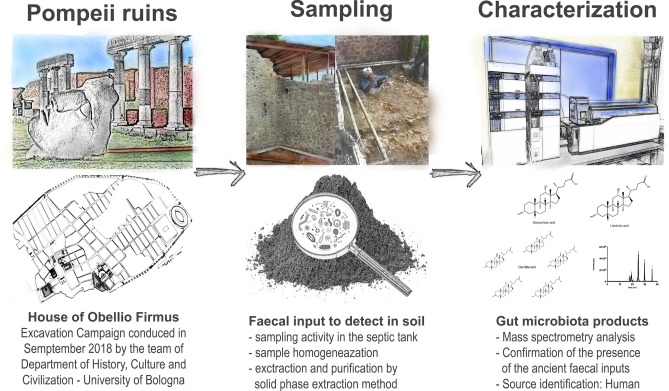
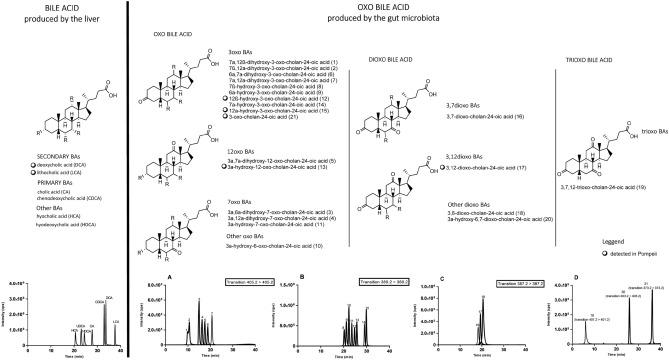
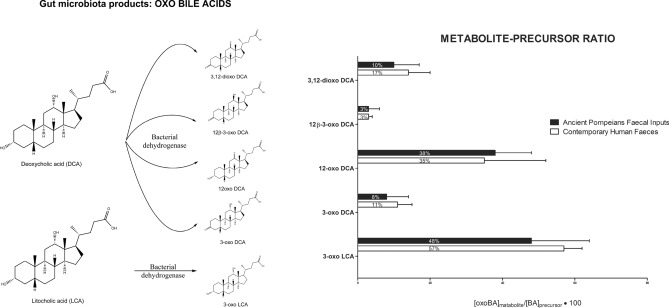
Small organic molecules, lipids, proteins, and DNA fragments can remain stable over centuries. Powerful and sensitive chemical analysis can therefore be used to characterize ancient remains for classical archaeological studies. This bio-ecological dimension of archaeology can contribute knowledge about several aspects of ancient life, including social organization, daily habits, nutrition, and food storage. Faecal remains (i.e. coprolites) are particularly interesting in this regard, with scientists seeking to identify new faecal markers. Here, we report the analysis of faecal samples from modern-day humans and faecal samples from a discharge pit on the site of the ruins of ancient Pompeii. We propose that bile acids and their gut microbiota oxo-metabolites are the most specific steroid markers for detecting faecal inputs. This is due to their extreme chemical stability and their exclusive occurrence in vertebrate faeces, compared to other ubiquitous sterols and steroids.
小有机分子、脂质、蛋白质和 DNA 片段可以在数百年内保持稳定。因此,强大而敏感的化学分析可用于对古代遗骸进行特征分析,以进行经典的考古学研究。考古学的这种生物生态学维度可以为古代生活的多个方面提供知识,包括社会组织、日常习惯、营养和食物储存。在这方面,粪便(即粪化石)特别有趣,科学家们试图确定新的粪便标志物。在这里,我们报告了对现代人类粪便样本和庞贝古城遗址排泄坑中粪便样本的分析。我们提出胆汁酸及其肠道微生物群的氧化代谢物是检测粪便输入的最特异的甾体标志物。这是因为与其他普遍存在的甾醇和类固醇相比,它们具有极端的化学稳定性和在脊椎动物粪便中的排他性。