Molecular Biology and Microbial Food Safety Group, Swammerdam Institute for Life Sciences, Faculty of Science, University of Amsterdam, Amsterdam, The Netherlands.
Computational Intelligence Group, Department of Computer Science, Faculty of Science, Vrije Universiteit Amsterdam, Amsterdam, The Netherlands.
Sci Rep. 2021 Feb 11;11(1):3640. doi: 10.1038/s41598-021-83229-6.
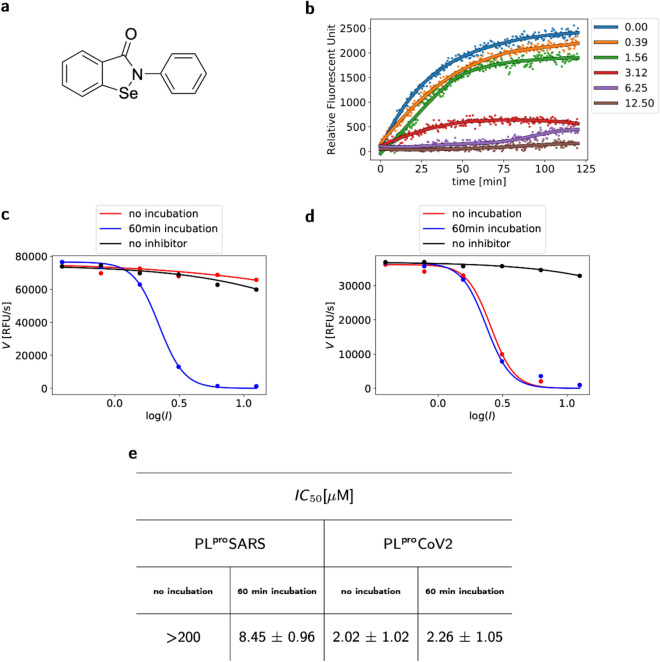
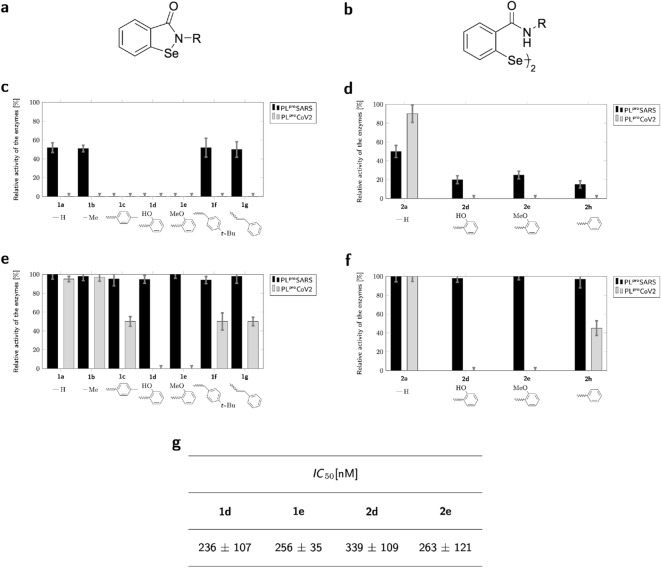
An efficient treatment against a COVID-19 disease, caused by the novel coronavirus SARS-CoV-2 (CoV2), remains a challenge. The papain-like protease (PL) from the human coronavirus is a protease that plays a critical role in virus replication. Moreover, CoV2 uses this enzyme to modulate the host's immune system to its own benefit. Therefore, it represents a highly promising target for the development of antiviral drugs. We used Approximate Bayesian Computation tools, molecular modelling and enzyme activity studies to identify highly active inhibitors of the PL. We discovered organoselenium compounds, ebselen and its structural analogues, as a novel approach for inhibiting the activity of PLCoV2. Furthermore, we identified, for the first time, inhibitors of PLCoV2 showing potency in the nanomolar range. Moreover, we found a difference between PL from SARS and CoV2 that can be correlated with the diverse dynamics of their replication, and, putatively to disease progression.
针对由新型冠状病毒 SARS-CoV-2(CoV2)引起的 COVID-19 疾病,目前仍缺乏有效的治疗方法。来自人类冠状病毒的木瓜蛋白酶样蛋白酶(PL)是一种在病毒复制过程中发挥关键作用的蛋白酶。此外,CoV2 利用这种酶来调节宿主的免疫系统,使其受益。因此,它代表了开发抗病毒药物的极具前景的靶标。我们使用近似贝叶斯计算工具、分子建模和酶活性研究来鉴定 PL 的高活性抑制剂。我们发现有机硒化合物,如 ebselen 及其结构类似物,是抑制 PLCoV2 活性的一种新方法。此外,我们首次鉴定出具有纳摩尔效力的 PLCoV2 抑制剂。此外,我们发现 SARS 的 PL 和 CoV2 之间的差异,这可能与它们复制的不同动态相关,并且推测与疾病进展相关。