Department of Cardiothoracic Surgery, University of Pittsburgh School of Medicine, Pittsburgh, PA, USA.
Department of Surgery, University of Pittsburgh School of Medicine, Pittsburgh, PA, USA.
Ann Surg Oncol. 2021 May;28(5):2715-2727. doi: 10.1245/s10434-020-09477-4. Epub 2021 Feb 11.
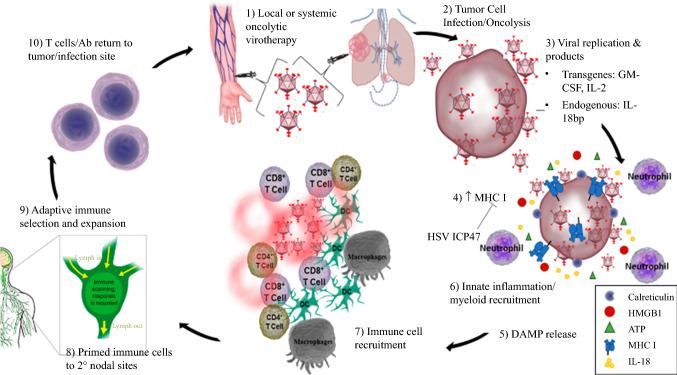
Thoracic malignancies are associated with high mortality rates. Conventional therapy for many of the patients with thoracic malignancies is obviated by a high incidence of locoregional recurrence and distant metastasis. Fortunately, developments in immunotherapy provide effective strategies for both local and systemic treatments that have rapidly advanced during the last decade. One promising approach to cancer immunotherapy is to use oncolytic viruses, which have the advantages of relatively high tumor specificity, selective replication-mediated oncolysis, enhanced antigen presentation, and potential for delivery of immunogenic payloads such as cytokines, with subsequent elicitation of effective antitumor immunity. Several oncolytic viruses including adenovirus, coxsackievirus B3, herpes virus, measles virus, reovirus, and vaccinia virus have been developed and applied to thoracic cancers in preclinical murine studies and clinical trials. This review discusses the current state of oncolytic virotherapy in lung cancer, esophageal cancer, and metastatic malignant pleural effusions and considers its potential as an emergent therapeutic for these patients.
胸部恶性肿瘤与高死亡率相关。对于许多患有胸部恶性肿瘤的患者,局部复发和远处转移的高发生率使得常规治疗方法变得无效。幸运的是,免疫疗法的发展为局部和全身治疗提供了有效的策略,在过去十年中迅速发展。癌症免疫疗法的一种有前途的方法是使用溶瘤病毒,它具有相对较高的肿瘤特异性、选择性复制介导的溶瘤作用、增强的抗原呈递作用以及传递免疫原性有效载荷(如细胞因子)的潜力,随后引发有效的抗肿瘤免疫。已经开发并应用了几种溶瘤病毒,包括腺病毒、柯萨奇病毒 B3、疱疹病毒、麻疹病毒、呼肠孤病毒和牛痘病毒,用于肺癌、食管癌和转移性恶性胸腔积液的临床前小鼠研究和临床试验。本文讨论了溶瘤病毒治疗在肺癌、食管癌和转移性恶性胸腔积液中的现状,并考虑了其作为这些患者的新兴治疗方法的潜力。