549350GlaxoSmithKline (GSK), Nonclinical Safety, Collegeville, PA, USA.
Cellular and Molecular Pathology Branch, National Toxicology Program (NTP), 6857National Institute of Environmental Health Sciences, National Institutes of Health, Research Triangle Park, NC, USA.
Toxicol Pathol. 2021 Jul;49(5):996-1023. doi: 10.1177/0192623320985045. Epub 2021 Feb 12.
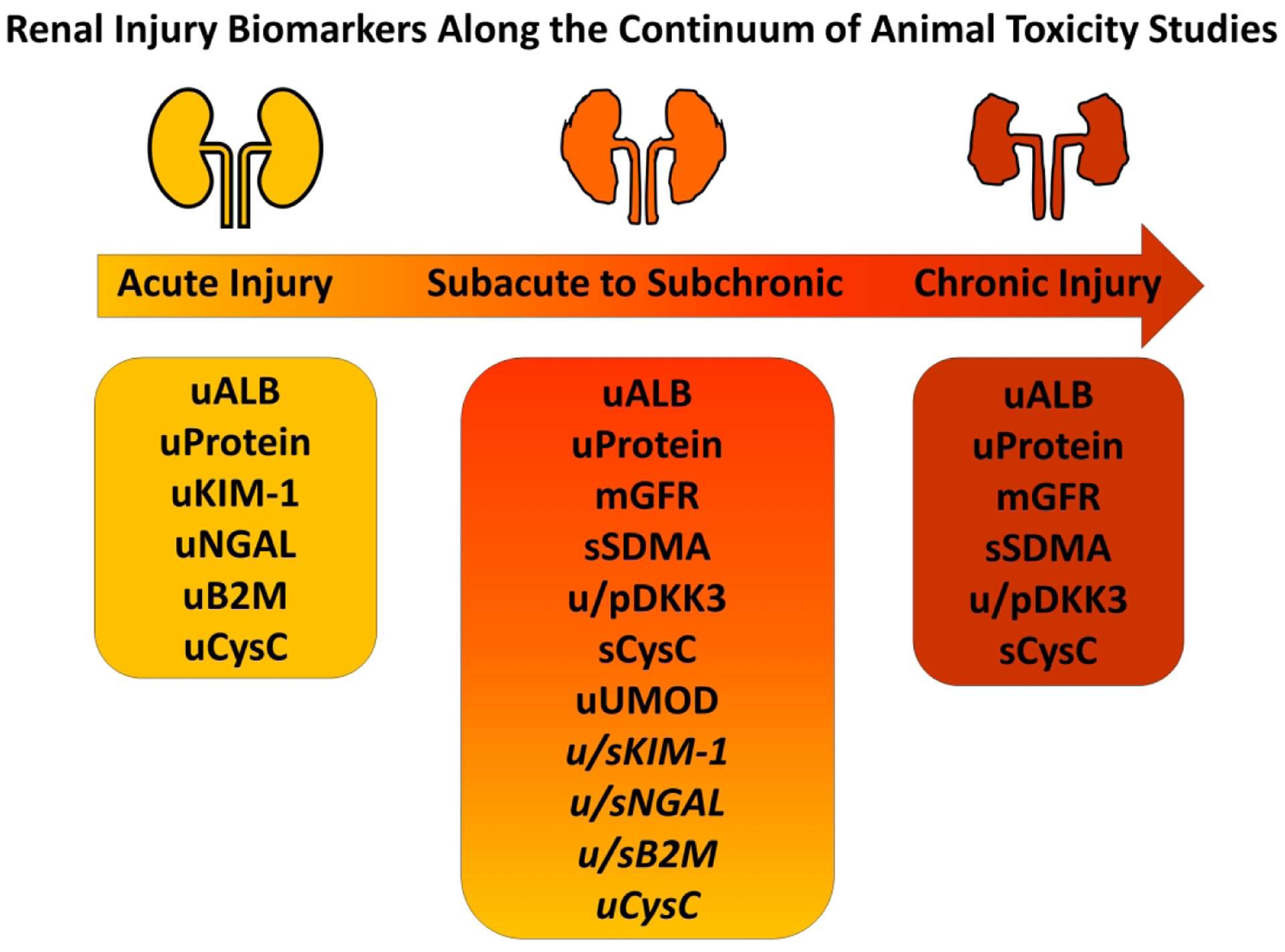
A host of novel renal biomarkers have been developed over the past few decades which have enhanced monitoring of renal disease and drug-induced kidney injury in both preclinical studies and in humans. Since chronic kidney disease (CKD) and acute kidney injury (AKI) share similar underlying mechanisms and the tubulointerstitial compartment has a functional role in the progression of CKD, urinary biomarkers of AKI may provide predictive information in chronic renal disease. Numerous studies have explored whether the recent AKI biomarkers could improve upon the standard clinical biomarkers, estimated glomerular filtration rate (eGFR), and urinary albumin to creatinine ratio, for predicting outcomes in CKD patients. This review is an introduction to alternative assays that can be utilized in chronic (>3 months duration) nonclinical safety studies to provide information on renal dysfunction and to demonstrate specific situations where these assays could be utilized in nonclinical drug development. Novel biomarkers such as symmetrical dimethyl arginine, dickkopf homolog 3, and cystatin C predict chronic renal injury in animals, act as surrogates for GFR, and may predict changes in GFR in patients over time, ultimately providing a bridge from preclinical to clinical renal monitoring.
在过去的几十年中,已经开发出了许多新型的肾脏生物标志物,这增强了对临床前研究和人类的肾脏疾病和药物引起的肾损伤的监测。由于慢性肾脏病(CKD)和急性肾损伤(AKI)具有相似的潜在机制,并且肾小管间质在 CKD 的进展中具有功能作用,因此 AKI 的尿生物标志物可能为慢性肾脏病的预后提供预测信息。许多研究都探讨了最近的 AKI 生物标志物是否可以改善标准的临床生物标志物,即肾小球滤过率估计值(eGFR)和尿白蛋白/肌酐比值,以预测 CKD 患者的结局。这篇综述介绍了替代测定法,这些方法可用于慢性(>3 个月)临床前安全性研究,以提供肾功能障碍信息,并证明在非临床药物开发中可以利用这些测定法的特定情况。新型生物标志物,如对称二甲基精氨酸、Dickkopf 同源物 3 和胱抑素 C,可以预测动物的慢性肾损伤,作为 GFR 的替代物,并且可能随时间预测患者的 GFR 变化,最终为临床前和临床肾脏监测提供了桥梁。