Ykema Berbel L M, Bisseling Tanya M, Spaander Manon C W, Moons Leon M G, van der Biessen-van Beek Dorien, Saveur Lisette, Kerst Martijn, Mulder Sasja F, de Wit Ronald, Zweers Danielle, Meijer Gerrit A, Beijnen Jos H, Lansdorp-Vogelaar Iris, van Leeuwen Flora E, Snaebjornsson Petur, van Leerdam Monique E
Department of Gastroenterology and Hepatology, Netherlands Cancer Institute, Plesmanlaan 121, 1066 CX, Amsterdam, The Netherlands.
Department of Gastroenterology and Hepatology, Radboud University Medical Center, Nijmegen, The Netherlands.
BMC Gastroenterol. 2021 Feb 12;21(1):67. doi: 10.1186/s12876-021-01639-2.
Testicular cancer (TC) survivors have an increased risk of various second primary malignancies. A recent cohort study detected an increased risk of colorectal cancer (CRC) in TC survivors treated with platinum-based chemotherapy with a hazard ratio of 3.9. CRC risk increased with higher cisplatin-dose. We know that colonoscopy surveillance in high-risk populations results in reduced incidence and mortality of CRC. TC survivors treated with platinum-based chemotherapy can potentially benefit from colonoscopy surveillance; however, to which extent is unknown. Furthermore, the pathogenesis of these secondary CRCs is unknown, and better insights into the carcinogenesis may affect surveillance decisions.
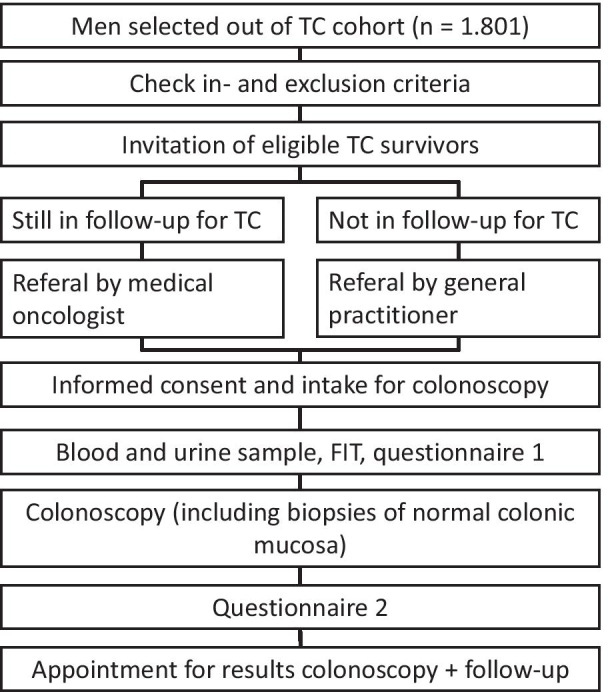
This prospective multicenter study will be performed in four Dutch hospitals. TC survivors are eligible if treated with ≥ 3 cycles of cisplatin before age 50. Colonoscopy will be performed ≥ 8 years after initial treatment (minimum and maximum ages at colonoscopy, 35 and 75 years, respectively). The primary aim of the study is the diagnostic yield of advanced neoplasia detected during colonoscopy. As secondary aim, we will evaluate the molecular profile of advanced colorectal neoplasia and will assess current platinum levels in blood and urine and correlate blood-platinum levels with prevalence of colorectal lesions. Furthermore, we will investigate effectiveness of fecal immunochemical testing (FIT) and burden of colonoscopy by two questionnaires. Demographic data, previous history, results of colonoscopy, hemoglobin level of FIT and results of molecular and platinum levels will be obtained. Yield of colonoscopy will be determined by detection rate of adenoma and serrated lesions, advanced adenoma detection rate and CRC detection rate. The MISCAN model will be used for cost-effectiveness analyses of CRC surveillance. With 234 participants undergoing colonoscopy, we can detect an absolute difference of 6% of advanced neoplasia with 80% power.
TC survivors treated with cisplatin-based chemotherapy can benefit from CRC surveillance. Evaluation of the diagnostic performance and patient acceptance of CRC surveillance is of importance to develop surveillance recommendations. Insight into the carcinogenesis of cisplatin-related advanced colorectal lesions will contribute to CRC prevention in the increasing number of TC survivors. The results may also be important for the many other cancer survivors treated with platinum-based chemotherapy.
Clinical Trials: NCT04180033, November 27, 2019, https://clinicaltrials.gov/ct2/show/NCT04180033 .
睾丸癌(TC)幸存者患各种第二原发性恶性肿瘤的风险增加。最近一项队列研究发现,接受铂类化疗的TC幸存者患结直肠癌(CRC)的风险增加,风险比为3.9。CRC风险随顺铂剂量增加而升高。我们知道,对高危人群进行结肠镜监测可降低CRC的发病率和死亡率。接受铂类化疗的TC幸存者可能会从结肠镜监测中获益;然而,获益程度尚不清楚。此外,这些继发性CRC的发病机制尚不清楚,对致癌作用有更深入的了解可能会影响监测决策。
这项前瞻性多中心研究将在四家荷兰医院进行。如果在50岁之前接受≥3个周期顺铂治疗的TC幸存者符合条件。结肠镜检查将在初始治疗≥8年后进行(结肠镜检查的最小和最大年龄分别为35岁和75岁)。该研究的主要目的是结肠镜检查期间检测到的高级别瘤变的诊断率。作为次要目的,我们将评估高级别结直肠瘤变的分子特征,并评估血液和尿液中当前的铂水平,并将血铂水平与结直肠病变的患病率相关联。此外,我们将通过两份问卷调查粪便免疫化学检测(FIT)的有效性和结肠镜检查的负担。将获取人口统计学数据、既往史、结肠镜检查结果、FIT血红蛋白水平以及分子和铂水平的结果。结肠镜检查的检出率将由腺瘤和锯齿状病变的检出率、高级别腺瘤检出率和CRC检出率来确定。MISCAN模型将用于CRC监测的成本效益分析。通过234名接受结肠镜检查的参与者,我们可以以80%的把握度检测到高级别瘤变6%的绝对差异。
接受铂类化疗的TC幸存者可从CRC监测中获益。评估CRC监测的诊断性能和患者接受度对于制定监测建议很重要。深入了解顺铂相关的高级别结直肠病变的致癌作用将有助于预防越来越多的TC幸存者患CRC。研究结果对于许多其他接受铂类化疗的癌症幸存者也可能很重要。
临床试验:NCT04180033,2019年11月27日,https://clinicaltrials.gov/ct2/show/NCT04180033 。