College of Animal Science and Technology, Yunnan Agricultural University, Kunming, 650201, China.
Yunnan Academy of Grassland and Animal Science, Kunming, 650212, China.
BMC Vet Res. 2021 Feb 12;17(1):74. doi: 10.1186/s12917-021-02762-8.
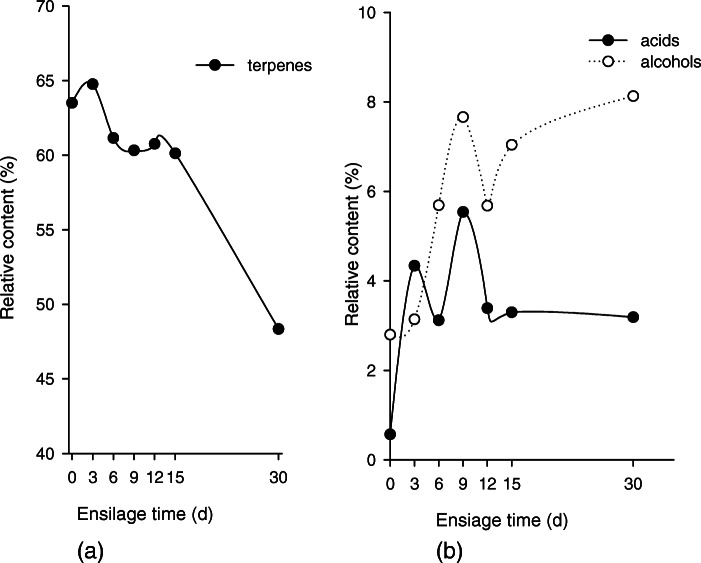
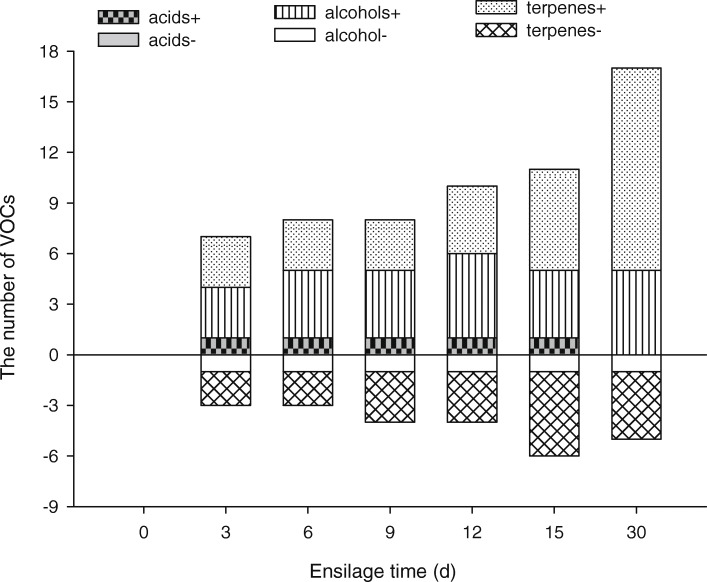
Marigold (Tagetes erecta L) accounts for over half of the world's loose flower production, and marigold crop residue (MCR) are abundantly available and should be used as a forage. In this study, MCR from the last commercial flower pickings was ensilaged with lactic acid bacteria (LAB) and the shift in their volatile organic compounds (VOCs) profiles was monitored. Samples were collected at 6 different times during ensilage (3, 6, 9, 12, 15, 30 days) to determine and quantify the VOCs changes using a solid-phase microextraction (SPME) technique and gas chromatography - mass spectrometry (GC-MS).
After 30 days, the caryophyllene and piperitone, which account for 14.7 and 12.1% of total VOCs, decreased by 32.9 and 9.6% respectively, alcohols increased from 2.8 to 8.1%, and the acetic acid content increased by 560%.
We have confirmed LAB can degrade the content of terpenes and enhance the content of alcohols and acids in MCR, which was for the first time on terpene degradation in fodder by ensilage. These results have shed light on our understanding of how to improve fodder odor and to enhance terpene degradation by lactic acid bacteria fermentation.
万寿菊(Tagetes erecta L)占世界散花产量的一半以上,万寿菊作物残茬(MCR)大量存在,应该作为饲料使用。在这项研究中,用乳酸菌(LAB)对最后一次商业采摘的万寿菊作物残茬进行青贮,监测其挥发性有机化合物(VOCs)谱的变化。在青贮过程中(3、6、9、12、15、30 天)的 6 个不同时间点采集样品,使用固相微萃取(SPME)技术和气相色谱-质谱联用(GC-MS)来确定和量化 VOCs 的变化。
30 天后,占总 VOCs 14.7%和 12.1%的石竹烯和胡椒酮分别减少了 32.9%和 9.6%,醇类从 2.8%增加到 8.1%,乙酸含量增加了 560%。
我们已经证实,LAB 可以降解萜烯的含量,并增加 MCR 中醇类和酸类的含量,这是首次在青贮饲料中对萜烯降解进行研究。这些结果有助于我们理解如何改善饲料气味,并通过乳酸菌发酵增强萜烯的降解。