School of Biological Sciences, University of Auckland, Auckland, New Zealand.
School of Biological Sciences, University of Edinburgh, Edinburgh, UK.
Nat Commun. 2021 Feb 12;12(1):1002. doi: 10.1038/s41467-021-21191-7.
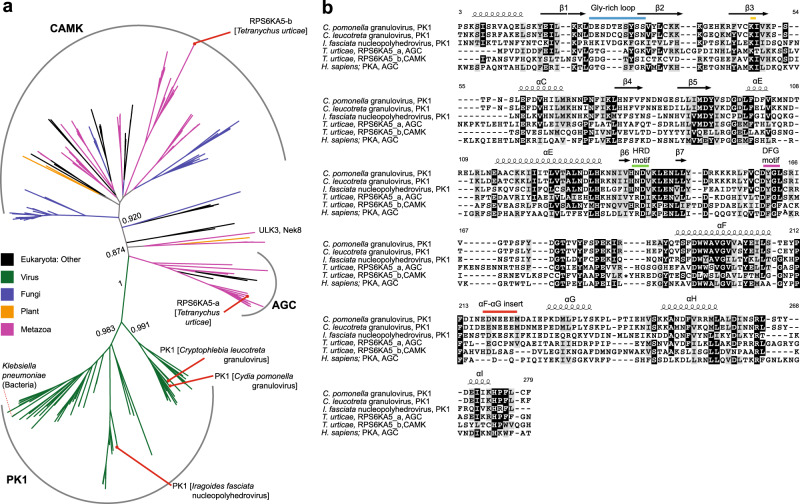
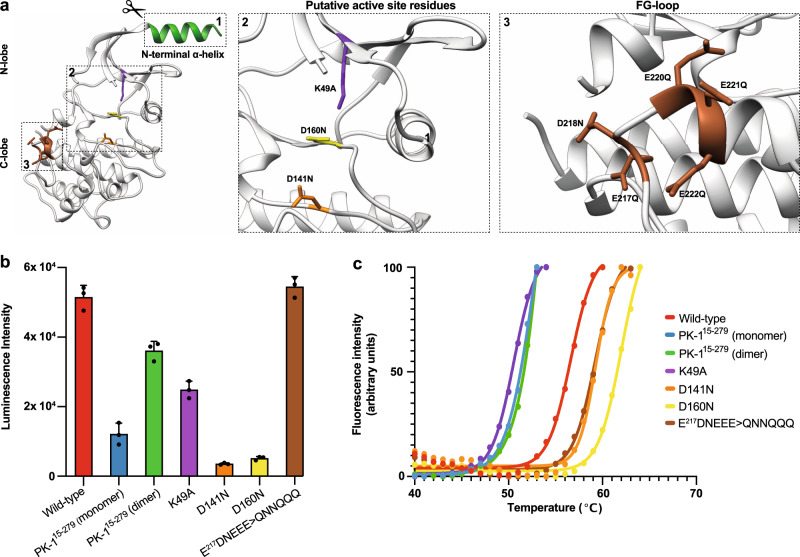
The life cycle of Baculoviridae family insect viruses depends on the viral protein kinase, PK-1, to phosphorylate the regulatory protein, p6.9, to induce baculoviral genome release. Here, we report the crystal structure of Cydia pomenella granulovirus PK-1, which, owing to its likely ancestral origin among host cell AGC kinases, exhibits a eukaryotic protein kinase fold. PK-1 occurs as a rigid dimer, where an antiparallel arrangement of the αC helices at the dimer core stabilizes PK-1 in a closed, active conformation. Dimerization is facilitated by C-lobe:C-lobe and N-lobe:N-lobe interactions between protomers, including the domain-swapping of an N-terminal helix that crowns a contiguous β-sheet formed by the two N-lobes. PK-1 retains a dimeric conformation in solution, which is crucial for catalytic activity. Our studies raise the prospect that parallel, side-to-side dimeric arrangements that lock kinase domains in a catalytically-active conformation could function more broadly as a regulatory mechanism among eukaryotic protein kinases.
杆状病毒科昆虫病毒的生命周期依赖于病毒蛋白激酶 PK-1 将调节蛋白 p6.9 磷酸化,从而诱导杆状病毒基因组的释放。在这里,我们报告了 Cydia pomenella 颗粒体病毒 PK-1 的晶体结构,由于其可能起源于宿主细胞 AGC 激酶,因此表现出真核蛋白激酶折叠。PK-1 以刚性二聚体的形式存在,二聚体核心处的 αC 螺旋的反平行排列将 PK-1 稳定在封闭的活性构象中。通过亚基之间的 C- lobe:C- lobe 和 N- lobe:N- lobe 相互作用促进二聚化,包括在两个 N- lobe 形成的连续 β- 片层上形成冠的 N- 末端螺旋的结构域交换。PK-1 在溶液中保持二聚体构象,这对催化活性至关重要。我们的研究提出了这样一种可能性,即平行的、侧向二聚体排列将激酶结构域锁定在催化活性构象中,可能更广泛地作为真核蛋白激酶之间的一种调节机制。