Dellazizzo Laura, Potvin Stéphane, Phraxayavong Kingsada, Dumais Alexandre
Research center of the Institut Universitaire en Santé Mentale de Montréal, Montreal, Canada.
Department of Psychiatry and addictology, Faculty of Medicine, University of Montreal, Montreal, Canada.
NPJ Schizophr. 2021 Feb 12;7(1):9. doi: 10.1038/s41537-021-00139-2.
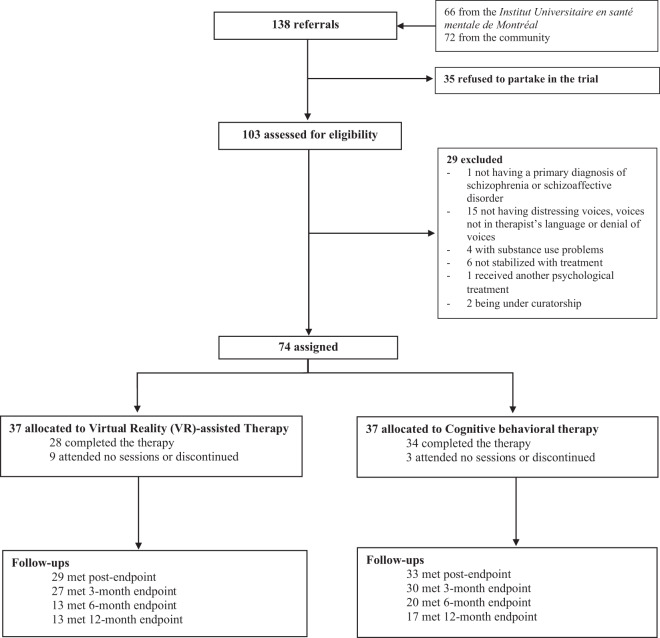
The gold-standard cognitive-behavioral therapy (CBT) for psychosis offers at best modest effects. With advances in technology, virtual reality (VR) therapies for auditory verbal hallucinations (AVH), such as AVATAR therapy (AT) and VR-assisted therapy (VRT), are amid a new wave of relational approaches that may heighten effects. Prior trials have shown greater effects of these therapies on AVH up to a 24-week follow-up. However, no trial has compared them to a recommended active treatment with a 1-year follow-up. We performed a pilot randomized comparative trial evaluating the short- and long-term efficacy of VRT over CBT for patients with treatment-resistant schizophrenia. Patients were randomized to VRT (n = 37) or CBT (n = 37). Clinical assessments were administered before and after each intervention and at follow-up periods up to 12 months. Between and within-group changes in psychiatric symptoms were assessed using linear mixed-effects models. Short-term findings showed that both interventions produced significant improvements in AVH severity and depressive symptoms. Although results did not show a statistically significant superiority of VRT over CBT for AVH, VRT did achieve larger effects particularly on overall AVH (d = 1.080 for VRT and d = 0.555 for CBT). Furthermore, results suggested a superiority of VRT over CBT on affective symptoms. VRT also showed significant results on persecutory beliefs and quality of life. Effects were maintained up to the 1-year follow-up. VRT highlights the future of patient-tailored approaches that may show benefits over generic CBT for voices. A fully powered single-blind randomized controlled trial comparing VRT to CBT is underway.
治疗精神病的金标准认知行为疗法(CBT)效果充其量只能说是一般。随着技术的进步,针对幻听(AVH)的虚拟现实(VR)疗法,如阿凡达疗法(AT)和VR辅助疗法(VRT),正处于可能增强疗效的新一轮关系疗法浪潮之中。先前的试验表明,这些疗法在长达24周的随访中对幻听有更大的效果。然而,尚无试验将它们与推荐的积极治疗方法进行比较,并进行1年的随访。我们进行了一项初步随机对照试验,评估VRT与CBT相比,对难治性精神分裂症患者的短期和长期疗效。患者被随机分为VRT组(n = 37)或CBT组(n = 37)。在每次干预前后以及长达12个月的随访期进行临床评估。使用线性混合效应模型评估组间和组内精神症状的变化。短期结果表明,两种干预措施均使幻听严重程度和抑郁症状有显著改善。虽然结果未显示VRT在幻听方面相对于CBT有统计学上的显著优势,但VRT在总体幻听方面确实取得了更大的效果,尤其是在总体幻听方面(VRT的d = 1.080,CBT的d = 0.555)。此外,结果表明VRT在情感症状方面优于CBT。VRT在被害妄想信念和生活质量方面也显示出显著效果。这些效果在长达1年的随访中得以维持。VRT凸显了针对患者量身定制方法的未来前景,这种方法可能比针对幻听的通用CBT更具优势。一项将VRT与CBT进行比较的全功率单盲随机对照试验正在进行中。