Institute of Forest Management, TUM School of Life Sciences Weihenstephan, Technische Universität München, Hans-Carl-von-Carlowitz-Platz 2, 85354, Freising, Germany.
Department of Forest Economics and Sustainable Land Use Planning, University of Göttingen, Büsgenweg 1, 37077, Göttingen, Germany.
Environ Manage. 2021 Jun;67(6):1119-1136. doi: 10.1007/s00267-021-01439-0. Epub 2021 Feb 12.
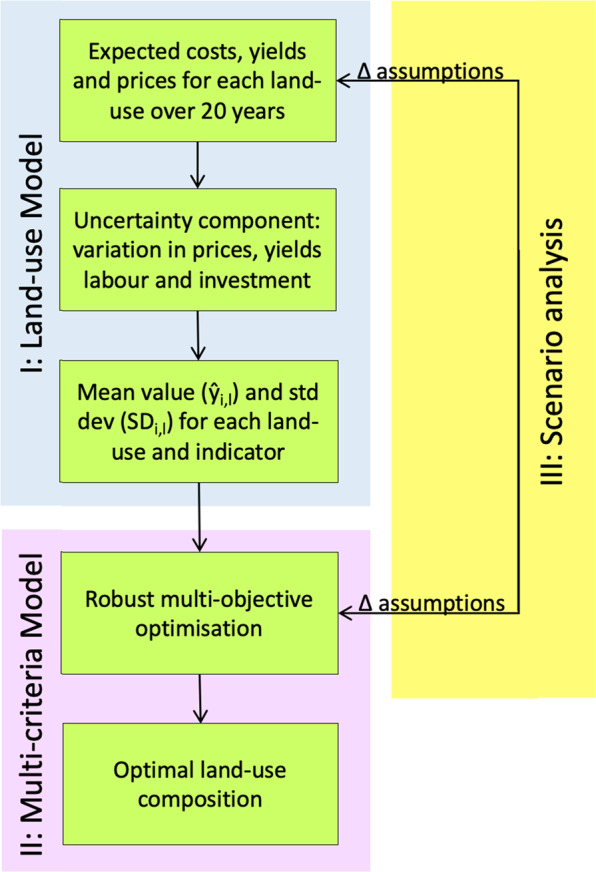
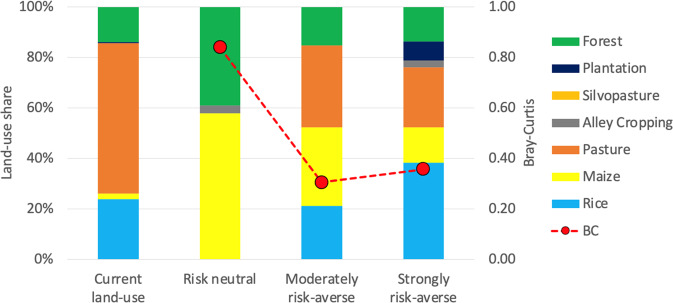
Models are essential to assess the socio-economic credentials of new agroforestry systems. In this study, we showcase robust optimisation as a tool to evaluate agroforestry's potential to meet farmers' multiple goals. Our modelling approach has three parts. First, we use a discrete land-use model to evaluate two agroforestry systems (alley cropping and silvopasture) and conventional land uses against five socio-economic objectives, focusing on the forest frontier in eastern Panama. Next, we couple the land-use model with robust optimisation, to determine the mix of land uses (farm portfolio) that minimises trade-offs between the five objectives. Here we consider uncertainty to simulate the land-use decisions of a risk-averse farmer. Finally, we assess how the type and amount of agroforestry included in the optimal land-use portfolio changes under different environmental, socio-economic and political scenarios, to explore the conditions that may make agroforestry more attractive for farmers. We identify silvopasture as a promising land use for meeting farmers' goals, especially for farms with less productive soils. The additional labour demand compared to conventional pasture, however, may prove an important barrier to adoption for farms facing acute labour shortages. The selection of agroforestry responded strongly to changes in investment costs and timber prices, suggesting that cost-sharing arrangements and tax incentives could be effective strategies to enhance adoption. We found alley cropping to be less compatible with farmers' risk aversion, but this agroforestry system may still be a desirable complement to the land-use portfolio, especially for farmers who are more profit-oriented and tolerant of risk.
模型对于评估新的农林复合系统的社会经济价值至关重要。本研究展示了稳健优化作为一种工具,用于评估农林复合系统实现农民多项目标的潜力。我们的建模方法有三个部分。首先,我们使用离散土地利用模型来评估两种农林复合系统(林粮间作和农林复合系统)和传统土地利用方式,针对五个社会经济目标,重点关注巴拿马东部的森林前沿。其次,我们将土地利用模型与稳健优化相结合,以确定最小化五个目标之间权衡的土地利用组合(农场投资组合)。在这里,我们考虑不确定性来模拟风险厌恶型农民的土地利用决策。最后,我们评估在不同的环境、社会经济和政治情景下,最优土地利用组合中包含的农林复合类型和数量如何变化,以探索可能使农林复合对农民更具吸引力的条件。我们发现,农林复合系统是实现农民目标的一种很有前途的土地利用方式,特别是对于土壤生产力较低的农场。与传统牧场相比,农林复合系统需要更多的劳动力,这可能成为采用农林复合系统的一个重要障碍,特别是对于面临劳动力严重短缺的农场。农林复合系统的选择对投资成本和木材价格的变化反应强烈,这表明成本分担安排和税收激励可能是增强采用的有效策略。我们发现林粮间作与农民的风险规避不太兼容,但这种农林复合系统可能仍然是土地利用组合的理想补充,特别是对于以利润为导向且能承受风险的农民。