Sirois Fuschia M, Owens Janine
Department of Psychology, University of Sheffield, Sheffield, United Kingdom.
School of Clinical Dentistry, University of Sheffield, Sheffield, United Kingdom.
Front Psychiatry. 2021 Jan 28;11:589545. doi: 10.3389/fpsyt.2020.589545. eCollection 2020.
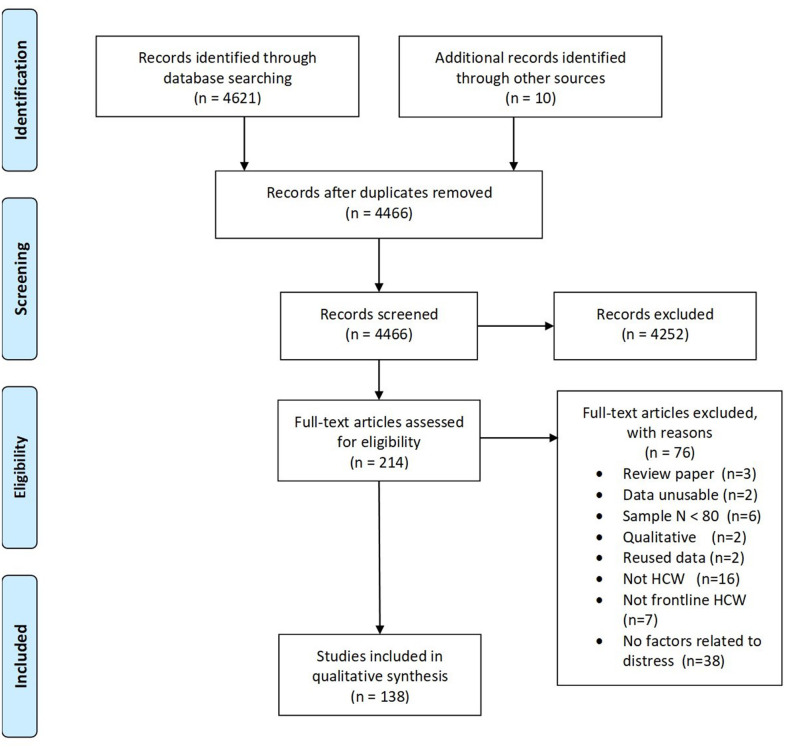
Health-care workers (HCW) are at risk for psychological distress during an infectious disease outbreak, such as the coronavirus pandemic, due to the demands of dealing with a public health emergency. This rapid systematic review examined the factors associated with psychological distress among HCW during an outbreak. We systematically reviewed literature on the factors associated with psychological distress (demographic characteristics, occupational, social, psychological, and infection-related factors) in HCW during an outbreak (COVID-19, SARS, MERS, H1N1, H7N9, and Ebola). Four electronic databases were searched (2000 to 15 November 2020) for relevant peer-reviewed research according to a pre-registered protocol. A narrative synthesis was conducted to identify fixed, modifiable, and infection-related factors linked to distress and psychiatric morbidity. From the 4,621 records identified, 138 with data from 143,246 HCW in 139 studies were included. All but two studies were cross-sectional. The majority of the studies were conducted during COVID-19 ( = 107, = 34,334) and SARS ( = 21, = 18,096). Consistent evidence indicated that being female, a nurse, experiencing stigma, maladaptive coping, having contact or risk of contact with infected patients, and experiencing quarantine, were risk factors for psychological distress among HCW. Personal and organizational social support, perceiving control, positive work attitudes, sufficient information about the outbreak and proper protection, training, and resources, were associated with less psychological distress. This review highlights the key factors to the identify HCW who are most at risk for psychological distress during an outbreak and modifying factors to reduce distress and improve resilience. Recommendations are that HCW at risk for increased distress receive early interventions and ongoing monitoring because there is evidence that HCW distress can persist for up to 3 years after an outbreak. Further research needs to track the associations of risk and resilience factors with distress over time and the extent to which certain factors are inter-related and contribute to sustained or transient distress.
在传染病爆发期间,如冠状病毒大流行,医护人员由于应对突发公共卫生事件的压力而面临心理困扰的风险。本快速系统评价研究了疫情期间医护人员心理困扰的相关因素。我们系统回顾了关于疫情期间(新冠病毒、非典、中东呼吸综合征、甲型H1N1流感、H7N9禽流感和埃博拉)医护人员心理困扰相关因素(人口统计学特征、职业、社会、心理和感染相关因素)的文献。根据预先注册的方案,检索了四个电子数据库(2000年至2020年11月15日),以查找相关的同行评审研究。进行了叙述性综合分析,以确定与困扰和精神疾病相关的固定、可改变和感染相关因素。从识别出的4621条记录中,纳入了139项研究中143246名医护人员的数据的138条记录。除两项研究外,所有研究均为横断面研究。大多数研究在新冠病毒疫情期间进行(n = 107,N = 34334)和非典期间(n = 21,N = 18096)。一致的证据表明,女性、护士、遭受污名化、适应不良的应对方式、接触或有接触感染患者的风险以及经历隔离,是医护人员心理困扰的风险因素。个人和组织的社会支持、感知到的控制感、积极的工作态度、关于疫情的充分信息以及适当的保护、培训和资源,与较少的心理困扰相关。本综述强调了识别疫情期间心理困扰风险最高的医护人员的关键因素,以及改变因素以减少困扰并提高恢复力。建议心理困扰风险增加的医护人员接受早期干预和持续监测,因为有证据表明医护人员的困扰在疫情爆发后可持续长达3年。进一步的研究需要追踪风险和恢复力因素与困扰随时间的关联,以及某些因素相互关联并导致持续或短暂困扰的程度。