Ye Ding, Huang Huijun, Wu David J H, Zhang Wanting, Zhou Feixiang, Qian Yu, Zheng Jusheng, Mao Yingying
School of Public Health, Zhejiang Chinese Medical University, Hangzhou, China.
School of Medicine, University of Minnesota, Minneapolis, MN, United States.
Front Genet. 2021 Jan 8;11:582623. doi: 10.3389/fgene.2020.582623. eCollection 2020.
Observational studies have shown an inverse association between circulating linoleic acid (LA) and risk of ischemic stroke (IS).
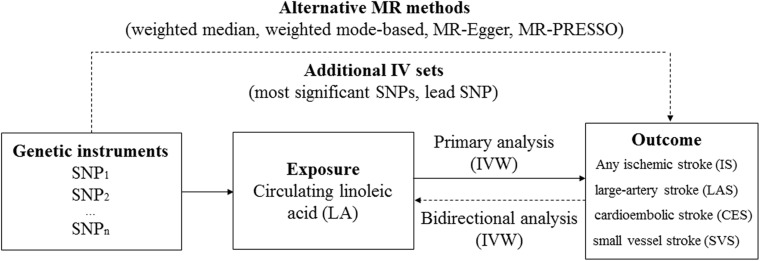
The aim of this study was to explore whether genetic variants predicting levels of circulating LA are associated with IS and its subtypes using a two-sample Mendelian randomization (MR) analysis.
LA-related single-nucleotide polymorphisms (SNPs) were selected from a genome-wide association study of 8,631 participants, and summary statistics of IS and IS subtypes were obtained from the MEGASTROKE consortium. MR analysis was performed using the inverse-variance weighted (IVW) method complemented with other approaches, including weighted-median, weighted-mode, MR Pleiotropy RESidual Sum and Outlier test and MR-Egger regression, to test for the robustness of the association. Moreover, we conducted bidirectional MR analysis to assess the impact of IS-associated SNPs on circulating LA levels. Odds ratios (ORs) with 95% confidence intervals (95% CIs) were calculated.
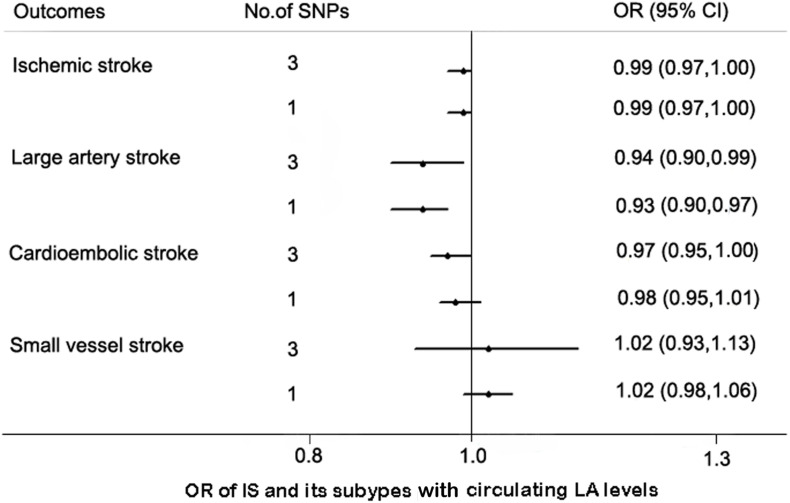
We found that genetically predicted circulating LA levels were inversely associated with the risk of IS by the IVW method (OR = 0.98, 95% CI: 0.97-0.99, and = 0.003). Subgroup analyses showed a statistically significant association between LA and risk of large artery stroke (LAS; OR = 0.95, 95% CI: 0.92-0.98, and = 0.004), but not for other IS subtypes. The results were stable in sensitivity analyses, and no evidence of reverse association between LA and risk of IS, or LAS was observed.
Our study supports a potential inverse association of genetically predicted circulating LA levels with risk of IS, particularly LAS.
观察性研究表明,循环亚油酸(LA)与缺血性中风(IS)风险之间存在负相关。
本研究旨在通过两样本孟德尔随机化(MR)分析,探讨预测循环LA水平的基因变异是否与IS及其亚型相关。
从一项对8631名参与者的全基因组关联研究中选择与LA相关的单核苷酸多态性(SNP),并从MEGASTROKE联盟获得IS及其亚型的汇总统计数据。使用逆方差加权(IVW)方法并辅以其他方法进行MR分析,包括加权中位数、加权模式、MR多效性残差和离群值检验以及MR-Egger回归,以检验关联的稳健性。此外,我们进行了双向MR分析,以评估与IS相关的SNP对循环LA水平的影响。计算了95%置信区间(95%CI)的比值比(OR)。
我们发现,通过IVW方法,基因预测的循环LA水平与IS风险呈负相关(OR = 0.98,95%CI:0.97 - 0.99,P = 0.003)。亚组分析显示,LA与大动脉粥样硬化性卒中(LAS)风险之间存在统计学显著关联(OR = 0.95,95%CI:0.92 - 0.98,P = 0.004),但与其他IS亚型无关。敏感性分析结果稳定,未观察到LA与IS或LAS风险之间存在反向关联的证据。
我们的研究支持基因预测的循环LA水平与IS风险,尤其是LAS风险之间可能存在负相关。