Schwartz Mathieu, Neiers Fabrice, Feron Gilles, Canon Francis
Centre des Sciences du Goût et de l'Alimentation, UMR1324 INRA, UMR6265 CNRS Université de Bourgogne, Dijon, France.
Front Nutr. 2021 Jan 28;7:612735. doi: 10.3389/fnut.2020.612735. eCollection 2020.
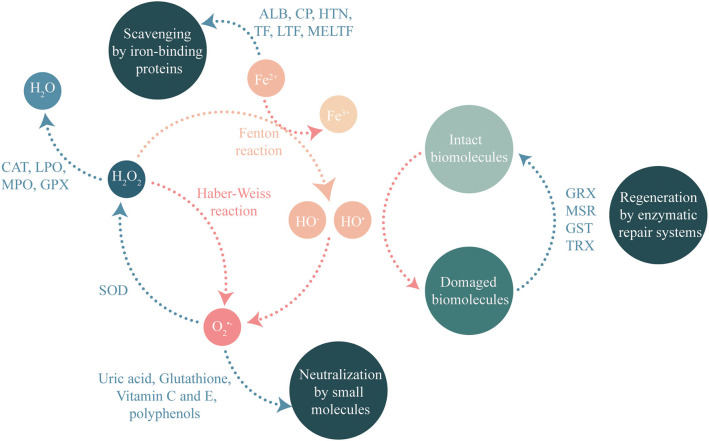
The mouth is the gateway for entrance of food and microorganisms into the organism. The oral cavity is bathed by saliva, which is thus the first fluid that food and microorganisms will face after their entrance. As a result, saliva plays different functions, including lubrication, predigestion, protection, detoxification, and even transport of taste compounds to chemoreceptors located in the taste buds. To ensure its function of protection, saliva contains reactive harmful compounds such as reactive oxygen species that are controlled and neutralized by the antioxidant activity of saliva. Several antioxidant molecules control the production of molecules such as reactive oxygen compounds, neutralize them and/or repair the damage they have caused. Therefore, a balance between reactive oxidant species and antioxidant compounds exists. At the same time, food can also contain antioxidant compounds, which can participate in the equilibrium of this balance. Numerous studies have investigated the effects of different food components on the antioxidant capacity of saliva that correspond to the ability of saliva to neutralize reactive oxygen species. Contradictory results have sometimes been obtained. Moreover, some antioxidant compounds are also cofactors of enzymatic reactions that affect flavor compounds. Recent studies have considered the salivary antioxidant capacity to explain the release of flavor compounds or . This article aims to review the effect of food on the antioxidant capacity of saliva and the impact of salivary antioxidant capacity on flavor perception after a brief presentation of the different molecules involved.
口腔是食物和微生物进入机体的门户。口腔被唾液浸润,因此唾液是食物和微生物进入后首先接触的液体。因此,唾液具有多种功能,包括润滑、初步消化、保护、解毒,甚至将味觉化合物输送到味蕾中的化学感受器。为确保其保护功能,唾液含有活性有害化合物,如活性氧,这些化合物由唾液的抗氧化活性控制和中和。几种抗氧化分子控制活性氧等分子的产生,中和它们并/或修复它们造成的损伤。因此,活性氧化物质和抗氧化化合物之间存在平衡。同时,食物也可能含有抗氧化化合物,它们可以参与这种平衡的维持。许多研究调查了不同食物成分对唾液抗氧化能力的影响,唾液抗氧化能力对应于唾液中和活性氧的能力。有时会得到相互矛盾的结果。此外,一些抗氧化化合物也是影响风味化合物的酶促反应的辅助因子。最近的研究考虑了唾液抗氧化能力来解释风味化合物的释放。本文旨在简要介绍相关不同分子后,综述食物对唾液抗氧化能力的影响以及唾液抗氧化能力对风味感知的影响。