Cognition and Perception Unit (CPU), Psychology Department, University of Waterloo, Waterloo, Ontario, Canada.
Q J Exp Psychol (Hove). 2021 Jul;74(7):1164-1169. doi: 10.1177/1747021821998572. Epub 2021 Mar 19.
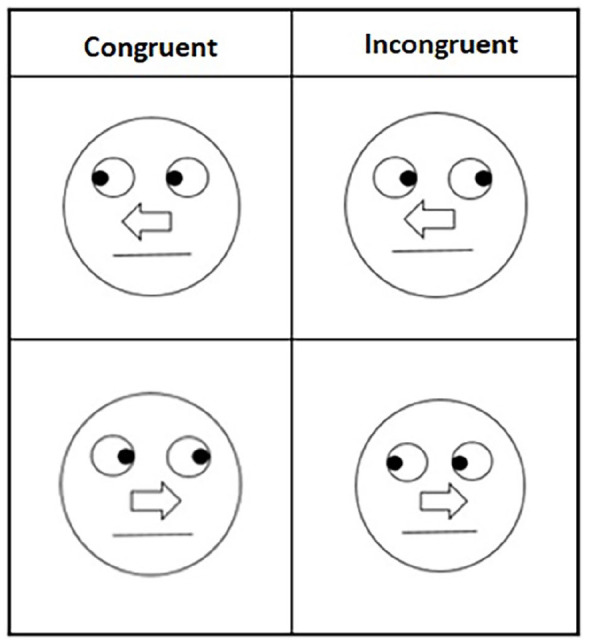
Eyes in a schematic face and arrows presented at fixation can each cue an upcoming lateralized target such that responses to the target are faster to a valid than an invalid cue (sometimes claimed to reflect "automatic" orienting). One test of an automatic process concerns the extent to which it can be interfered with by another process. The present experiment investigates the ability of eyes and arrows to cue an upcoming target when both cues are present at the same time. On some trials they are congruent (both cues signal the same direction); on other trials they are incongruent (the two cues signal opposite directions). When the cues are congruent a valid cue produced faster response times than an invalid cue. In the incongruent case arrows are resistant to interference from eyes, whereas an incongruent arrow eliminates a cueing effect for eyes. The discussion elaborates briefly on the theoretical implications.
示意图中的眼睛和注视点处呈现的箭头都可以提示即将出现的侧偏目标,从而使得对目标的反应在有效提示时比无效提示时更快(有时被认为反映了“自动”定向)。对自动过程的一种检验涉及到它受到另一个过程干扰的程度。本实验研究了当两个提示同时出现时,眼睛和箭头提示即将出现的目标的能力。在一些试验中,它们是一致的(两个提示都指向相同的方向);在其他试验中,它们是不一致的(两个提示指向相反的方向)。当提示一致时,有效提示比无效提示产生更快的反应时。在不一致的情况下,箭头不受眼睛干扰的影响,而不一致的箭头则消除了眼睛的提示效应。讨论简要阐述了理论意义。