National Wildlife Forensic Laboratory, Ex-Situ Conservation Division, Department of Wildlife and National Parks (DWNP) Peninsular Malaysia, KM 10 Cheras Road, 56100, Kuala Lumpur, Malaysia.
Faculty of Resource Science and Technology (FRST), Universiti Malaysia Sarawak (UNIMAS), 94300, Kota Samarahan, Sarawak, Malaysia.
BMC Ecol Evol. 2021 Feb 15;21(1):26. doi: 10.1186/s12862-021-01757-1.
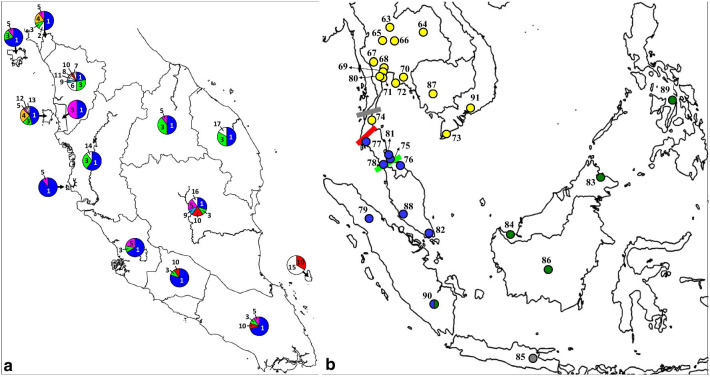
We analyzed a combined segment (2032-bp) of the sex-determining region and the testis-specific protein of the Y-chromosome (Y-DNA) gene to clarify the gene flow and phylogenetic relationships of the long-tailed macaques (Macaca fascicularis) in Southeast Asia. Phylogenetic relationships were constructed using the maximum likelihood, Bayesian inference, and the median-joining network from a total of 164 adult male M. fascicularis from 62 localities in Malaysia, including sequences from the other regions from previous studies.
Based on Y-DNA, we confirm the presence of two lineages of M. fascicularis: the Indochinese and Sundaic lineages. The Indochinese lineage is represented by M. fascicularis located northwards of the Surat Thani-Krabi depression region and is introgressed by the Macaca mulatta Y-DNA. The Sundaic lineage is free from such hybridization event, thus defined as the original carrier of the M. fascicularis Y-DNA. We further revealed that the Sundaic lineage differentiated into two forms: the insular and the continental forms. The insular form, which represents the ancestral form of M. fascicularis, consists of two haplotypes: a single homogenous haplotype occupying the island of Borneo, Philippines, and southern Sumatra; and the Javan haplotype. The more diverse continental form consists of 17 haplotypes in which a dominant haplotype was shared by individuals from southern Thai Peninsular (south of Surat Thani-Krabi depression), Peninsular Malaysia, and Sumatra. Uniquely, Sumatra contains both the continental and insular Y-DNA which can be explained by a secondary contact hypothesis.
Overall, the findings in this study are important: (1) to help authority particularly in Malaysia on the population management activities including translocation and culling of conflict M. fascicularis, (2) to identify the unknown origin of captive M. fascicularis used in biomedical research, and; (3) the separation between the continental and insular forms warrants for the treatment as separate management units.
我们分析了 Y 染色体性别决定区和睾丸特异性蛋白(Y-DNA)基因的一个组合片段(2032 个碱基对),以阐明东南亚长尾猕猴(Macaca fascicularis)的基因流和系统发育关系。我们从马来西亚 62 个地点的 164 只成年雄性 M. fascicularis 中构建了系统发育关系,包括来自先前研究的其他地区的序列,使用最大似然法、贝叶斯推断和中位数连接网络。
基于 Y-DNA,我们证实了 M. fascicularis 存在两个谱系:印度支那谱系和巽他谱系。印度支那谱系由位于苏拉特他尼-甲米凹陷地区以北的 M. fascicularis 代表,并被 M. mulatta Y-DNA 渗入。巽他谱系没有这种杂交事件,因此被定义为 M. fascicularis Y-DNA 的原始载体。我们进一步揭示,巽他谱系分化为两种形式:岛屿和大陆形式。岛屿形式代表 M. fascicularis 的原始形式,由两个单倍型组成:一个单一的同质单倍型占据了婆罗洲、菲律宾和苏门答腊南部的岛屿;以及爪哇单倍型。更多样化的大陆形式由 17 个单倍型组成,其中一个优势单倍型由泰国南部半岛(苏拉特他尼-甲米凹陷以南)、马来半岛和苏门答腊的个体共享。独特的是,苏门答腊包含大陆和岛屿的 Y-DNA,可以用二次接触假说来解释。
总的来说,本研究的发现非常重要:(1)有助于马来西亚当局特别是在人口管理活动中,包括冲突 M. fascicularis 的转移和清除;(2)确定用于生物医学研究的圈养 M. fascicularis 的未知来源;(3)大陆和岛屿形式的分离需要作为单独的管理单位进行治疗。