Institute of Development Studies, University of Sussex, Brighton, UK.
Int J Health Policy Manag. 2021 Dec 1;10(12):817-827. doi: 10.34172/ijhpm.2020.259.
While child undernutrition is improving overall, different population groups are experiencing different outcomes. What sets some groups apart is their experience of the 'basic determinants' of malnutrition, that underpin the 'immediate' and 'underlying' determinants, and that have been much less studied, defined and understood.
We undertook a qualitative narrative review based in two sets of ideas: nutrition's basic determinants as laid out in the original United Nations Children's Fund (UNICEF) framework, and critical concepts emerging from development studies. These ideas informed searches in Google Scholar, and resulting papers formed the basis for the review.
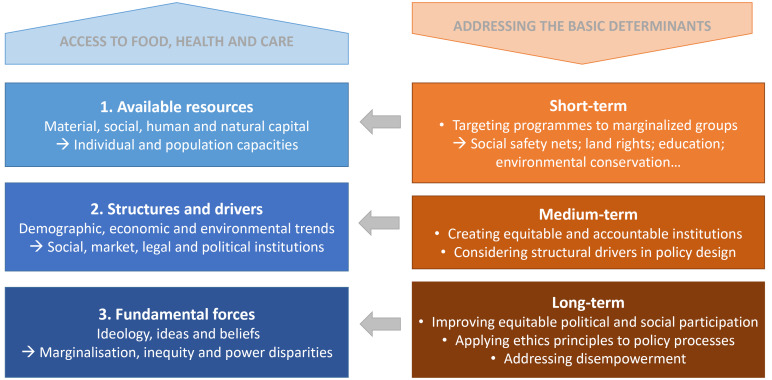
Based on this literature, we expand and clarify the terminology of 'basic determinants' into a new framework, to include (1) resources and (material, human, social and natural) capitals at the basic level; (2) structures including social, market, legal and political systems driven by long-term demographic, economic, and environmental trends; and (3) ideas, beliefs and ideologies prevailing within a given society - crystallising into social norms and institutions - fundamentally shaping how societies are structured around power and marginalisation. We then illustrate with existing literature how these basic factors play out in the food, health and care determinants of malnutrition; and how theories of human rights and collective commons point us towards practical redressal options through improved participation and accountability.
We show here that the basic determinants are not a black box of 'context,' but can be broken down into comprehensible issues that are amenable to change, and should be considered explicitly in research and action to reduce the global burden of malnutrition.
尽管儿童营养状况总体上有所改善,但不同人群的结果却有所不同。一些群体的不同之处在于他们经历了营养不良的“基本决定因素”,这些因素构成了“直接”和“潜在”决定因素的基础,但这些因素的研究、定义和理解都要少得多。
我们根据两个概念进行了定性叙述性综述:最初的联合国儿童基金会(UNICEF)框架中列出的营养基本决定因素,以及发展研究中出现的关键概念。这些想法为在 Google Scholar 中的搜索提供了信息,而由此产生的论文则构成了综述的基础。
基于这些文献,我们将“基本决定因素”的术语扩展并澄清为一个新的框架,包括(1)基本层面的资源和(物质、人力、社会和自然)资本;(2)由长期人口、经济和环境趋势驱动的社会、市场、法律和政治系统;(3)特定社会中普遍存在的思想、信仰和意识形态——结晶成社会规范和机构——从根本上塑造了社会围绕权力和边缘化的结构。然后,我们用现有的文献来说明这些基本因素如何在营养不良的食物、健康和护理决定因素中发挥作用;以及人权和集体公地理论如何通过提高参与度和问责制,为我们提供了实际的补救选择。
我们在这里表明,基本决定因素不是“背景”的黑盒子,而是可以分解为可理解的问题,这些问题是可以改变的,在研究和行动中应明确考虑这些问题,以减少全球营养不良负担。