Hospital Universitario Miguel Servet, Zaragoza, Spain.
Hospital Universitario de Móstoles, Madrid, Spain.
BMC Anesthesiol. 2021 Feb 16;21(1):55. doi: 10.1186/s12871-021-01248-2.
Neuromuscular blocking (NMB) agents are often administered to facilitate tracheal intubation and prevent patient movement during surgical procedures requiring the use of general anesthetics. Incomplete reversal of NMB, can lead to residual NMB, which can increase the risk of post-operative pulmonary complications. Sugammadex is indicated to reverse neuromuscular blockade induced by rocuronium or vecuronium in adults. The aim of this study is to estimate the clinical and economic impact of introducing sugammadex to routine reversal of neuromuscular blockade (NMB) with rocuronium in Spain.
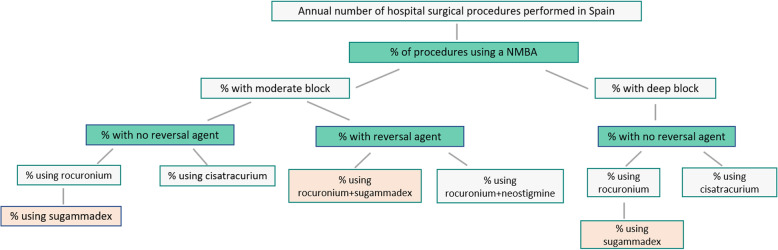
A decision analytic model was constructed reflecting a set of procedures using rocuronium that resulted in moderate or deep NMB at the end of the procedure. Two scenarios were considered for 537,931 procedures using NMB agents in Spain in 2015: a scenario without sugammadex versus a scenario with sugammadex. Comparators included neostigmine (plus glycopyrrolate) and no reversal agent. The total costs for the healthcare system were estimated from the net of costs of reversal agents and overall cost offsets via reduction in postoperative pneumonias and atelectasis for which incidence rates were based on a Spanish real-world evidence (RWE) study. The model time horizon was assumed to be one year. Costs were expressed in 2019 euros (€) and estimated from the perspective of a healthcare system. One-way sensitivity analysis was carried out by varying each parameter included in the model within a range of +/- 50%.
The estimated budget impact of the introduction of sugammadex to the routine reversal of neuromuscular blockade in Spanish hospitals was a net saving of €57.1 million annually. An increase in drug acquisition costs was offset by savings in post-operative pulmonary events, including 4806 post-operative pneumonias and 13,996 cases of atelectasis. The total cost of complications avoided was €70.4 million. All parameters included in the model were tested in sensitivity analysis and were favorable to the scenario with sugammadex.
This economic analysis shows that sugammadex can potentially lead to cost savings for the reversal of rocuronium-induced moderate or profound NMB compared to no reversal and reversal with neostigmine in the Spanish health care setting. The economic model was based on data obtained from Spain and from assumptions from clinical practice and may not be valid for other countries.
神经肌肉阻断剂(NMB)通常用于促进气管插管并防止在需要全身麻醉的手术过程中患者移动。NMB 不完全逆转可导致残留 NMB,从而增加术后肺部并发症的风险。Sugammadex 用于逆转成人罗库溴铵或维库溴铵引起的神经肌肉阻滞。本研究旨在评估在西班牙常规使用罗库溴铵逆转神经肌肉阻滞(NMB)时引入 sugammadex 的临床和经济影响。
构建了一个决策分析模型,反映了一组使用罗库溴铵的程序,这些程序在手术结束时导致中度或深度 NMB。考虑了两种情况:2015 年在西班牙使用 NMB 药物进行的 537931 例手术:一种是没有 sugammadex 的情况,另一种是有 sugammadex 的情况。比较包括新斯的明(加格利吡咯烷)和无逆转剂。从逆转剂的净成本和通过减少术后肺炎和肺不张的总体成本抵消来估计医疗保健系统的总成本,发病率基于西班牙真实世界证据(RWE)研究。模型时间范围设定为一年。成本以 2019 年欧元(€)表示,并从医疗保健系统的角度进行估计。通过在模型中包含的每个参数在 +/- 50%的范围内变化进行了单向敏感性分析。
在西班牙医院常规逆转神经肌肉阻滞中引入 sugammadex 的估计预算影响是每年净节省 5710 万欧元。药物采购成本的增加被术后肺部事件的节省所抵消,包括 4806 例术后肺炎和 13996 例肺不张。避免并发症的总成本为 7040 万欧元。模型中包含的所有参数均在敏感性分析中进行了测试,对 sugammadex 方案均有利。
这项经济分析表明,与无逆转和新斯的明逆转相比,在西班牙医疗保健环境中,sugammadex 可能会导致罗库溴铵诱导的中度或深度 NMB 逆转的成本节约。经济模型基于从西班牙获得的数据以及从临床实践中的假设,对于其他国家可能无效。