Liang Zuanji, Lai Yunfeng, Li Meng, Shi Junnan, Lei Chi Ieong, Hu Hao, Ung Carolina Oi Lam
State Key Laboratory of Quality Research in Chinese Medicine, Institute of Chinese Medical Science, University of Macau, Macao, Taipa, China.
Chin Med. 2021 Feb 16;16(1):23. doi: 10.1186/s13020-021-00433-2.
The National Medical Products Administration (NMPA) in China has set to advance the regulatory capacity of traditional Chinese medicines (TCMs) with the adoption of regulatory science (RS). However, the priority of actions at the interface of RS and TCMs were yet to be defined. This research aims to identify the priority areas and summarize core actions for advancing RS for traditional medicines in China.
A mixed approach of documentary analysis of government policies, regulations and official information about TCMs regulation in China, and a scoping review of literature using 4 databases (PubMed, ScienceDirect, Scopus and CNKI) on major concerns in TCMs regulation was employed.
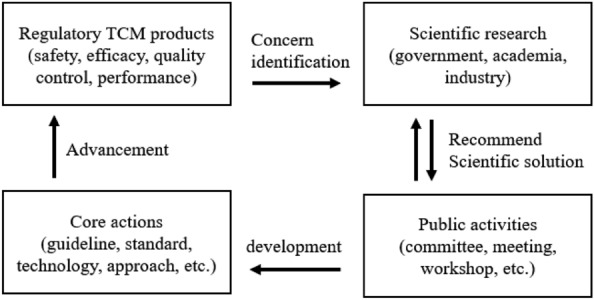
Ten priority areas in the development of TCM-related regulatory science in China have been identified, including: (1) modernizing the regulatory system with a holistic approach; (2) advancing the methodology for the quality control of TCMs; (3) fostering the control mechanism of TCMs manufacturing process; (4) improving clinical evaluation of TCMs and leveraging real world data; (5) re-evaluation of TCMs injection; (6) developing evaluation standards for classic TCMs formula; (7) harnessing diverse data to improve pharmacovigilance of TCMs; (8) evaluating the value of integrative medicine in clinical practice with scientific research; (9) advancing the regulatory capacity to encourage innovation in TCMs; and (10) advancing a vision of collaboration for RS development in TCMs.
RS for TCMs in China encompasses revolution of operational procedures, advancement in science and technology, and cross-disciplinary collaborations. Such experiences could be integrated in the communications among drug regulatory authorities to promote standardized and scientific regulation of traditional medicines.
中国国家药品监督管理局(NMPA)已着手通过采用监管科学(RS)来提升中药的监管能力。然而,RS与中药交叉领域的行动重点尚未明确。本研究旨在确定优先领域,并总结推进中国传统药物监管科学的核心行动。
采用混合方法,对中国有关中药监管的政府政策、法规和官方信息进行文献分析,并使用4个数据库(PubMed、ScienceDirect、Scopus和CNKI)对中药监管主要问题的文献进行范围综述。
确定了中国中药相关监管科学发展的10个优先领域,包括:(1)以整体方法实现监管体系现代化;(2)推进中药质量控制方法;(3)强化中药生产过程控制机制;(4)改进中药临床评价并利用真实世界数据;(5)重新评估中药注射剂;(6)制定经典中药方剂评价标准;(7)利用多样数据改善中药药物警戒;(8)通过科研评估中西医结合在临床实践中的价值;(9)提升鼓励中药创新的监管能力;(10)推进中药监管科学发展的合作愿景。
中国中药监管科学涵盖操作程序变革、科技进步和跨学科合作。这些经验可融入药品监管机构间的交流,以促进传统药物的标准化和科学化监管。