Wang Can, Shi Qing-Ping, Ding Feng, Jiang Xiao-Dong, Tang Wei, Yu Mei-Ling, Zhu Jian-Hua
Department of Pharmacy, The First Affiliated Hospital of Bengbu Medical College, Bengbu, People's Republic of China.
Faculty of Pharmacy, Bengbu Medical College, Bengbu, People's Republic of China.
Drug Des Devel Ther. 2018 Apr 5;12:757-767. doi: 10.2147/DDDT.S156000. eCollection 2018.
To evaluate the factors influencing suspected hypersensitivity and adverse systemic reactions after Shuxuening injection and to provide innovative ideas and methods for the reevaluation of post-marketing safety of Shuxuening.
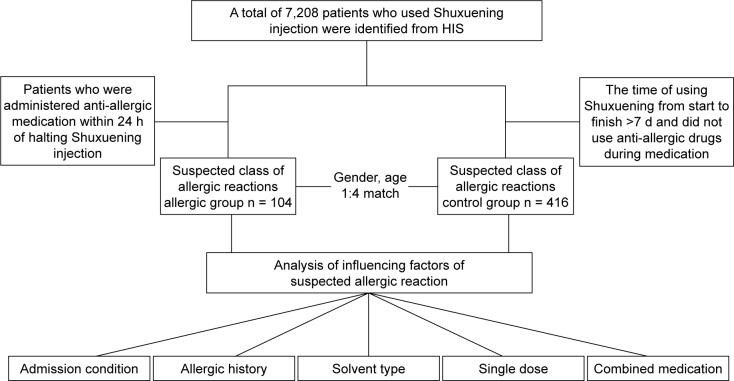
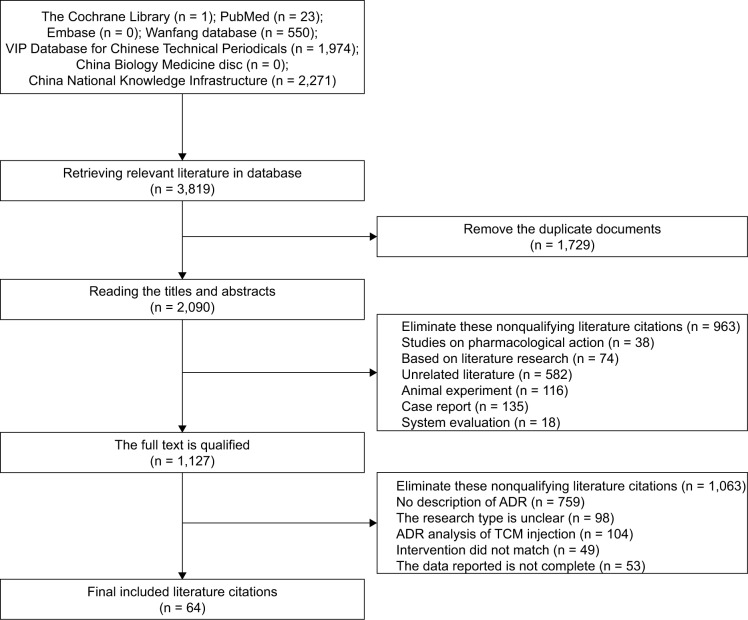
This study used a prospective, nested case-control study design, combined with a prescription sequence analysis design method. It classified patients who exhibited trigger signals after administration of Shuxuening injection as suspected allergic patients and made comparisons with patients who did not report adverse effects to calculate the correlation between relevant risk factors and suspected allergic reactions. Randomized controlled studies and cohort studies of the adverse drug reaction (ADR) of Shuxuening were performed using a computer database. Data retrieval was carried out by the foundation governing the individual database. Meta-analysis was performed by using R3.2.3 software to evaluate the ADRs of Shuxuening.
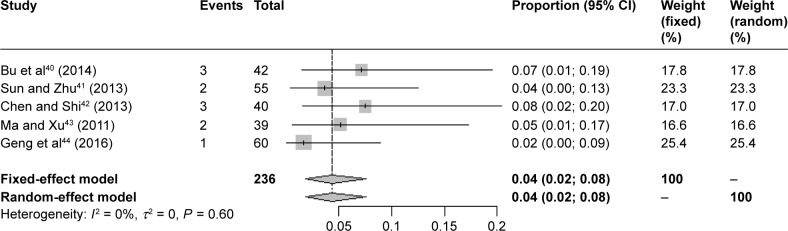
The results of real-world study showed that administration of Shuxuening in combination with potassium aspartate and magnesium, atorvastatin calcium, Shengmai injection, pantoprazole sodium, or high-dose medication was a risk factor for suspected allergic reactions. Meta-analysis showed that the incidence of adverse events was 5.84% (95% CI 0.0499; 0.0674), and serious adverse reaction rate was 4.36% (95% CI 0.0188; 0.0760) when Shuxuening was used in combination with these drugs. The incidence of allergic reaction was also influenced by the vehicle, duration of treatment, single dose, and indicated vs off-label use.
Risk factors for adverse reaction following the use of Shuxuening injection in patients are associated with a single dose, vehicle, type of disease, and combination with potassium aspartate, atorvastatin calcium, Shengmai injection, injection with pantoprazole sodium, and other drugs. Physicians should be careful to follow guidelines when administering this drug. We further propose that the unique methodology used in this study may be useful for reevaluation of the safety of other traditional Chinese medicines.
评估影响舒血宁注射液疑似过敏及全身不良反应的因素,为舒血宁上市后安全性再评价提供新思路和方法。
本研究采用前瞻性巢式病例对照研究设计,并结合处方序贯分析设计方法。将舒血宁注射液给药后出现触发信号的患者分类为疑似过敏患者,并与未报告不良反应的患者进行比较,以计算相关危险因素与疑似过敏反应之间的相关性。利用计算机数据库对舒血宁的药物不良反应(ADR)进行随机对照研究和队列研究。数据检索由管理各个数据库的机构进行。使用R3.2.3软件进行荟萃分析,以评估舒血宁的ADR。
真实世界研究结果表明,舒血宁与门冬氨酸钾镁、阿托伐他汀钙、生脉注射液、泮托拉唑钠联合使用或大剂量用药是疑似过敏反应的危险因素。荟萃分析表明,舒血宁与这些药物联合使用时,不良事件发生率为5.84%(95%CI 0.0499;0.0674),严重不良反应率为4.36%(95%CI 0.0188;0.0760)。过敏反应发生率还受溶媒、治疗持续时间、单次剂量以及适应证用药与超适应证用药的影响。
患者使用舒血宁注射液后不良反应的危险因素与单次剂量、溶媒、疾病类型以及与门冬氨酸钾、阿托伐他汀钙、生脉注射液、泮托拉唑钠注射液等药物联合使用有关。医生在使用该药物时应谨慎遵循指南。我们进一步提出,本研究中使用的独特方法可能有助于其他中药安全性的再评价。