Martinez-Huenchullan Sergio F, Shipsey Isaac, Hatchwell Luke, Min Danqing, Twigg Stephen M, Larance Mark
Faculty of Science, Charles Perkins Centre, School of Life and Environmental Sciences, University of Sydney, New South Wales, Australia; Faculty of Medicine and Health, Central Clinical School, University of Sydney, New South Wales, Australia; Faculty of Medicine, School of Physical Therapy, Austral University of Chile, Valdivia, Chile.
Faculty of Science, Charles Perkins Centre, School of Life and Environmental Sciences, University of Sydney, New South Wales, Australia.
Mol Cell Proteomics. 2021;20:100027. doi: 10.1074/mcp.TIR120.002343. Epub 2020 Dec 19.
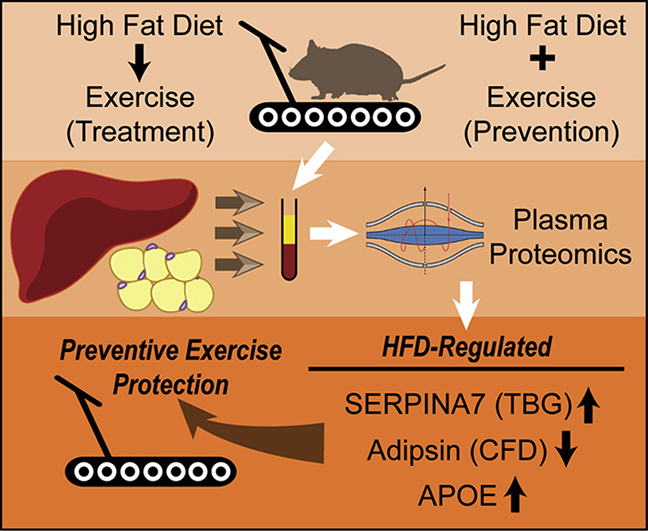
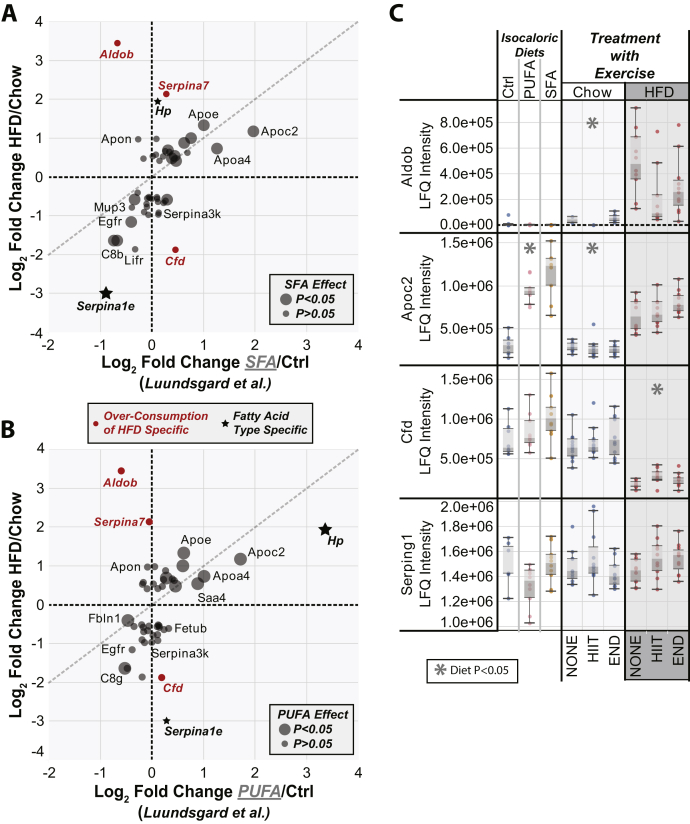
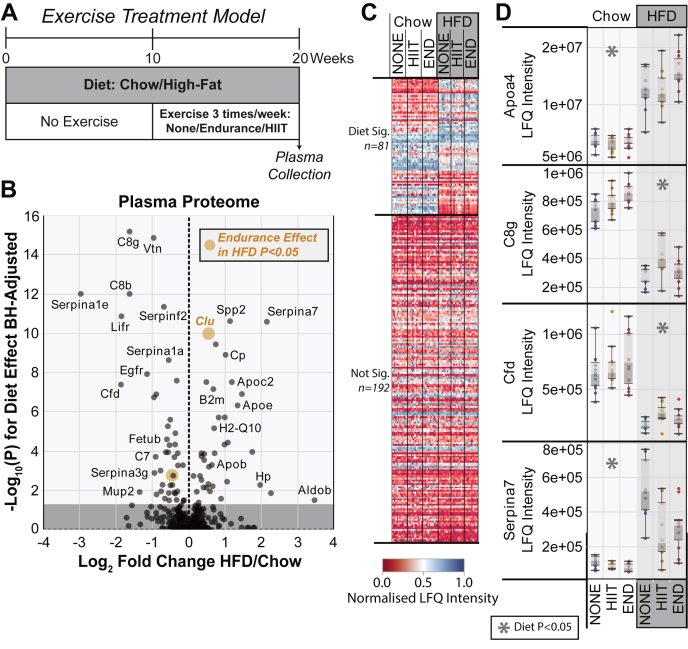
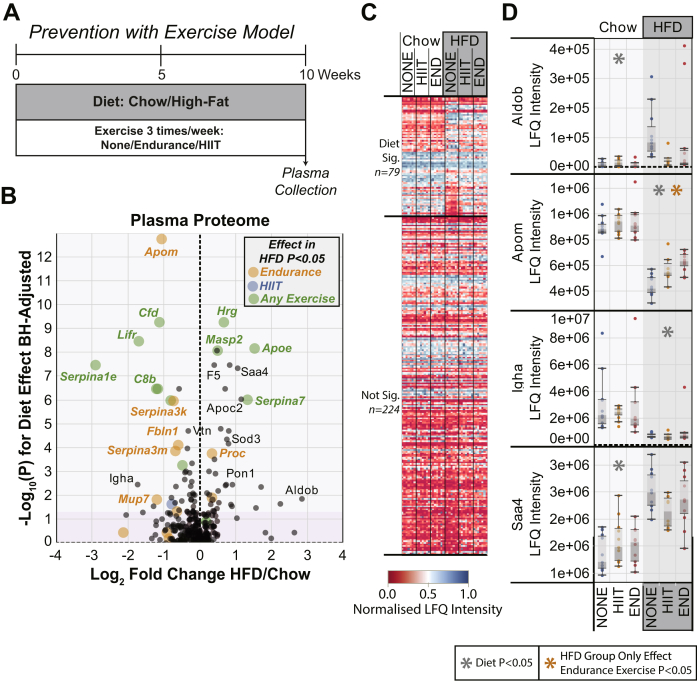
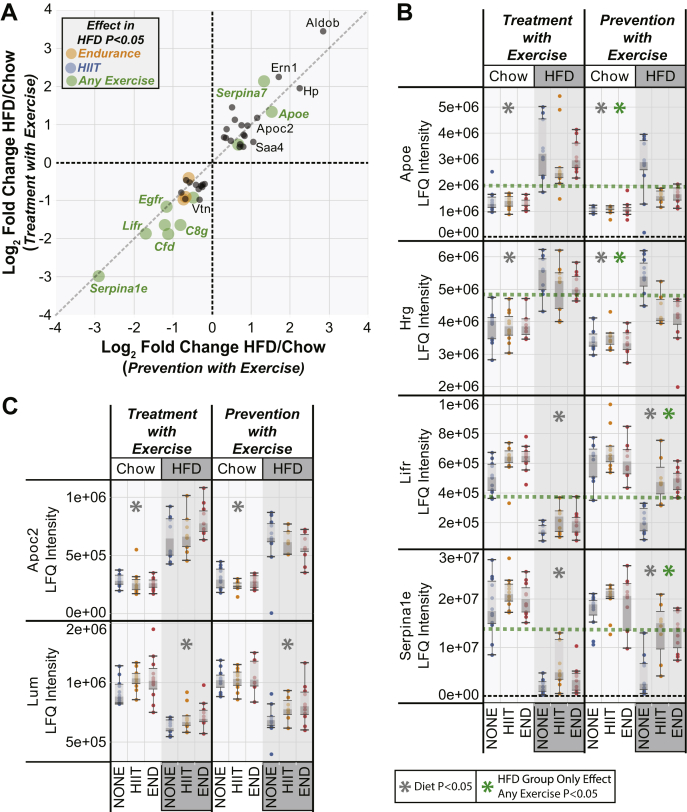
The increasing consumption of high-fat foods combined with a lack of exercise is a major contributor to the burden of obesity in humans. Aerobic exercise such as running is known to provide metabolic benefits, but how the overconsumption of a high-fat diet (HFD) and exercise interact is not well characterized at the molecular level. Here, we examined the plasma proteome in mice for the effects of aerobic exercise as both a treatment and as a preventative regimen for animals on either a HFD or a healthy control diet. This analysis detected large changes in the plasma proteome induced by the HFD, such as increased abundance of SERPINA7, ALDOB, and downregulation of SERPINA1E and complement factor D (CFD; adipsin). Some of these changes were significantly reverted using exercise as a preventative measure but not as a treatment regimen. To determine if either the intensity or duration of exercise influenced the outcome, we compared high-intensity interval training and endurance running. Endurance running slightly outperformed high-intensity interval training exercise, but overall, both provided similar reversion in abundance of plasma proteins modulated by the HFD, including SERPINA7, apolipoprotein E, SERPINA1E, and CFD. Finally, we compared the changes induced by overconsumption of a HFD with previous data from mice fed on an isocaloric high-saturated fatty acid or polyunsaturated fatty acid diet. This identified several common changes, including not only increased apolipoprotein C-II and apolipoprotein E but also highlighted changes specific for overconsumption of a HFD (fructose-bisphosphate aldolase B, SERPINA7, and CFD), saturated fatty acid-based diets (SERPINA1E), or polyunsaturated fatty acid-based diets (haptoglobin). Together, these data highlight the importance of early intervention with exercise to revert HFD-induced phenotypes and suggest some of the molecular mechanisms leading to the changes in the plasma proteome generated by HFD consumption. Web-based interactive visualizations are provided for this dataset (larancelab.com/hfd-exercise), which give insight into diet and exercise phenotypic interactions on the plasma proteome.
高脂肪食物摄入量的增加,再加上缺乏运动,是导致人类肥胖负担的主要因素。众所周知,像跑步这样的有氧运动具有代谢益处,但在分子水平上,高脂肪饮食(HFD)的过度摄入与运动之间如何相互作用,目前还没有得到很好的描述。在这里,我们研究了小鼠的血浆蛋白质组,以探究有氧运动作为治疗方法以及作为对食用HFD或健康对照饮食的动物的预防方案所产生的影响。该分析检测到HFD诱导的血浆蛋白质组发生了巨大变化,例如SERPINA7、ALDOB的丰度增加,以及SERPINA1E和补体因子D(CFD;脂肪酶)的下调。其中一些变化通过运动作为预防措施可显著逆转,但作为治疗方案则不能。为了确定运动的强度或持续时间是否会影响结果,我们比较了高强度间歇训练和耐力跑。耐力跑在改善由HFD调节的血浆蛋白丰度方面略优于高强度间歇训练,但总体而言,两者在逆转HFD调节的血浆蛋白丰度方面效果相似,这些血浆蛋白包括SERPINA7、载脂蛋白E、SERPINA1E和CFD。最后,我们将HFD过度摄入引起的变化与之前以等热量高饱和脂肪酸或多不饱和脂肪酸饮食喂养的小鼠的数据进行了比较。这确定了几个常见变化,不仅包括载脂蛋白C-II和载脂蛋白E的增加,还突出了HFD过度摄入特有的变化(果糖二磷酸醛缩酶B、SERPINA7和CFD)、基于饱和脂肪酸的饮食特有的变化(SERPINA1E)或基于多不饱和脂肪酸的饮食特有的变化(触珠蛋白)。总之,这些数据突出了早期进行运动干预以逆转HFD诱导的表型的重要性,并揭示了一些导致HFD摄入引起血浆蛋白质组变化的分子机制。针对该数据集提供了基于网络的交互式可视化工具(larancelab.com/hfd-exercise),可深入了解饮食和运动对血浆蛋白质组的表型相互作用。