Agurto Carla, Heisig Stephen, Abrami Avner, Ho Bryan K, Caggiano Vittorio
IBM Research - Healthcare and Life Sciences, Yorktown Heights, Yorktown, New York, United States of America.
Department of Neurology, Boston, Massachusetts, United States of America.
PLoS One. 2021 Feb 17;16(2):e0244842. doi: 10.1371/journal.pone.0244842. eCollection 2021.
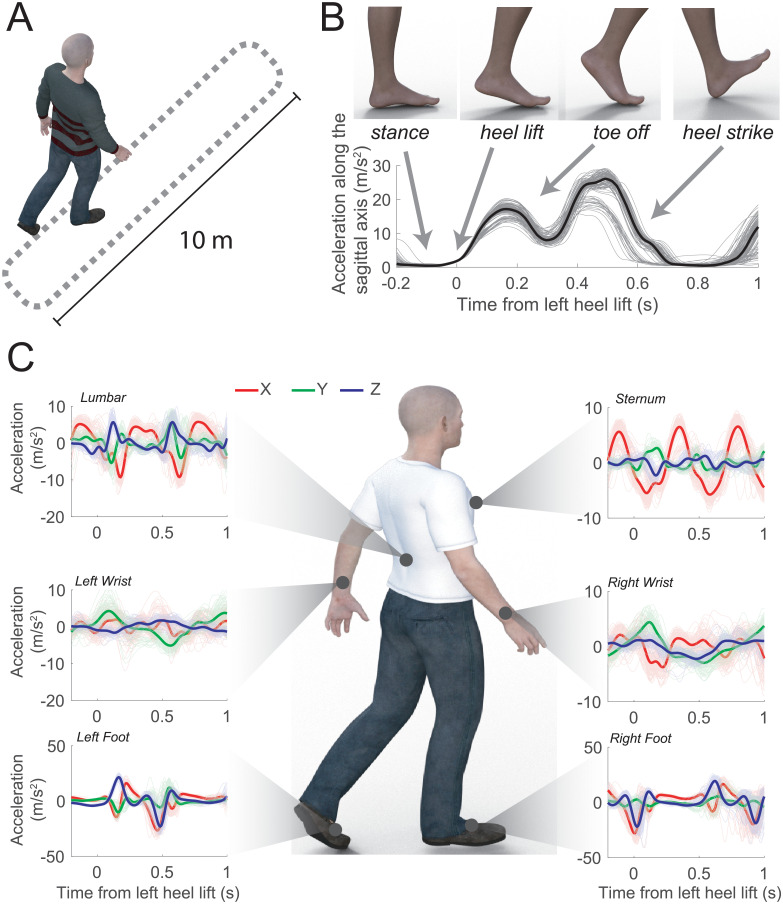
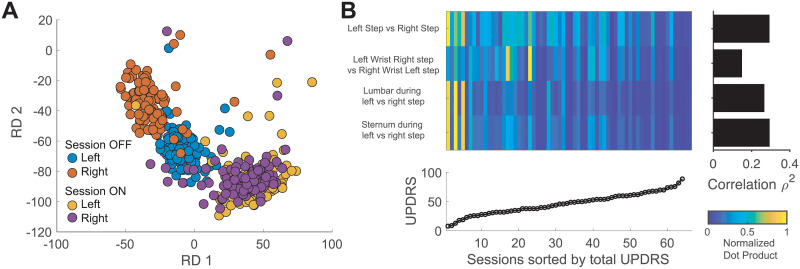
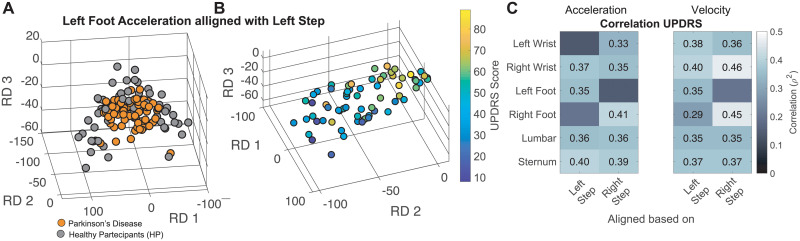
Walking is a complex motor function requiring coordination of all body parts. Parkinson's disease (PD) motor signs such as rigidity, bradykinesia, and impaired balance affect movements including walking. Here, we propose a computational method to objectively assess the effects of Parkinson's disease pathology on coordination between trunk, shoulder and limbs during the gait cycle to assess medication state and disease severity. Movements during a scripted walking task were extracted from wearable devices placed at six different body locations in participants with PD and healthy participants. Three-axis accelerometer data from each device was synchronized at the beginning of either left or right steps. Canonical templates of movements were then extracted from each body location. Movements projected on those templates created a reduced dimensionality space, where complex movements are represented as discrete values. These projections enabled us to relate the body coordination in people with PD to disease severity. Our results show that the velocity profile of the right wrist and right foot during right steps correlated with the participant's total score on the gold standard Unified Parkinson's Disease Rating Scale (UPRDS) with an r2 up to 0.46. Left-right symmetry of feet, trunk and wrists also correlated with the total UPDRS score with an r2 up to 0.3. In addition, we demonstrate that binary dopamine replacement therapy medication states (self-reported 'ON' or 'OFF') can be discriminated in PD participants. In conclusion, we showed that during walking, the movement of body parts individually and in coordination with one another changes in predictable ways that vary with disease severity and medication state.
行走是一项复杂的运动功能,需要身体各部位的协调配合。帕金森病(PD)的运动症状,如僵硬、运动迟缓以及平衡受损,会影响包括行走在内的各种动作。在此,我们提出一种计算方法,以客观评估帕金森病病理对步态周期中躯干、肩部和四肢之间协调性的影响,从而评估药物状态和疾病严重程度。在脚本化行走任务期间的动作,是从放置在帕金森病患者和健康参与者六个不同身体部位的可穿戴设备中提取的。每个设备的三轴加速度计数据在左步或右步开始时进行同步。然后从每个身体部位提取动作的标准模板。投影到这些模板上的动作创建了一个降维空间,其中复杂动作被表示为离散值。这些投影使我们能够将帕金森病患者的身体协调性与疾病严重程度联系起来。我们的结果表明,右步期间右手腕和右脚的速度曲线与参与者在金标准统一帕金森病评定量表(UPRDS)上的总分相关,r2高达0.46。双脚、躯干和手腕的左右对称性也与UPDRS总分相关,r2高达0.3。此外,我们证明在帕金森病患者中可以区分二元多巴胺替代疗法的药物状态(自我报告的“开”或“关”)。总之,我们表明在行走过程中,身体各部位单独以及相互协调的运动以可预测的方式变化,这些变化随疾病严重程度和药物状态而不同。