Fairfield Bradley, Schnabl Bernd
Department of Medicine, University of California San Diego, La Jolla, CA, USA.
Department of Medicine, VA San Diego Healthcare System, San Diego, CA, USA.
JHEP Rep. 2020 Dec 10;3(2):100220. doi: 10.1016/j.jhepr.2020.100220. eCollection 2021 Apr.
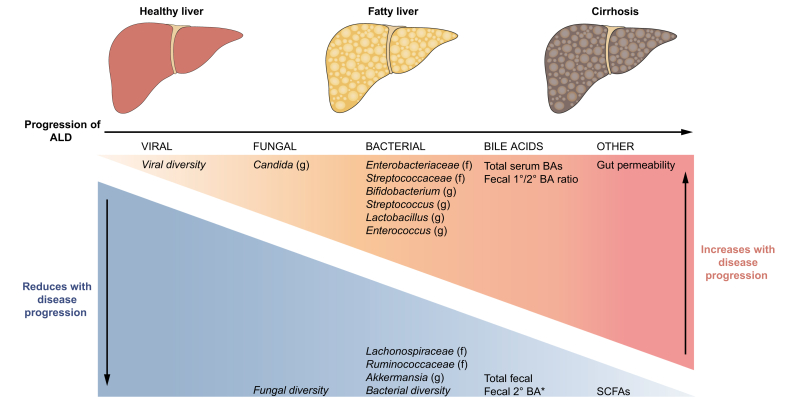
Alcohol-related liver disease characterises a broad spectrum of hepatic diseases that result from heavy alcohol use, and include alcohol-related steatosis, steatohepatitis, fibrosis, cirrhosis, and alcoholic hepatitis. Amongst heavy drinkers, progression to more severe forms of alcohol-related liver disease is not universal, with only 20% developing cirrhosis and up to one-third developing alcoholic hepatitis. Non-alcohol-related triggers for severe disease are not well understood, but the intestinal microbiome is thought to be a contributing factor. This review examines the role of the microbiome in mild alcohol-related liver disease, cirrhosis, and alcoholic hepatitis. While most of the literature discusses bacterial dysbiosis, we also discuss the available evidence on fungal (mycobiome) and virome alterations in patients with alcohol-related liver disease. Additionally, we explore the mechanisms by which the microbiome contributes to the pathogenesis of alcohol-related liver disease, including effects on intestinal permeability, bile acid dysregulation, and production of hepatotoxic virulence factors.
酒精性肝病是指由大量饮酒导致的一系列肝脏疾病,包括酒精性脂肪变性、脂肪性肝炎、纤维化、肝硬化和酒精性肝炎。在重度饮酒者中,并非所有人都会发展为更严重的酒精性肝病,只有20%的人会发展为肝硬化,高达三分之一的人会发展为酒精性肝炎。严重疾病的非酒精相关触发因素尚不完全清楚,但肠道微生物群被认为是一个促成因素。本综述探讨了微生物群在轻度酒精性肝病、肝硬化和酒精性肝炎中的作用。虽然大多数文献讨论的是细菌失调,但我们也讨论了酒精性肝病患者真菌(真菌微生物群)和病毒组改变的现有证据。此外,我们还探讨了微生物群导致酒精性肝病发病机制的途径,包括对肠道通透性、胆汁酸失调和肝毒性毒力因子产生的影响。